
WASHINGTON — The Pentagon announced Thursday that over 10,000 American service members are currently participating in naval operations designed to restrict Iranian shipping access, with military leaders warning they’re prepared to use escalating force against vessels attempting to bypass the maritime restrictions.
According to U.S. Central Command, which is overseeing operations against Iran, 14 vessels have already reversed course during the first three days rather than challenge the naval presence.
Maritime tracking companies report that Iranian-connected or sanctioned ships departing the Persian Gulf via the Strait of Hormuz have been observed stopping their movements, disabling radio transponders, or returning to Iranian coastal waters.
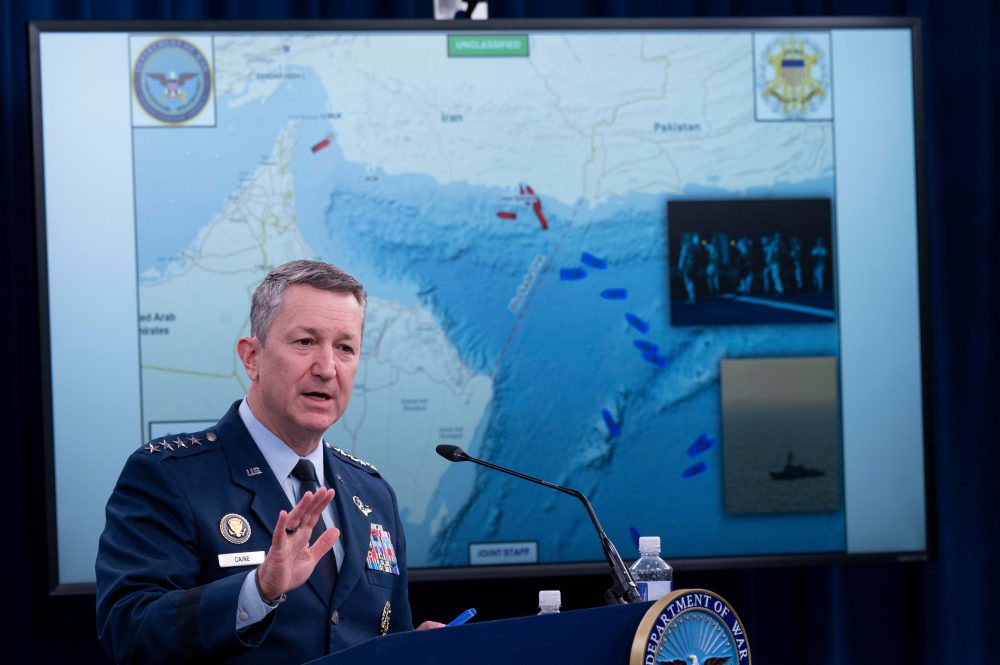
Gen. Dan Caine, chairman of the Joint Chiefs of Staff, explained to Pentagon reporters that approaching vessels receive initial warnings before potential force escalation. The maritime restrictions are being implemented both within Iran’s territorial boundaries and in international shipping lanes, though not within the Strait of Hormuz itself.
“Any ship that would cross the blockade would result in our sailors executing pre-planned tactics designed to bring the force to that ship — if need be, board the ship and take her over,” he said.
Military officials have distributed radio warnings throughout the region, with Central Command releasing recordings of broadcasts informing vessels that force may be necessary to ensure compliance.
“Vessels will be boarded for interdiction and seizure transiting to or from Iranian port,” the message said.
Defense Secretary Pete Hegseth characterized the current deployment as utilizing “less than 10% of America’s naval power.” The operation involves 16 warships from the Navy’s approximately 300-vessel fleet, including 11 destroyers, three amphibious assault vessels, one aircraft carrier, and one littoral combat ship positioned throughout the Middle East.
Supporting the maritime operation are various aircraft platforms along with surveillance, reconnaissance and intelligence capabilities providing real-time vessel information to Navy commanders.
Caine emphasized the international scope of Iran’s maritime restrictions, noting that American military assets positioned globally, including Pacific operations, would pursue vessels illegally transporting Iranian petroleum or providing material assistance to Tehran.
The Joint Chiefs chairman described the operational challenges using an analogy about the congested maritime environment around the restricted zone.
“There is a lot out there,” Caine said. “It is like driving a sports car through a supermarket parking lot on a payday weekend, with thousands of kids in that parking lot, as you attempt to maneuver through there to get to that ship that would attempt to run that blockade.”