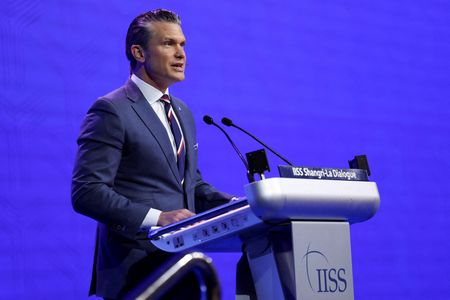

The United States delivered sharp criticism toward European NATO members during a weekend security conference in Singapore, though Western European representatives maintained that the alliance remains strong.
At the Shangri-La Dialogue, Defense Secretary Pete Hegseth commended Asian allies for increasing their defense budgets and working closely with Washington amid rising tensions with China.
“When our interests align, we act together with focused resolve,” he said. “When our interests diverge, we adjust pragmatically without the drama or the moralising. I think Western Europe might take note.”
“Europe and NATO have some big decisions to make,” he said.
The Trump administration has consistently criticized European nations for insufficient military spending and excessive dependence on American security guarantees, while pushing both European and Asian partners to increase defense expenditures to 3.5% of GDP.
In May, Washington revealed intentions to withdraw 5,000 military personnel from Germany, and Trump has made threats about leaving NATO entirely.
A high-ranking NATO representative minimized the significance of the American troop reduction, explaining it had been previously scheduled and would not impact alliance unity.
“In a mature alliance, if one ally which in this case is the principal stakeholder needs to redirect some power somewhere else, he can do so, and the others must be able to step in,” said Admiral Giuseppe Cavo Dragone, chair of the NATO Military Committee.
Nils Hilmer, state secretary at Germany’s Federal Ministry of Defence, indicated Berlin would continue increasing military spending independent of future U.S. force deployments.
“What we know for sure… is that there’s going to be shifts in that field,” he said. “That’s why we are about to take the security in our own hands.”
European officials also utilized the conference to assure Asian counterparts that NATO maintained effectiveness beyond its traditional region.
“Our credibility in Asia also depends on our robustness in Europe, defending Ukraine in the face of the Russian aggression,” said French Defence Minister Catherine Vautrin in a speech to delegates.
Additional European defense leaders contended that global security regions are becoming more connected.
“The European Atlantic and the Indo-Pacific theatres are becoming inseparable,” said Tore Sandvik, Norway’s minister of defence, noting that North Korean troops were fighting in Ukraine.
“The U.S. will be occupied in more theatres,” he said.
Despite Pentagon criticism, multiple U.S. Senators and House Representatives emphasized their efforts to reassure both European and Asian partners of continued bipartisan Congressional support.
“I’ve heard the same anxiety from everyone, not just in the region,” said U.S. Senator Tammy Duckworth. “I’ve actually got NATO allies worried about America’s commitment to the Indo-Pacific.”
However, doubt persists among conference participants regarding Europe’s progress in improving collective security investments.
“Europe has to learn how to become a player,” said Pavlo Klimkin, non-resident senior fellow at the Carnegie Endowment and a former Ukrainian minister of foreign affairs. “There is no way around it. But it could be extremely beneficial for their partnership with the United States, because the States would respect such European drive.”