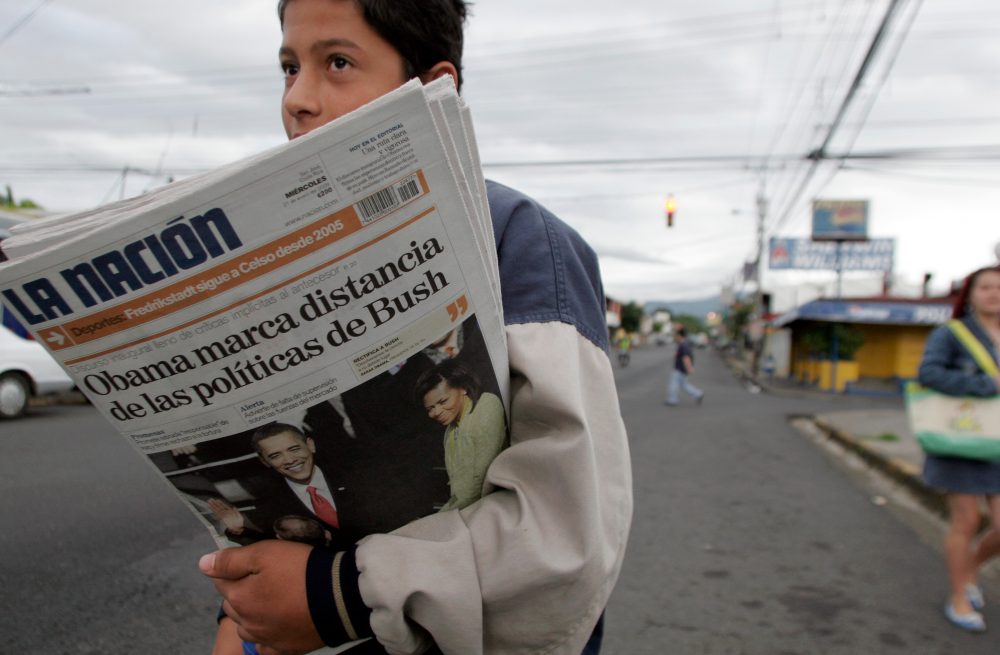

SAN JOSE, Costa Rica — Several board members of La Nación, a prominent Costa Rican newspaper, have had their United States entry visas canceled, sparking new allegations that America is collaborating with Costa Rica’s government to silence critics through immigration penalties.
The newspaper’s board of directors announced in a front-page statement Sunday that the affected executives discovered their visa cancellations through reports in government-friendly media outlets.
La Nación has consistently challenged outgoing Costa Rican President Rodrigo Chaves, who maintains close ties with U.S. President Donald Trump and has committed to accepting up to 100 deportees monthly from third countries as part of Trump’s expanded deportation initiatives.
The publication, which Chaves has repeatedly attacked since it reported sexual harassment allegations during his 2022 presidential race, stated that American officials provided no explanation for canceling the visas.
The U.S. State Department has not yet responded to requests for comment.
“We fully recognize that the United States, like any sovereign state, has the power to determine the terms of entry into its territory,” La Nación said. “However, it is unprecedented in Costa Rica’s recent history for visas to be revoked from members of the board of a general-interest and independent newspaper.”
This action appears to represent another example of the Trump administration using immigration policies to target political adversaries, drawing harsh criticism from Costa Rican opposition groups and press freedom advocates who are demanding explanations from both governments.
“If this decision is based on their critical stance toward this government, it would be yet another troubling signal for our democratic system,” the organizations said in a statement, adding that failing to provide transparent information would “constitute an unacceptable form of complicity.”
Mauricio Herrera, a journalist and former Costa Rican communications minister from 2015 to 2018, made stronger accusations, stating “there is no doubt that the cancellation of visas for its board of directors is in response to a request from the Costa Rican government.”
“The sanction seeks to intimidate those who dare to dissent and exercise their freedom of expression,” Herrera told The Associated Press.
Multiple prominent figures in Costa Rica have experienced visa cancellations, as conservative President Chaves’ confrontational leadership approach has faced criticism for undermining democratic principles.
In the previous year, the U.S. canceled the visa of Nobel Prize winner and former Costa Rican President Óscar Arias, a vocal Trump critic, along with his brother Rodrigo Arias, who served as legislative president and believed Chaves requested the U.S. action.
Opposition legislators including Francisco Nicolás from the centrist National Liberation Party and independent Cynthia Córdoba, both known for criticizing Chaves, have also seen their U.S. visas canceled recently, as has Constitutional Court Judge Fernando Cruz, a migrant rights defender who was prevented from traveling to the U.S. last month to receive recognition from Northwestern Law School.
Chaves, who has worked closely with the Trump administration on accepting deportees from various nations and extraditing suspected drug traffickers to the U.S., will step down Friday when President-elect Laura Fernández takes office.