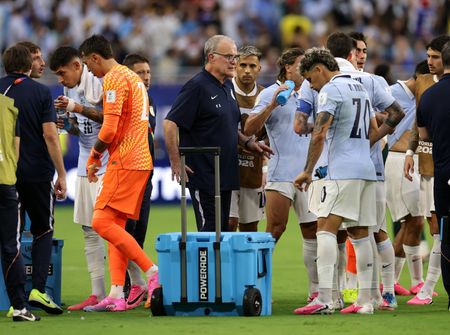

Uruguay’s head coach Marcelo Bielsa is not holding back when it comes to the new hydration breaks at the World Cup, saying the stoppages strip football of its cultural identity while adding nothing of value to the game.
FIFA implemented the three-minute breaks at the midpoint of each half in response to intense heat conditions across host cities in the United States, Canada, and Mexico. However, the policy has sparked debate among players and coaches throughout the tournament.
Those opposed to the breaks argue they effectively divide soccer into four quarters rather than two halves, and primarily exist to give broadcasters a window for commercial advertising — a point of frustration among longtime fans of the sport.
“Playing four times instead of two alters the conception of what had been culturally built to interpret football,” Bielsa told reporters.
“This change of culture does not add anything and takes away a lot. I will just say that before this decision, football had a characteristic, now it has another. People fall in love with the game because of its characteristics.”
Bielsa acknowledged that some technology, like VAR, has been a welcome addition to the sport, but drew a distinction between that and the hydration breaks. “Of course technology like VAR, we commend it and value it. Technology offers more opportunities. There is another intention for the breaks and the conclusions I’m making here are not really my own. I also echo what I hear as well,” he said.
Uruguay will face Cape Verde in their second group stage match on Sunday, with the group tightly bunched — all four teams currently sitting on one point apiece. Cape Verde recently held European champions Spain to a scoreless draw through disciplined defensive play, and Bielsa said his team has taken note heading into the matchup.
Reflecting on Uruguay’s 1-1 draw with Saudi Arabia, Bielsa pointed to the challenges his squad faced breaking down a deep defensive setup. “We did have a lot of possession and very few chances created in the first half,” he said, adding that the team already has a formation plan in place for the next game. “In the second half, it was agile and offensive possession, dynamic in nature with a high level of mobility.”
Striker Darwin Nunez struggled to make an impact against Saudi Arabia, managing just one shot before being substituted at halftime. The 26-year-old has now gone 14 consecutive Uruguay appearances without finding the net, drawing criticism from observers. Despite speculation about his confidence, Bielsa pushed back on the notion that motivation is a concern.
“Any footballer who is taking part at the World Cup doesn’t need any motivation,” Bielsa said. “The consequences, the scope, the magnificence of such a high-calibre tournament — anyone taking part makes them highly driven and justifiably so.”
On a lighter note, Bielsa was asked whether any of his players might follow the example of Spain’s Marc Cucurella, who pledged to get a tattoo of his coach if Spain wins the World Cup. Bielsa shut down the idea quickly. “This is not going to happen,” he said flatly, drawing laughter from those in the room.