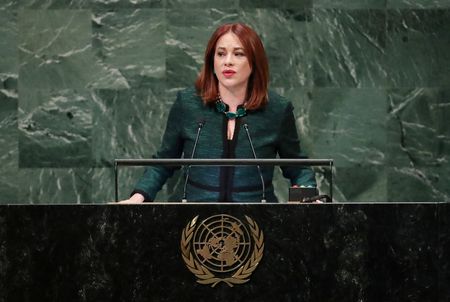

An Ecuadorean candidate seeking to become the next United Nations secretary-general told a candidacy hearing Monday that while the global organization remains vital, it must be reduced in size in a thoughtful and deliberate way.
Maria Fernanda Espinosa, who previously served as both foreign affairs minister and defense minister of Ecuador, is one of six people competing to take over from Antonio Guterres when his term concludes at the end of this year.
Whoever steps into that role will inherit a massive challenge: breathing new life into an organization that has seen its influence and reputation diminish in recent years.
“I am under no illusion about the difficulties ahead, yet I remain optimistic,” Espinosa stated during her candidacy hearing.
Like the other candidates in the running, she pledged to push forward with reform efforts at the UN, while stressing that the need for the organization — founded in the aftermath of World War Two — was still “undeniable.”
“Too often the U.N. is missing in action, or relegated to the sidelines. Too often it is slow, fragmented, and constrained … the U.N. needs to rebuild credibility and show, not just say, that it can deliver real change,” she said.
She also made clear her vision for restructuring: “We can shrink the U.N. responsibly, while strengthening national ownership and delivery, and restoring faith in the U.N.”
Espinosa, who previously served as Ecuador’s ambassador to the UN and led the UN General Assembly between 2018 and 2019, suggested that national governments could take on expanded roles in areas where the UN currently operates, though she did not elaborate on specifics.
Within Ecuador, she was part of the leftist administration of former President Rafael Correa, though she has distanced herself from his political party over the past several years.
The small Caribbean island nation of Antigua and Barbuda put her name forward as a candidate to replace Guterres. Ecuador’s current government, led by President Daniel Noboa — a right-wing ally of U.S. President Donald Trump — has not weighed in on her candidacy.
Last week, Guyana’s President Irfaan Ali announced that his country would put forward its UN Ambassador, Carolyn Rodrigues-Birkett, for the position.
Back in April, four additional candidates also pledged their commitment to UN reform while emphasizing the organization’s core missions of promoting peace and supporting global development. Those candidates are Rebeca Grynspan, a former vice president of Costa Rica; Michelle Bachelet, the former president of Chile; Macky Sall, a former president of Senegal; and Rafael Grossi of Argentina, who currently serves as director-general of the International Atomic Energy Agency.
The selection process is expected to conclude later this year. Notably, no woman has ever held the position of UN secretary-general.
By tradition, the secretary-general is not drawn from one of the five permanent members of the Security Council — Britain, China, France, Russia, and the United States — though the support of those powerful nations plays a crucial role in the complex and opaque selection process.