
Above the countryside of western Ukraine, an interceptor drone shaped like a bullet plunged toward its objective while dozens of military personnel watched from below. Soldiers erupted in celebration as the aircraft successfully severed a cable connecting another drone to a balloon, sending it floating into the distance.
This week, Ukraine’s top military drone operators faced off in an unusual competition – not battling Russian forces, but competing against fellow pilots for recognition and advanced equipment for their respective units.
Unmanned aircraft have revolutionized warfare in Ukraine. Young soldiers operating explosive-laden strike drones through video game controllers – often from command posts well behind battle lines – have become a source of terror for opposing forces.
The “Wild Drones” competition took place in open fields near the resort community of Truskavets, bringing together operators from 19 of Ukraine’s premier units alongside manufacturers of frontline drone equipment.
“This is an opportunity for them to communicate with each other a little, to learn something or share something with someone, and to see from manufacturers what new products are available,” said “Grey”, the sergeant major of the Black Raven drone battalion of the 93rd Mechanized Brigade, an organizer of the event. He asked to be identified by his military call sign.
Ukraine has embraced the “gamification” of warfare. The previous year saw implementation of a scoring system for confirmed drone eliminations. Military units can exchange these points for gear through the armed forces’ DOT-Chain and Brave1 Market digital platforms, dubbed “Amazon for war”.
“It’s a bit like choosing a car. They all do different things,” said one soldier from the first battalion of the 22nd Separate Mechanized Brigade, who asked not to be identified.
Military leaders say this approach boosts soldier morale through competitive elements while ensuring top-performing pilots receive resources most effectively.
While Russia’s monetary reward system focuses on equipment destruction, Ukraine’s point structure also incentivizes targeting personnel, as Defence Minister Mykhailo Fedorov aims to inflict 50,000 casualties monthly on Moscow’s forces. Ukrainian officials estimate current Russian military deaths and serious injuries at approximately 35,000 per month, though Moscow disputes these numbers.
The competition, established two years prior, provided respite for participants who have served on the front since Russia’s 2022 invasion. The atmosphere remained casual, featuring barbecue meals and social gatherings, with some attendees accompanied by spouses and children.
Multiple officers reported their units maintain regular communication with drone producers to suggest enhancements.
“It’s a constant, ongoing process,” said “Dym”, the call sign of the commander of the about 400-strong Black Raven unit. “If we have one version of a drone today, in three months it could be a completely different drone.”
The expanding operational range of drones continues to widen the “Kill Zone” – presently extending roughly 15 kilometers (nine miles) on either side of battle lines – where personnel and vehicles face rapid drone strikes.
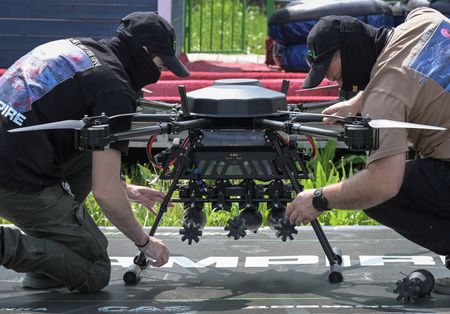
Multiple competitors noted that aircraft like the Vampire heavy bomber – manufactured by Ukrainian defense technology firm Skyfall – now transport food, water and medical equipment into dangerous areas to minimize human presence.
Category champions at the competition earned three Vampire drones along with batteries and operating systems.
A company representative, using the call sign “Ares”, stated Skyfall maintains capacity for producing over 10,000 drones daily while continuously incorporating battlefield feedback.
“The biggest demand is automisation, so fewer people can operate more drones,” he said.