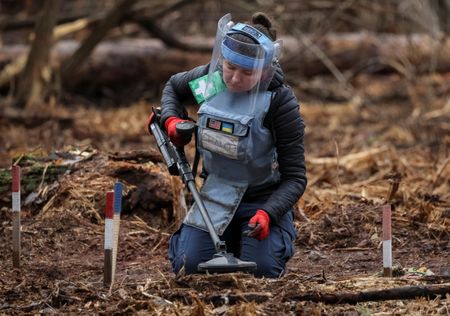

In the Ukrainian village of Myrotske, teams of mine clearance specialists advance methodically through forests and farmland, using metal detectors to locate deadly explosives left behind during Russian occupation of the region located 25 miles northwest of Kyiv.
The painstaking work addresses a massive problem facing Ukraine, which has become heavily contaminated with mines and unexploded weapons after years of warfare.
“Unfortunately, Ukraine is the most heavily mined country in the world,” said Olena Shustova, media manager for demining charity HALO Trust. “Ukraine will not be demined in less than 10 years.”
HALO Trust initiated clearing operations in this particular area after a Ukrainian soldier stepped on an anti-personnel mine while gathering firewood two years ago, demonstrating the ongoing dangers that persist long after combat moves to other areas.
“Everywhere where there was occupation, there are minefields and explosive ordnance,” said Shustova. The international mine action organization employs 1,350 Ukrainian nationals in their demining efforts.
Government data from Demine Ukraine shows that more than 132,000 square kilometers – roughly equivalent to the entire state of Mississippi – remains littered with explosive devices. Teams have successfully cleared nearly 42,000 square kilometers so far.
Facing such an enormous challenge, HALO Trust has implemented artificial intelligence technology to examine detailed drone photographs of contaminated zones, training computer systems to recognize mines and explosive remnants with approximately 70% accuracy.
“The process may take decades, but advances in technology are helping to accelerate it,” Shustova said.
At a separate clearing site north of Kyiv, operator Oleksandr Liatsevych works from inside a protective steel enclosure, wearing virtual reality goggles and controlling a specialized excavator with a joystick. The remotely operated machine digs up contaminated soil and processes it through an industrial grinder designed to destroy explosive materials.
These unmanned excavators represent one method demining teams are using to clear dangerous areas more rapidly and with greater safety for workers.
“The difference between driving from a cabin and driving a remote joystick is big,” said Liatsevych, a 39-year-old former government worker and farmer from Huliaipole, a town on the front lines between Ukrainian and Russian forces.
“As I didn’t play many computer games as a child, it was difficult for me at first.”
In nearby wooded areas, deminer Olha Kava continues using traditional methods, wearing protective gear while carefully searching by hand for potential anti-personnel mines.
The former travel agent and mother of three decided to become a deminer after watching friends join the military following Russia’s full-scale invasion.
“Of course, there is fear,” she said. “It … motivates you to do your job correctly and responsibly.”