
Ukraine has announced a significant military aircraft acquisition that will add 36 Swedish-manufactured Gripen fighter jets to its air force fleet as the nation continues defending against Russian forces.
According to Ukrainian President Volodymyr Zelenskiy’s announcement in May, the arrangement involves purchasing 20 of the advanced Gripen E models from manufacturer Saab, while Sweden will donate an additional 16 jets from an earlier generation to support Ukraine’s defense efforts.
The two nations established the framework for this transaction through a letter of intent signed last year, which opens the door for Sweden to potentially sell as many as 150 aircraft to Ukraine. Funding for the initial 20 jets comes from a €2.5 billion allocation taken from a larger €90 billion European Union loan package.
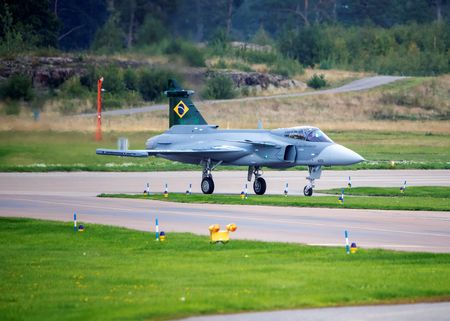
The Gripen represents a fourth-generation lightweight supersonic fighter with a single engine design. Military experts classify it as a multi-role combat aircraft capable of handling air-to-air engagements, bombing operations, and surveillance missions. Defense analysts view it as an economical alternative to more costly fifth-generation fighters like the F-35.
The aircraft takes its name from the Griffin, a creature from Swedish mythology, and has served in active duty since 1996 with multiple upgrades over the years. Sweden’s Air Force received its first Gripen E model this past October, and production has exceeded 280 units total.
Ukraine’s selection of the Gripen stems from its specific design advantages for confronting Russian forces and operating in challenging battlefield conditions. Unlike aircraft such as the F-35 that require established airbases or aircraft carriers, Gripens possess the flexibility to use any straight roadway for takeoffs and landings. This dispersal capability makes the aircraft more difficult to target while grounded.
Ukrainian officials emphasize that Gripen maintenance simplicity translates to increased mission frequency. A six-person team consisting of one trained technician and five conscripts can complete refueling, rearming, and pre-flight preparations in less than 10 minutes.
The fighter’s compatibility with weapons systems from various NATO member countries, including American JDAM and AIM-120 AMRAAM missiles, British Storm Shadow munitions, and French SCALP weapons, eliminates dependence on a single supplier nation.
Combat deployment of Gripens occurred for the first time this year when Thailand utilized the fighters during confrontations with Cambodia, according to Swedish media reports. Previously, the aircraft primarily served air policing functions, including deployment to Poland in 2025 for a NATO airspace patrol mission and enforcement of the NATO-imposed no-fly zone over Libya in 2014.
Sweden maintained neutrality until joining the European Union in 1995 and remained militarily unaligned until NATO membership in 2024, relying on Saab for air force equipment since World War Two. The decision to develop the Gripen dates back to the 1980s.
In the international fighter aircraft market, the Gripen competes against Lockheed Martin’s F-35 and F-16 models, Dassault Aviation’s Rafale, and the Eurofighter. Current operators include South Africa, Thailand, Brazil, the Czech Republic, and Hungary, with Colombia also committing to purchase the aircraft.
Technical specifications for the Gripen E include a length slightly exceeding 15 meters, a weight of 16.5 tonnes, and the capability to complete turnaround operations within 10 minutes of landing. The aircraft maintains lower operational costs per flight hour compared to competitors such as Lockheed’s F-35.