
TALLINN, Estonia — From her safe haven in Estonia, Inna Vnukova still cannot shake the haunting memories of Russian occupation in eastern Ukraine during the early days of the conflict and her family’s desperate flight to freedom.
The family sought shelter in a wet basement for several days in their hometown of Kudriashivka following Russia’s comprehensive assault in February 2022. Armed soldiers terrorized locals in the streets, established military checkpoints, ransacked houses, and maintained constant artillery bombardment.
“Everyone was very scared and afraid to go outside,” Vnukova shared with The Associated Press, explaining how forces targeted Ukrainian supporters and government workers like herself and her spouse, Oleksii Vnukov.
By mid-March, she made the difficult choice to evacuate with her teenage son Zhenya, 16, alongside her brother’s family, despite having to temporarily abandon her husband. Their dangerous automobile journey to nearby Starobilsk required displaying a white flag while dodging mortar attacks.
“We had already said our goodbyes to life, cursing this Russian world,” stated the 42-year-old Vnukova. “I’ve been trying to forget this nightmare for four years, but I can’t.”
Numerous Ukrainians like Vnukova escaped the advancing military. Those who remained faced detention risks or worse outcomes as Russian troops eventually seized approximately 20% of Ukraine’s territory and its estimated 3 to 5 million inhabitants.
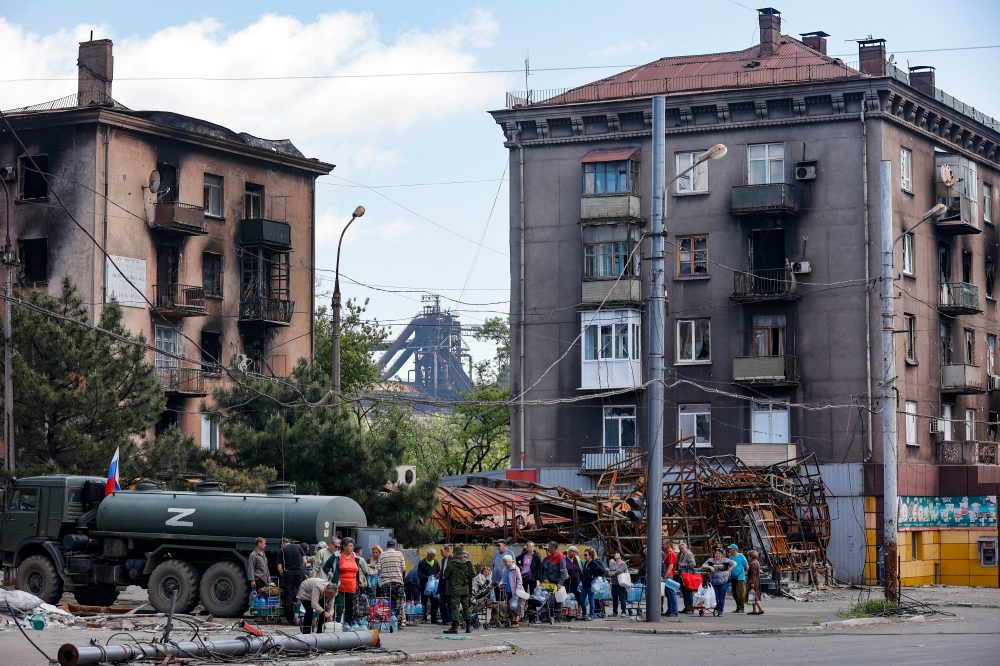
Following four years of conflict, existence in devastated urban centers like Mariupol and rural communities like Kudriashivka continues to be challenging, with locals confronting issues regarding shelter, water supply, electricity, heating, and medical services. Even President Vladimir Putin has admitted they face “many truly pressing, urgent problems.”
Within the unlawfully seized territories of Donetsk, Luhansk, Kherson and Zaporizhzhia, authorities impose Russian citizenship, language and customs on inhabitants, including through educational materials and classroom instruction. By spring 2025, approximately 3.5 million residents across these four areas received Russian documentation — mandatory for accessing essential services like healthcare.
Residents in these territories report living with constant anxiety about being suspected of Ukrainian allegiance. Numerous individuals have faced imprisonment, physical assault and death, according to human rights advocates.
Oleksii Vnukov, employed as courthouse security, remained in the community for almost two weeks. Russian troops threatened his life twice, including one incident where soldiers forcibly removed him and a companion from the street. However, he survived and eventually fled the village as well.
The family journeyed through Russia before reaching Estonia, where Inna found employment at a printing facility and Oleksii, 43, works as an electrician.
“All life is leaving the occupied territories,” Vnukov explained. “The people there aren’t living, they’re just surviving.”
Mykhailo Savva from Ukraine’s Center for Civil Liberties described the Russian military’s ongoing practice of maintaining “systemic and total control” throughout these regions.
“Even though a significant number of socially active people have already been detained, Russian special services continue to identify disloyal Ukrainians, extract confessions, and continue to detain people,” Savva explained. “Residents face such practices as document checks, mass searches, and denunciations on a daily basis.”
Human rights organizations report Russian officials utilized “filtration camps” to locate potentially disloyal persons, including government employees, Ukrainian military supporters, those with military family members, plus journalists, educators, researchers and political figures.
Stanislav Shkuta, 25, formerly of occupied Nova Kakhovka in Kherson region, narrowly avoided multiple arrests before reaching Ukrainian-held territory in 2023. He remembered being aboard a bus halted by Russian soldiers.
“It was horrific. Men and women were asked to strip to the waist to see if they had Ukrainian tattoos,” recalled Shkuta, now residing in Estonia. “I turned white with fear, wondering if I’d cleared everything on my phone.”
His friends remaining in Nova Kakhovka describe deteriorating conditions, with suspected Ukrainian supporters detained during street stops or unexpected home inspections.
“Today, my friends complain that life there has become impossible,” he stated.
Russia created a “vast network of secret and official detention centers where tens of thousands of Ukrainian civilians” remain held indefinitely without charges, according to Oleksandra Matviichuk, director of the Nobel Peace Prize-winning Center for Civil Liberties.
“Everyone knows that if you end up in the basement, your life is worth nothing,” she noted.
Russian representatives have declined to address previous accusations by U.N. human rights officials regarding civilian and prisoner torture.
Approximately 16,000 civilians face illegal detention, though actual numbers could be significantly higher due to incommunicado holdings, stated Ukrainian Human Rights Ombudsman Dmytro Lubinets.
A U.N. report from last summer revealed that between July 2024 and June 2025, investigators interviewed 57 detained civilians from occupied regions, with 52 reporting severe beatings, electrical torture, sexual assault, humiliation and violence threats.
One notable case involves Ukrainian journalist Victoria Roshchyna, 27, who vanished in 2023 while reporting near the Zaporizhzhia Nuclear Power Plant and died while in Russian custody. When her remains were returned to Ukraine in 2025, they showed torture evidence with some organs removed, prosecutors reported.
“Russia uses terror in the occupied territories to physically eliminate active people working in certain fields: teachers, children’s writers, musicians, mayors, journalists, environmentalists. It also intimidates the passive majority,” Matviichuk states.
During the war’s beginning, Russian forces surrounded Mariupol before the coastal city surrendered in May 2022. The Russian attack on the Donetsk Academic Regional Drama Theater on March 16 that year killed nearly 600 people in and surrounding the structure, according to an AP investigation, marking the conflict’s single most deadly civilian attack.
Most of the city’s roughly half-million residents evacuated, but many sheltered in basements, including a former theater performer who spent months hiding with his parents, reporting they nearly died from Russian bombardment.
The former performer, now in Estonia, requested anonymity to protect his 76-year-old parents still in Mariupol. They accepted Russian citizenship to access medical treatment and received a one-time $1,300 payment per person as compensation for their destroyed residence, he explained.
Similar to other occupied cities, Mariupol undergoes Russification through street name changes, Moscow-approved school curricula, Russian telecommunications and television networks, and adoption of Moscow’s time zone.
“But even today, the threat of death has not gone away. Only those who have Russian passports can survive,” the former performer explained, adding his parents requested he avoid sending Ukrainian postcards because “it could be dangerous.”
Putin “openly states that there is no Ukrainian language, no Ukrainian culture, no Ukrainian nation. And in the occupied territories, these words are turning into terrible practice,” Matviichuk observed.
However, not everyone opposes Russian control in Mariupol. The former performer reports half his former theater colleagues now support the Kremlin and believe Kyiv “provoked the war.”
Housing remains problematic in Mariupol, where current population equals roughly half the pre-2022 level. New residential buildings emerged from destruction, but instead of housing displaced residents, they’re sold to Russian newcomers.
Some displaced residents have created video pleas to Putin. “You said we ‘don’t abandon our own.’ Do we not count as your own?” questioned one resident during a large gathering.
At least 12,191 Mariupol apartments were designated as supposedly “ownerless” and abandoned properties for seizure during 2025’s first half. Thousands more face confiscation elsewhere.
Moscow encourages Russian citizens to relocate to occupied territories, providing various incentives. Teachers, medical professionals and cultural workers receive salary bonuses for five-year residency commitments.
Years of warfare and neglect have created serious heating, electrical and water supply challenges in many occupied eastern Ukrainian cities.
The northeastern city of Sievierodonetsk experienced major destruction before falling to Russia in June 2022. Once housing 140,000 residents, only 45,000 remain, primarily elderly or disabled individuals.
A single ambulance crew serves the entire city, with doctors and medical staff rotating from Russian regions like Perm to staff the hospital, according to a 67-year-old former engineer who requested anonymity fearing retaliation.
Despite conditions, she still endorses “the great work Putin is doing,” citing her Soviet Union upbringing.
In Alchevsk, located in Luhansk region, over half the residences have lacked heating for two frigid months. Five warming centers operate while utility companies report over 60% of municipal heating infrastructure requires repair without available funding.
Even pro-Moscow politician Oleg Tsaryov accused authorities of freezing “an entire city.” When heating failed in 2006, he noted on social media that Ukrainian authorities “and the entire country stepped in to help and completely replaced the faulty equipment.” Following Russian takeover, officials “contrived to repeat this Armageddon scenario all over again,” he added.
In Donetsk region, water delivery trucks fill containers outside apartment buildings — but they freeze completely during winter, reported a resident who requested anonymity fearing consequences.
“There’s constant squabbling over water,” she explained, noting “insane” lines for the vital resource, with working people often missing truck arrivals.
Donetsk residents submitted an appeal for Putin’s intervention in what became “a humanitarian and environmental catastrophe.”
Putin acknowledged last year the difficulties across the four regions.
“I know how difficult it is now for the residents of the liberated cities and towns. There are many truly pressing, urgent problems,” he stated while marking the third anniversary of incorporating these areas into Russia. He mentioned needs for dependable water supplies and healthcare access, among other concerns, announcing a “large-scale socioeconomic development program” for these territories.
Meanwhile, Inna Vnukova builds her new Estonian life: She and Oleksii now parent 1-year-old daughter Alisa. Their son reached age 20.
Only approximately 150 people — including the couple’s parents — remain in the village that once housed 800, Vnukova reported, expressing hopes to someday show her daughter the family’s native Luhansk region.
“We’ve been dreaming of returning for four years, but we increasingly wonder — what will we see there?” she questioned.