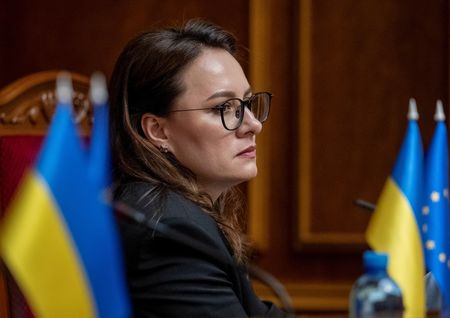

KYIV — Ukraine’s parliament is preparing to vote on a new government this week following President Volodymyr Zelenskiy’s surprise decision to remove Prime Minister Yulia Svyrydenko from her post — a move the president says will inject fresh leadership into the country, but one that has drawn sharp criticism from opponents who fear it could fuel disorder during a pivotal phase of the war.
Zelenskiy made the unexpected announcement Sunday, saying Svyrydenko — who had been in office for only one year — would be replaced. The news immediately set off a wave of speculation about who would step into the role as Ukraine continues to face intensified Russian attacks.
According to lawmakers posting on social media, the leading candidates for the prime minister position include Serhiy Koretskyi, who heads the state-owned oil and gas company Naftogaz; Energy Minister Denys Shmyhal, who previously served as defence minister for six months; and current Defence Minister Mykhailo Fedorov.
Zelenskiy posted photos of individual meetings with each of the potential candidates following his announcement of Svyrydenko’s removal. Under Ukraine’s political system, the president nominates a prime minister, who then selects most of the other cabinet members — all of whom must receive parliamentary approval.
The president stated Sunday that he is pursuing “renewal” at the top levels of government and law enforcement. He said the changes are meant to strengthen Ukraine’s push for more air defense systems from its allies, advance the country’s bid to join the European Union, and prepare for anticipated Russian strikes on the power grid during the coming winter.
Many observers consider Koretskyi the frontrunner for the top job. Placing the well-regarded technocrat in charge would put a focus on energy security — a growing priority as Russian attacks on infrastructure have repeatedly left Ukrainian towns and cities without heat or electricity.
Kyiv-based political analyst Volodymyr Fesenko said other experienced crisis managers could also receive cabinet positions in the reshuffling, pointing to Kharkiv Mayor Ihor Terekhov — whose city is a frequent target of Russian strikes — as one such possibility.
Defence Minister Fedorov was also cited as a strong contender given his central role in Ukraine’s war effort. However, Fesenko, who works with the Penta Centre think tank, cautioned that pulling Fedorov away from the defence portfolio could jeopardize important military reforms at a time when Ukraine is fighting for the upper hand against Russia. Some opposition lawmakers echoed that concern.
Ukraine has been conducting long-range strike operations targeting Russia’s oil sector and battlefield supply lines. Fedorov, who has guided the military’s technological development since taking the defence post in January, has also committed to overhauling the country’s recruitment system to address a shortage of soldiers.
Opposition lawmaker Inna Sovsun of the Holos party said she was “very frightened” by the possibility of new instability within the defence ministry.
“Previously, Denys Shmyhal was the minister for half a year, he promised something, started to fulfill it and was fired,” she wrote on Facebook. “If the same story repeats itself with Mykhailo Fedorov, it will not be funny at all.”
Parliamentary procedures to establish the new government could get underway as early as Tuesday.
Sunday’s announcement is the latest in a series of wartime leadership overhauls under Zelenskiy. The most recent came late last year, when he replaced longtime chief of staff Andriy Yermak with a well-known spy chief after Yermak became linked to a major corruption investigation. That probe — known as the “Midas” investigation — remains ongoing and has caught up a number of senior officials, keeping pressure on Zelenskiy’s administration.
Despite the turbulence, public confidence in Zelenskiy has held relatively steady over the past year at roughly 60%, according to the Kyiv International Institute of Sociology. With elections suspended under martial law, reshuffles represent one of the few tools Zelenskiy has to shake up his leadership team.
Opposition lawmaker Dmytro Razumkov, a former parliamentary speaker who served under Zelenskiy, told Reuters that the president’s “Sunday blitzkrieg” is unlikely to produce meaningful change. He repeated a common criticism of the Zelenskiy administration — that it leans heavily on a tight inner circle of loyalists.
“This … will most likely be a replacement of the same faces and simply a movement of beds around the house,” Razumkov said.