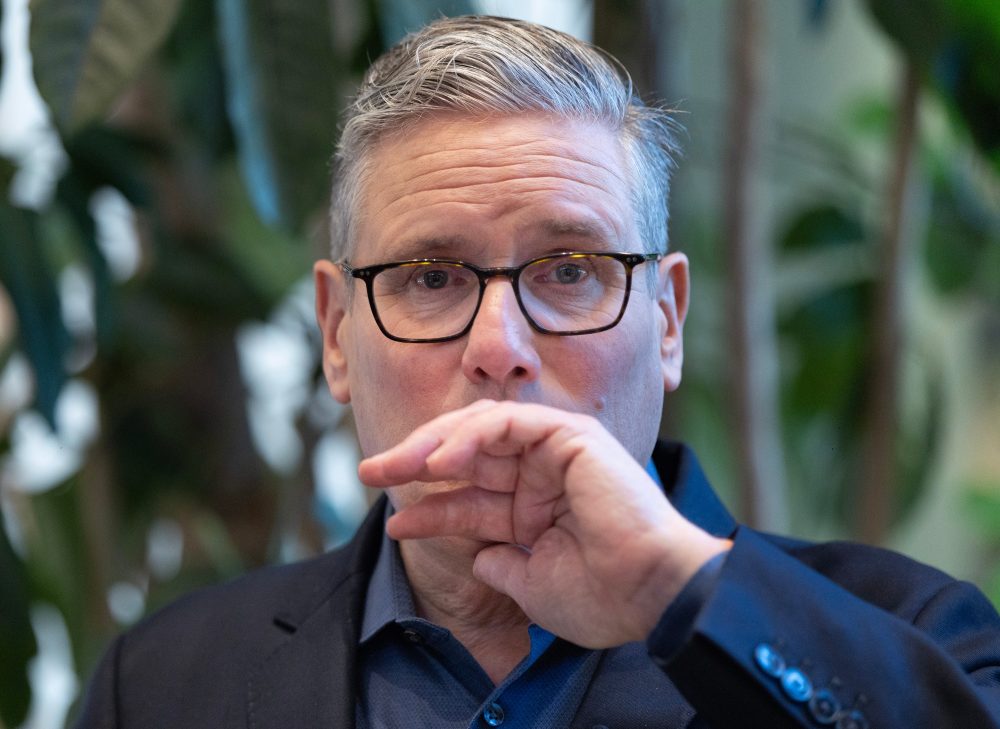

British Prime Minister Keir Starmer stepped down as head of the governing Labour Party on Monday, potentially making him the sixth leader in a decade to leave office ahead of schedule — and clearing the path for the United Kingdom’s seventh prime minister in just over ten years.
Starmer announced he will not immediately vacate 10 Downing Street, instead staying on as caretaker prime minister while Labour selects a new leader. He said nominations will open on July 9 and close when Parliament begins its summer recess, currently set to start July 16. Even if a leadership contest develops, Starmer said a successor would be in place by September 1.
In his remarks outside Downing Street, an emotional Starmer reflected on his time in office and explained his decision.
“Walking up this street two years ago was the proudest moment of my life. A new Labour government. The first in 14 years. A page in our country’s history turned after years of disappointment and despair. … The chance to change the lives of millions of people for the better. That’s what I came into politics for,” he said.
Starmer acknowledged the pressure he faced from within his own party, saying: “The question my party is asking now is whether I am best placed to lead us into the next general election. I have heard the answer of my parliamentary party to that question. And I accept that answer with good grace.”
He added: “Every decision I’ve taken has been about putting the country I love first. That is why I will resign as leader of the Labour Party. I have spoken to His Majesty the King this morning to inform him of my decision. I will remain in post as Prime Minister until the contest is complete. And I will do everything I can to ensure an orderly handover of power.”
His voice noticeably broke with emotion toward the end of the brief address. As he began speaking, protesters nearby played Beethoven’s “Ode to Joy” — the anthem of the European Union.
Former Manchester Mayor Andy Burnham is widely seen as the leading candidate to take over. Burnham, who until last week served as Labour mayor of Greater Manchester, won a special parliamentary election and was set to be sworn in as a member of Parliament on Monday. He has since confirmed he will run for the Labour leadership.
Another prominent contender, Wes Streeting, announced he would throw his support behind Burnham — a move that could allow Burnham to secure the leadership without a formal contest.
Starmer won a sweeping general election victory in July 2024 but saw his popularity and that of his party fall sharply during his two years in office, amid a series of political missteps that eroded public confidence.
International leaders offered reactions to the news. European Commission President Ursula von der Leyen praised Starmer’s record, writing on X: “It can take many leaders years to grow into the statesman you became in just two years. European and Ukrainian security is stronger because of you. Thank you, dear Keir.”
A spokesperson for German Chancellor Friedrich Merz described Starmer as “a reliable and close partner in foreign policy questions, particularly regarding Ukraine,” while declining to weigh in on the “internal motives in Britain.” The spokesperson added that a planned Wednesday meeting in Berlin of the so-called “E5” nations — Germany, France, Britain, Italy, and Poland — is expected to proceed as scheduled. That gathering is part of preparations for the upcoming NATO summit.
Liberal Democrat Leader Ed Davey said whoever succeeds Starmer must address deeper problems in British governance. “The British people are sick of being let down by an endless merry-go-round of prime ministers while nothing really changes for them,” Davey said. “This time must be different. It can’t just be about changing who’s in No. 10, it has to be about changing our broken politics so we can fix our country.”
Green Party leader Zack Polanski also called for significant change, saying the UK needs a “bold change of direction.” Referring to Burnham, Polanski warned: “The time for half measures and sticking plasters is long gone — if he becomes the next PM, Burnham must be bold or he will be bust.”
Starmer’s departure continues a turbulent stretch for British leadership. He had succeeded Rishi Sunak, who held the office from 2022 to 2024. Before Sunak, Liz Truss served only 45 days. Truss followed three other Conservative prime ministers: Boris Johnson (2019–2022), Theresa May (2016–2019), and David Cameron (2010–2016).
Starmer delivered his resignation speech at a lectern bearing the royal coat of arms — a crest featuring a lion and a unicorn that has been part of British royal symbolism since the 17th century. The lion, though never native to England, is its national animal. The unicorn, though mythical, is Scotland’s official animal. The two were united on the crest in 1603 when King James I took the English throne, having already ruled Scotland as King James VI.