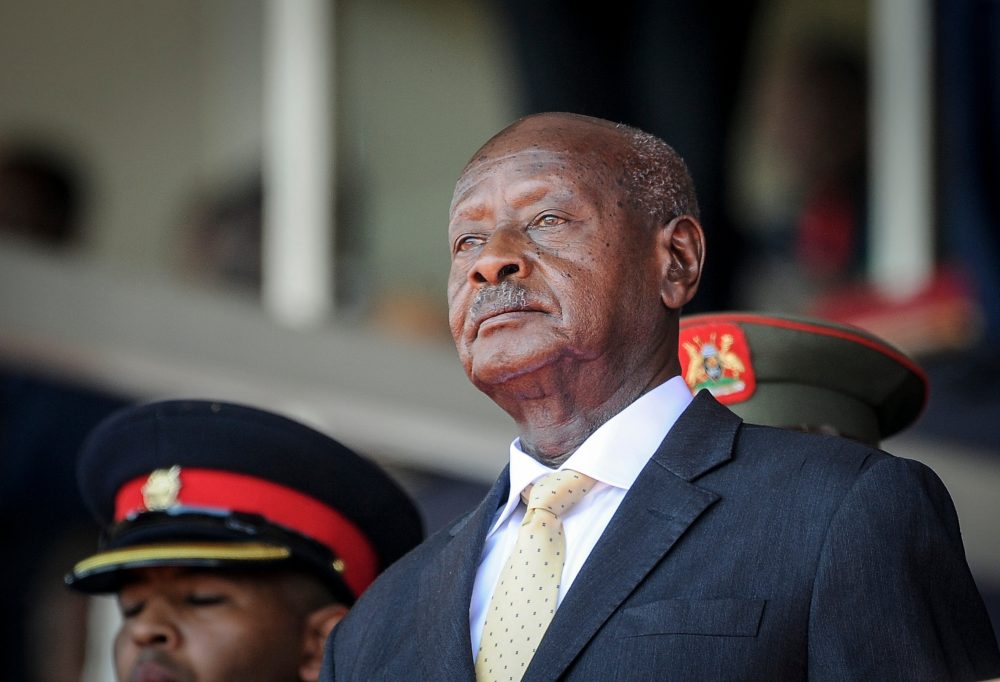

KAMPALA, Uganda — After four decades leading Uganda, President Yoweri Museveni begins his eighth term in office Tuesday at age 81, in what many believe could be his final presidency.
However, the Museveni family’s grip on power may continue through his son, army chief Gen. Muhoozi Kainerugaba, who supervised extensive military parade preparations for his father’s inauguration ceremony. Russian-manufactured Sukhoi fighter aircraft roared above Kampala’s official ceremonial venues during the multi-day rehearsals.
Millions of Ugandans have never experienced leadership under anyone other than Museveni, and many now recognize his presidency is approaching its conclusion. The key questions revolve around how the transition will unfold and whether it will proceed peacefully during his remaining time in office.
Kainerugaba appears positioned to assume control and has publicly expressed his intention to follow his father as president, recently stating the mission cannot be stopped.
Political observers identify two potential routes for his ascension: either an unconstitutional military takeover led by Kainerugaba, or constitutional changes allowing the ruling party’s legislative supermajority to select him as Museveni’s replacement. Electoral victory seems unlikely for Kainerugaba, who would face opposition leader Bobi Wine, the former entertainer who challenged Museveni twice and disputed the January election results.
Parliamentary Speaker Anita Among pledged last month that legislators would support Kainerugaba’s presidential ambitions.
“For the sake of MK, just assure MK that we will do whatever it takes,” Among told lawmakers celebrating the general’s birthday, using Kainerugaba’s initials. “In the 11th parliament, opposition got swallowed. In the 12th parliament, it is going to be walloped.”
Beyond the speaker, numerous officials have rushed to demonstrate loyalty to Kainerugaba. While these actions reflect their desire for political survival, they also highlight Kainerugaba’s emergence as Uganda’s effective leader as his aging father increasingly depends on the army chief to wield authority.
“Many Ugandans close to power have learned this lesson. That the president is old and exhausted, both intellectually and physically,” wrote Andrew Mwenda, a close ally and friend of Kainerugaba, in The Independent online newspaper last month. “He has a limited ability to monitor many things across a large spectrum of sectors.”
The 52-year-old Kainerugaba enlisted in the military during the late 1990s, and his advancement to military leadership has sparked controversy, with opponents calling it the “Muhoozi Project” designed to prepare him for the presidency.
Both Museveni and Kainerugaba previously rejected claims of such a plan, but recent developments over the past two years suggest hereditary succession may be the president’s preferred option.
With Museveni refusing to announce retirement plans and facing no internal party opposition, many analysts believe the military will play a decisive role in selecting his replacement.
“While people are waiting for the legal transition from Museveni, the de facto transition has already happened,” said Angelo Izama, an analyst who runs the Uganda-based Fanaka Kwawote think tank. “Kainerugaba, more than the president, is the final voice on defense and security matters.”
Those close to Kainerugaba portray him as a committed military leader who avoids flashy displays of wealth. He completed military education in both the United States and Britain before commanding a presidential guard unit that later expanded into an elite special forces division.
Beyond his military responsibilities, he established a political organization called the Patriotic League of Uganda, attracting supporters from government ministers to business leaders.
Unlike his father, Kainerugaba lacks Museveni’s public appeal and down-to-earth approach that helped maintain power through political negotiations and even recruiting former opponents into government service. Kainerugaba adopts a more aggressive stance, frequently making inflammatory social media statements that cause controversy. He has authorized corruption arrests of several generals, including former personal friends.
Museveni originally seized power through force in 1986, leading guerrilla fighters committed to democratizing Uganda following years of turmoil and civil conflict. He initially argued that Africa’s main issue was leaders who refused to step down. Later, he modified his position, claiming his criticism targeted leaders who extended their rule without electoral approval.
While Museveni, a U.S. partner on regional security matters, receives credit for maintaining relative peace and stability, critics point to growing authoritarian tendencies that contradict his early democratic promises. Constitutional term and age restrictions have been eliminated, and political opponents have faced imprisonment or marginalization.
Recently, legislators approved controversial legislation ostensibly aimed at preventing foreign interference, though critics worry it will damage non-governmental organizations and opposition movements.
The new law prohibits “agents of foreigners” from receiving grants or financial assistance from external sources exceeding 400 million Ugandan shillings — approximately $110,000 currently — within twelve months without interior ministry approval.
Wine’s National Unity Platform party criticized the legislation as “unconstitutional, irrelevant and brought in bad faith to further persecute those with divergent views.”