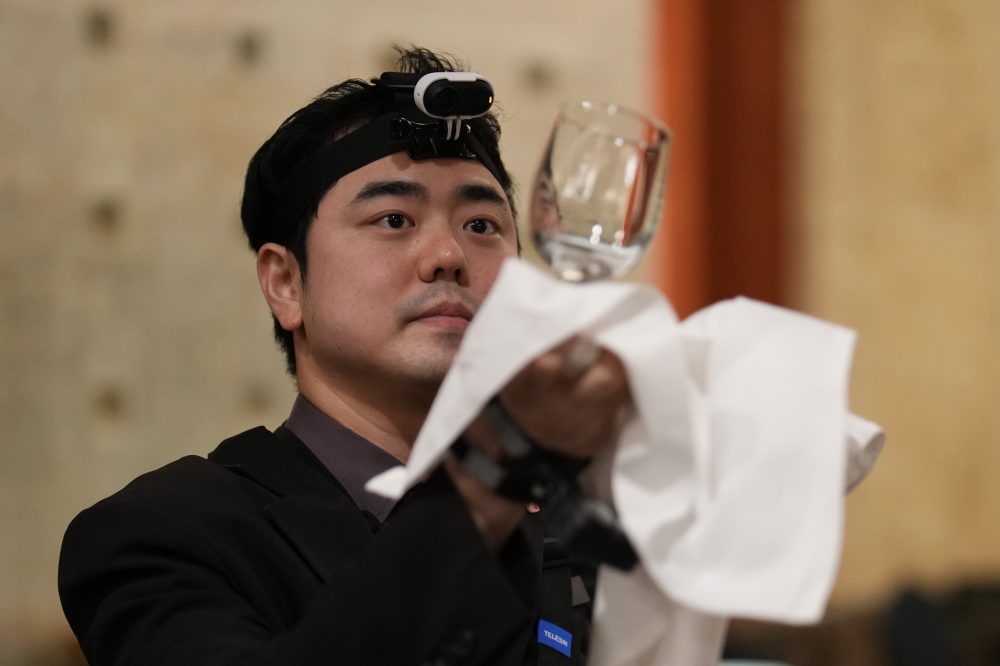

SEOUL, South Korea — Wearing body cameras on his head, chest and hands, David Park expertly folds banquet napkins at the luxury Lotte Hotel Seoul, a skill he’s perfected over nine years of service. Every movement he makes gets recorded into a computer system designed to eventually train robots to perform the same tasks.
The hotel represents just one client for South Korean AI company RLWRLD (pronounced “real world”), which is building a massive collection of human work skills from experienced employees across multiple industries. This data will help create artificial intelligence systems for robots destined for factories and eventually households.
The startup also gathers information from warehouse workers at CJ, documenting their techniques for gripping, lifting and moving products, plus employees at Japanese convenience store chain Lawson, recording their methods for arranging food displays.
RLWRLD aims to develop AI software that can operate robots in various industrial locations over the next few years, with plans to later move into residential markets. Company engineers emphasize that copying human hand coordination remains their top focus, believing that human-like machines will lead the robotics industry forward.
“I’ve been doing this about once a month,” Park explained, noting he’s one of roughly 10 food and beverage team members at Lotte Hotel participating in the motion capture program.
Following his napkin-folding demonstration, Park cleaned wine glasses and silverware in a section of the banquet room while his coworkers set up for actual events nearby. He mentioned to an engineer that the hand-mounted cameras felt uncomfortably snug.
RLWRLD joins numerous South Korean technology companies and manufacturers entering the emerging global “physical AI” marketplace. This concept describes machines equipped with artificial intelligence and sensors capable of observing, making decisions and taking action in real environments with some independence, advancing beyond traditional factory robots built for repetitive operations.
Though uncertainty remains about whether these machines will fully deliver on promises to revolutionize industries, they’re essential to South Korea’s strategy of using its semiconductor and manufacturing expertise to become an AI leader. The competition is intense, with American tech corporations like Tesla and numerous Chinese companies investing billions in humanoid robots and other AI-powered machines.
Similar to how chatbots like ChatGPT and Gemini learn from enormous amounts of internet text, AI robots need comprehensive data about human actions to master complex physical work. South Koreans may find it challenging to compete in chatbots, where English language skills give American companies significant advantages, but they believe they have better opportunities in physical AI due to their extensive base of skilled manufacturing and service workers who can help train robotic systems.
The government recently announced a $33 million initiative to record the “instinctive know-how and skills” of “master technicians” into a database for AI-powered manufacturing, hoping robots will increase productivity and compensate for an aging, declining workforce.
RLWRLD, which recently introduced its robotics foundation model — an AI system for robots — anticipates industrial AI robots will be widely deployed around 2028, a schedule that matches projections from major corporations.
Hyundai Motor intends to deploy humanoids created by its robotics division, Boston Dynamics, at manufacturing facilities worldwide in the coming years, beginning with its Georgia facility in 2028. Technology giant Samsung Electronics plans to transform all production sites into “AI-driven factories” by 2030, incorporating humanoids and specialized robots throughout assembly lines.
“South Korea has a highly developed manufacturing sector and the focus is squarely on humanoids tailored specifically for those industries,” explained Billy Choi, a professor at Korea University’s center for Human-Inspired AI Research.
South Korea’s AI initiative has concerned labor organizations, who worry robots might eliminate jobs and weaken the skilled workforce traditionally considered the country’s competitive advantage — the same resource it’s now relying on for its AI transformation.
Following warnings from Hyundai’s union in January that robots could create an “employment shock,” President Lee Jae Myung issued an unusual criticism, characterizing AI as an unstoppable “massive cart” and urging union members to adjust to changes “coming faster than expected.”
“Mastery of skills is ultimately a human achievement — even if AI can replicate existing abilities, the continuous development of craft will remain fundamentally human,” stated Kim Seok, policy director at the Korean Confederation of Trade Unions. He warned that widespread robot implementation could risk “severing the pipeline” for skilled labor and called on government and employers to work with employees on AI adoption to gain their support and address employment fears.
Humanoids created by American and Chinese companies have demonstrated remarkable physical capabilities, including long-distance running. However, Hyemin Cho, who manages business strategies at RLWRLD, emphasized that the capacity to execute delicate hand tasks will determine whether humanoids can function in varied industrial environments and homes.
“Capturing motion data in real-world settings is extremely important and the quality of that data matters greatly,” she noted.
After transforming worker recordings into computer-readable information, RLWRLD engineers add another dimension by performing those same tasks while wearing cameras, VR headsets and motion-tracking gloves. This information trains test robots, often controlled by RLWRLD “pilots” using wearable technology. The method records precise details including joint angles and force application, according to Song Hyun-ji from the company’s robotics division.
One RLWRLD laboratory fills a crowded 34th-floor suite at Lotte Hotel. Worn carpeting disappears under tangles of cables and computer equipment. Poles equipped with infrared laser scanners stand in corners. Under a chandelier — a rare reminder of the room’s previous elegance — a wheeled robot with black, human-like metal hands moves back and forth with a quiet mechanical hum.
During a recent presentation, the robot, controlled by engineers, carefully lifted and positioned cups at a minibar, occasionally knocking over a dish. The company’s newest test videos show a more sophisticated system: a humanoid cautiously opening a box, placing a computer mouse inside, closing it and positioning it on a conveyor belt.
Most robots, including Boston Dynamics’ Atlas, employ task-specific hands, such as two or three-fingered “grippers.” RLWRLD belongs to a smaller group of companies creating AI for five-fingered hands that replicate human touch.
While five-fingered designs may not always meet factory requirements, they could become essential as robots enter homes, where closer human interaction will be necessary, Choi explained.
Hospitality employees offer valuable training information for machines learning precise or subtle tasks — abilities that could also broaden their application in industrial environments, Cho said.
Even though current humanoids would require several hours to clean a guest room that human staff complete in approximately 40 minutes, Lotte Hotel expects robots will be prepared for cleaning and other behind-the-scenes duties by 2029. The hotel also plans robot rental services for hospitality and other service sectors, with possible expansion to residential use.
“If you look at the entire process of preparing for an event in back-of-house areas, we think humanoids might be able to take over about 30% to 40% of that workload,” Park said. “It will be difficult for them to replace the remaining 50%, 60% and 70%, which involves actual human-to-human interaction.”