
Over the course of two weeks, the United States has steadily widened the range of its military strikes against Iran, with the attacks increasingly taking on the character of opening moves in a full-scale war.
A short-lived ceasefire had been reached in June following an interim agreement aimed at ending the conflict, but fighting reignited when a struggle broke out for control of the Strait of Hormuz. That battle shattered the truce and pushed both nations back toward the edge of a broader regional war.
Early in the current campaign, the U.S. launched heavy waves of strikes targeting Iran’s naval forces and coastal defense systems, with the goal of limiting Tehran’s capacity to threaten shipping through the strait — a waterway critical to global energy supplies. More recently, U.S. forces have broadened their focus, striking bridges and infrastructure in southern Iran while also hitting targets deeper inside the country, including areas on the outskirts of the capital, Tehran.
Even with the growing scale of the strikes, the current campaign is not as intense as the one that launched the war, which began on February 28. In the first 100 hours of that conflict, the U.S. and Israel struck hundreds of military targets and killed top Iranian leaders, including Ayatollah Ali Khamenei.
Iran’s Health Ministry reports that 3,434 people have died since the war began, with 55 of those deaths occurring during the most recent escalation. The latest round of U.S. strikes temporarily cut off transportation and communications inside Iran and caused damage to water systems serving thousands of civilians.
While the U.S. military has said its strikes are intended to reduce Iran’s ability to threaten vessels in the strait, Iran has not backed down. Tehran has ramped up attacks on ships in the strait and on Gulf nations that host American military bases, killing at least four U.S. soldiers and damaging key infrastructure. Israel has not been targeted in this latest phase of fighting and has not participated in the U.S. strikes.
The renewed conflict escalated on July 12, when the U.S. military intensified its bombing campaign. The following day, President Donald Trump reinstated a U.S. blockade on Iranian ports. Over two days of strikes, the military reported hitting dozens of targets, including air-defense systems, coastal radar installations, missile and drone manufacturing sites, launchers, and small watercraft. The strikes made use of precision-guided munitions, naval vessels, and — for the first time — one-way attack sea drones.
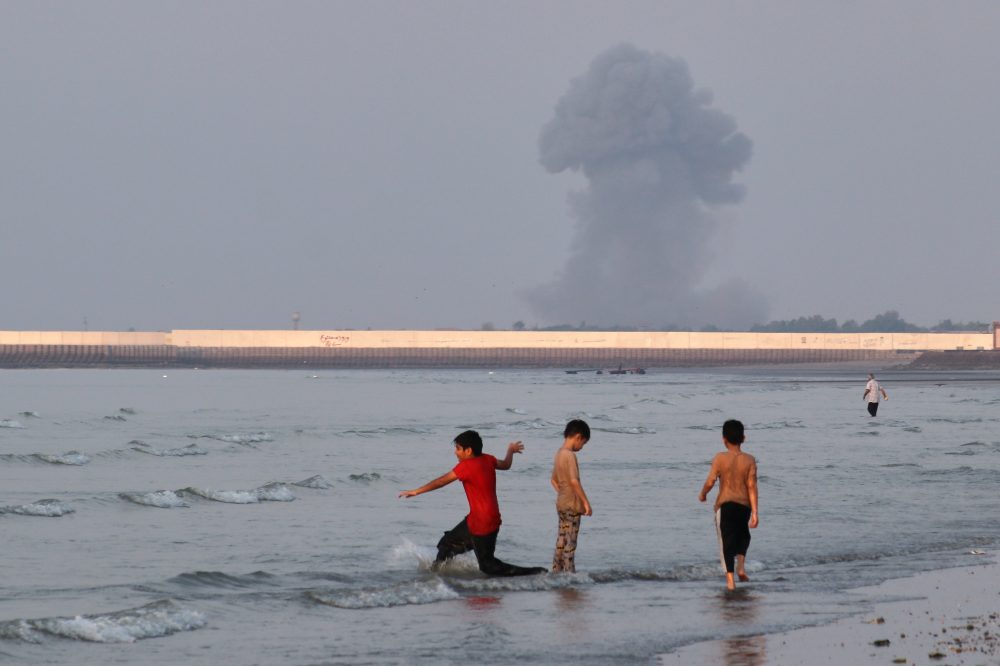
The strikes concentrated on coastal provinces along the strait and the Persian Gulf, specifically Khuzestan, Bushehr, and Hormozgan. The city and port of Bandar Abbas, which sits on the strait and contains vital naval and commercial infrastructure, absorbed much of the initial impact. Strikes also reached key Gulf islands — Qeshm, Abu Musa, and Kish — while naval and military installations in Sistan and Baluchistan province along the Gulf of Oman were also hit.
Images broadcast on Iranian state television showed that strikes over two days damaged at least six bridges and a tunnel near Bandar Abbas. The apparent objective was to cut off Revolutionary Guard bases in the area from the rest of the country. A railway junction west of the port city was also struck. Residents filmed traffic backups on nearby roads in the aftermath.
Over the past two weeks, additional strikes in Bandar Abbas hit the offices of the agency that oversees Iran’s radio-frequency spectrum. U.S. forces struck a maritime communications tower in one of the city’s ports on three separate occasions, completely destroying it on July 17. Another communications tower roughly 120 kilometers, or about 75 miles, down the coast was also hit.
Strikes disrupted communications between the Iranian mainland and the islands of Kharg and Qeshm, though Iranian authorities reported that connections had been restored by the tenth day of the campaign. A fishmeal production facility on Qeshm was also struck. In the northern part of the Persian Gulf, power outages were reported in sections of Khuzestan province following strikes there.
Other civilian infrastructure has been affected as well. An agricultural water pumping station in Khuzestan was struck, killing one person, according to local officials. A reported strike on July 18 hit a water desalination plant in Jask, on a peninsula just outside the Strait of Hormuz, destroying its pumping systems and cutting off water to roughly 10,000 nearby residents, according to Iranian officials. That strike came after Iran attacked U.S. bases in Jordan, where at least three soldiers were killed and others were wounded.
A U.S. strike on a border crossing with Iraq, where hundreds of pilgrims had gathered, killed two people, according to Iranian state media.
The American military has characterized its targets as “logistics infrastructure.” Last week, President Trump warned that every Iranian attack on the strait would result in a power plant or bridge being struck in retaliation. Iranian media, meanwhile, have reported that roads and tunnels damaged by U.S. strikes were being repaired and that alternate routes were being established to connect the south with the rest of the country.
By the third day of the renewed conflict, U.S. strikes began reaching further into Iran’s interior. Those targets included Revolutionary Guard and military bases believed to be behind attacks on American installations in the Gulf, along with reported missile production facilities, military sites, and airports used by the Guard.
U.S. forces struck a military barracks in the city of Iranshahr in the far southeastern part of the country, killing seven soldiers and wounding about a dozen more, according to Iranian officials. The Iranian military had recently claimed responsibility for drone attacks on American bases in the region, including one in Jordan on July 15, according to a report by the Institute for the Study of War and the Critical Threats Project.
At least two strikes hit a Revolutionary Guard Aerospace Force installation in Khuzestan province, which is also believed to have been involved in attacks on U.S. bases.
The Tehran area has so far been struck only twice in this current phase — a stark contrast to the opening of the war, when the capital was hit by hundreds of strikes, primarily carried out by Israel. On July 19, a strike hit the Khojir military complex near Tehran, one of Iran’s primary missile production sites. A missile facility outside the capital was subsequently struck as well.