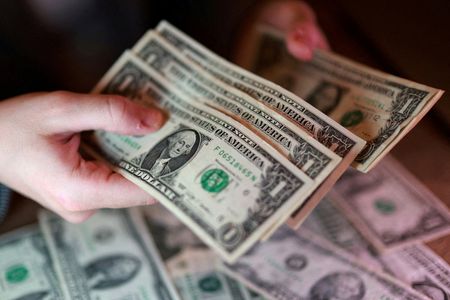

The U.S. dollar slipped to a 10-day low against major world currencies on Monday after the United States and Iran announced they had agreed on a framework to end their conflict, a development that sent oil prices falling and encouraged investors to move money into riskier assets.
American and Iranian officials confirmed Sunday that both sides had reached an agreement in principle to end the war, lift the U.S. blockade of Iran, and reopen the Strait of Hormuz — a critical waterway for global oil shipments. In response, Brent crude oil futures dropped more than 4%, settling at $83.82 per barrel.
Despite the optimism, uncertainty remained in the markets. President Donald Trump told the New York Times on Sunday that if Iran failed to finalize a nuclear agreement with the United States, he would consider resuming military strikes on Tehran — or alternatively, positioning the United States as what he called “the guardian of the Middle East” in exchange for 20% of the region’s revenues.
Currency markets reflected cautious optimism. The euro climbed 0.35% to $1.1607 in Asian trading, while the British pound rose 0.3% to $1.3448. The Australian dollar, which tends to move with global risk appetite, gained 0.50% to $0.7075, and the New Zealand dollar was up 0.4% at $0.5854.
The dollar index — a measure of the greenback’s strength against a basket of currencies including the yen and the euro — dropped 0.31% to 99.492, its weakest reading since June 5.
Nick Twidale, chief market strategist at ATFX Global in Sydney, offered a measured outlook on what comes next. “I think we’ll see the dollar fall over the course of the next few sessions. We’ll probably see some of the risk currencies like Aussie and yen appreciate a little bit. But I don’t think we’re going to see any huge moves,” he said.
Twidale added that much depends on how quickly the Strait of Hormuz can return to full operation. “There’s going to be a lot of wait and see, on how quickly the Strait really reopens and how long it’s going to take for oil flow to really get back to normal. It’s certainly going to be months rather than weeks.”
Meanwhile, the Japanese yen weakened to around 160.15, continuing to hover near the 160 level — a threshold widely considered a trigger point for possible government intervention in currency markets.
Japan’s central bank, the Bank of Japan, is expected to raise interest rates to a 31-year high when its two-day policy meeting concludes on June 16. Officials are expected to signal continued willingness to raise borrowing costs further, even as the bank’s governor is temporarily absent, as it works to address inflation risks tied to the Middle East conflict.
That move would put Japan in step with other central banks tightening monetary policy, including the European Central Bank, which raised its own interest rates on Thursday.