
SAN JUAN, Puerto Rico — While the United States intensifies pressure for new leadership in Cuba, questions swirl around who might succeed current President Miguel Díaz-Canel before his term ends.
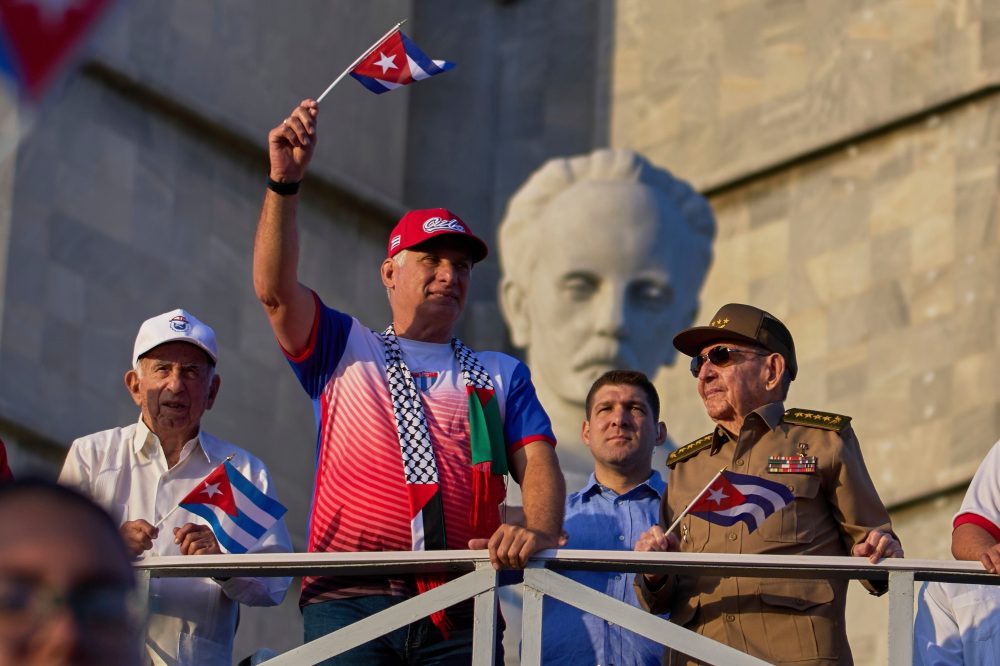
Díaz-Canel became the first non-Castro to lead Cuba since the 1959 revolution when Raúl Castro selected him as his successor in 2018. Though he has two years remaining in office, analysts and increasing numbers of Cubans question whether he will complete his term.
Political observers point to two Castro family members as possible successors.
The first is Oscar Pérez-Oliva Fraga, Raúl Castro’s 55-year-old great nephew, who has rapidly ascended to prominence after years in relative anonymity. In May 2024, he was named minister of Cuba’s powerful Ministry of Foreign Trade and Investment, followed by his appointment as deputy prime minister in October.
The second candidate is Raúl Guillermo Rodríguez Castro, Raúl Castro’s grandson, commonly called “Raulito” or “Little Raúl.” Unlike Pérez-Oliva, he has never held official government positions, instead working as his grandfather’s bodyguard and later leading Cuba’s version of the Secret Service.
Rodríguez Castro gained attention last month when he conducted a private meeting with U.S. Secretary of State Marco Rubio during a Caribbean Community summit in St. Kitts. Rubio declined to identify his Cuban counterpart at the time.
“The role Raulito is playing right now is the connection between Raúl Castro and whoever is on the U.S. side,” explained Sebastián Arcos, interim director of the Cuban Research Institute at Florida International University. “He enjoys the absolute trust of Raúl Castro.”
However, Arcos and fellow experts suggest that even if a Castro family member assumes the presidency, significant changes are unlikely.
“Party leadership doesn’t mean anything in Cuba,” Arcos stated. “The party is just a hollow façade. The real power resides in the military, under Raúl Castro.”
The 94-year-old Castro continues serving as general, attending major events and wielding considerable influence in Cuba, which has experienced over six decades of authoritarian rule under first Fidel Castro, then his brother Raúl.
This dynamic shows no signs of changing.
“The most significant thing that we have to consider for the last 30 years in Cuba is the absolute reluctance of this regime to implement serious structural economic reforms,” Arcos noted. “Asking them for political reforms would be too much.”
Pérez-Oliva’s background includes electrical engineering studies before directing an import company and serving as business director in Cuba’s Mariel Special Development Zone. Official Cuban sources provide limited additional information about him.
His online presence is minimal, lacking even a Wikipedia entry. His private X account displays the message: “Committed to the Revolution and to the ideas of FIDEL.”
Only recently has Pérez-Oliva become visible publicly, accompanying Cuban Foreign Minister Bruno Rodríguez on trips to Russia and Vietnam this year. During a February appearance addressing massive blackouts in western Cuba, he offered unusually candid remarks while other officials blamed U.S. sanctions exclusively.
“We don’t want to justify ourselves with the blockade; there are a number of internal deficiencies,” he acknowledged during a state television interview.
A significant milestone occurred in December when Pérez-Oliva joined Cuba’s National Assembly Popular Power as a deputy — a prerequisite for presidential candidacy.
Carlos M. Rodríguez Arechavaleta, a Cuba specialist and professor at Iberoamerican University in Mexico City, characterized Pérez-Oliva as having technocratic qualities with commercial negotiation experience. “This could be a more ideological figure … a more technocratic, potentially reformist-oriented official,” he observed.
Arcos believes Díaz-Canel could “very well be replaced” by Pérez-Oliva.
“This man looks more proper, more polished. He has been through more important positions,” Arcos said. “This is a family business.”
Rodríguez Castro is the son of Raúl Castro’s eldest daughter and Luis Alberto Rodríguez López-Calleja, who controlled GAESA, the military’s business operations, until his unexpected death in July 2022.
In his younger years, Rodríguez Castro was prominent in Cuba’s music and social scenes. During public appearances, observers would nudge each other and whisper, ‘That’s El Cangrejo’ — meaning “The Crab,” a nickname referencing his birth with an additional finger.
After military school, he became Raúl Castro’s bodyguard, traveling internationally with him. He later advanced to head Cuba’s equivalent of the Secret Service, though with responsibilities including surveillance of the country’s leadership, according to Arcos.
On March 13, experts observed Rodríguez Castro’s presence at a government meeting where Díaz-Canel announced U.S.-Cuba discussions. He also attended the subsequent news conference.
This unusual public appearance in government affairs attracted scrutiny from ordinary Cubans.
“The Crab doesn’t have a position there, so I don’t know why he was there,” said 20-year-old Maday Beltrán Acosta. “People posted a lot of comments about it.”
Beltrán Acosta also expressed frustration with Rodríguez Castro’s social media posts featuring “abundant food.”
“The people are suffering while he enjoys life,” she said.
Despite this, Arcos doubts Rodríguez Castro could become Cuba’s next president publicly, as his surname would signal continuity rather than the change demanded by Trump and Rubio.
“He cannot be the transitional figure,” Arcos explained, “because his last name disqualifies him.”
While speculation continues about potential leadership changes before Díaz-Canel’s term expires, experts note his unpopularity among Cubans.
He authorized harsh responses to July 2021 anti-government demonstrations triggered by food shortages — the largest protests in decades.
During Díaz-Canel’s presidency, Cuba’s economic and energy problems have worsened significantly.
“The living conditions of the population are on the verge of a humanitarian crisis,” said Rodríguez Arechavaleta. “The social situation is already unsustainable.”
Arcos added: “He’s a man with a pot belly in a country where everybody is trying to find (something) to eat.”
Last week, Deputy Foreign Minister Carlos Fernández de Cossío rejected suggestions about potential political system changes or Díaz-Canel’s departure as part of ongoing U.S. discussions.
“The Cuban political system is not up for negotiation, nor is the president, nor the position of any official in Cuba, subject to negotiation with the United States or with the government of any other country,” Fernández de Cossío told reporters.
Arcos said he cannot envision Raúl Castro surrendering power but believes Díaz-Canel could be replaced, describing him as “a gray apparatchik” within the party when he became president.
He suggested that Castro’s eventual death “would be the kind of shock that would crack the regime.”
“No one really knows who’s coming up to replace him,” Arcos said. “For the first time ever in Cuba, you have the possibility of several people struggling for power.”