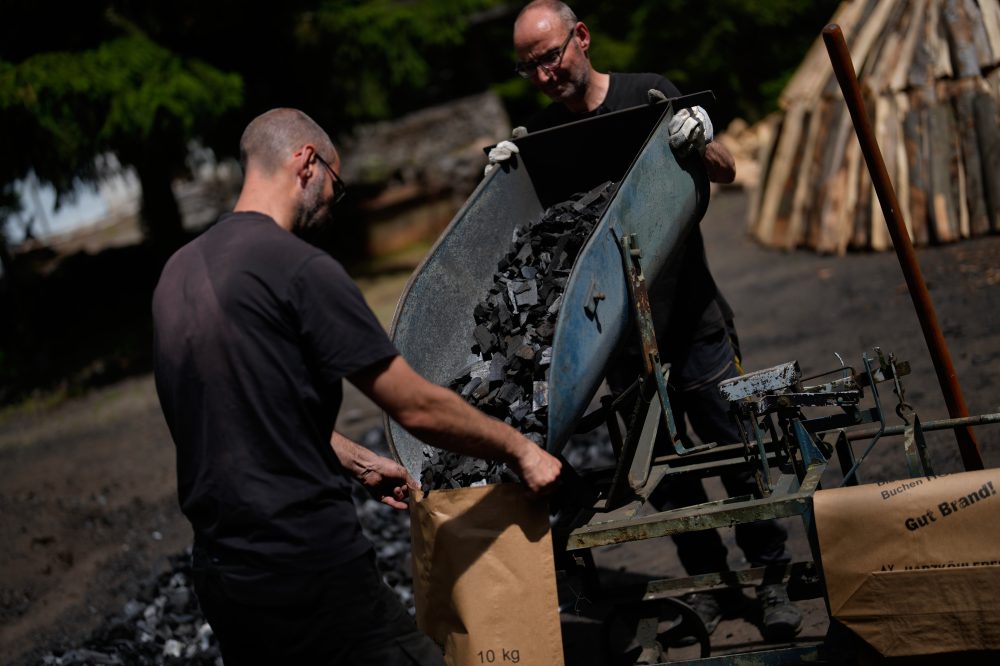

HASSELFELDE, Germany — Standing among large earthen mounds deep in a German forest, Immo Feldmer carefully poured glowing charcoal into one of the towering structures, beginning a process that has been carried out in this region for over a millennium.
Each mound is packed tightly with beech wood on the inside, which slowly smolders over the course of several weeks before transforming into charcoal. It is a craft with deep roots in the Harz mountain region of eastern Germany.
“We are making charcoal in traditional earthen kilns, just as it was done here in the Harz Mountains over 1,000 years ago,” Feldmer told The Associated Press during a recent interview near the small town of Hasselfelde.
Feldmer and his brother Sascha took over the family charcoal business, known as Harzköhlerei Stemberghaus, from their father. The operation requires constant attention — a small team of workers monitors the smoldering wood around the clock to prevent it from igniting into open flames and burning down to worthless ash.
Once the beech wood is sealed beneath a layer of earth, it burns slowly from top to bottom through a series of air holes. Beech wood is prized for its density and the intense heat it generates as charcoal. After the process is complete, the charcoal is cleaned of dirt and, once cooled, packaged into 10-kilogram (22-pound) bags for sale.
Historically, charcoal production was a cornerstone of the Harz Mountains’ mining industry. Extracting precious metals like silver, lead, copper, and zinc from rock required extreme heat that only charcoal could reliably provide. Over the centuries, hundreds of families in the region made their living as charcoal burners.
Today, ore mining in the area is a thing of the past, and only a small number of charcoal burners remain active across Germany. The Feldmers now sell most of their product to everyday consumers for backyard grilling.
Feldmer is proud of what sets his charcoal apart from what shoppers typically find on store shelves. “Our charcoal is, first and foremost, made from pure beech wood,” he said, noting that much of the charcoal sold at hardware stores throughout Germany is imported and produced from “mixed woods, scrap wood, and waste wood so it can be produced cheaply.”
Because charcoal burning alone — the brothers produce roughly 40 tons per year — cannot fully sustain the business financially, the Feldmers have expanded their operation. They now run a museum dedicated to the history of the craft, a small retail shop, and a restaurant where visitors can enjoy local dishes including steaks cooked over handmade birch charcoal.
Although charcoal burning has largely disappeared as a trade in Germany, Feldmer holds onto hope that the tradition will survive through his family for generations to come.
“Of course, we hope … that our business here will be taken over by our children, that it will continue to operate, and that the traditional craft of charcoal burning will be preserved here,” he said.