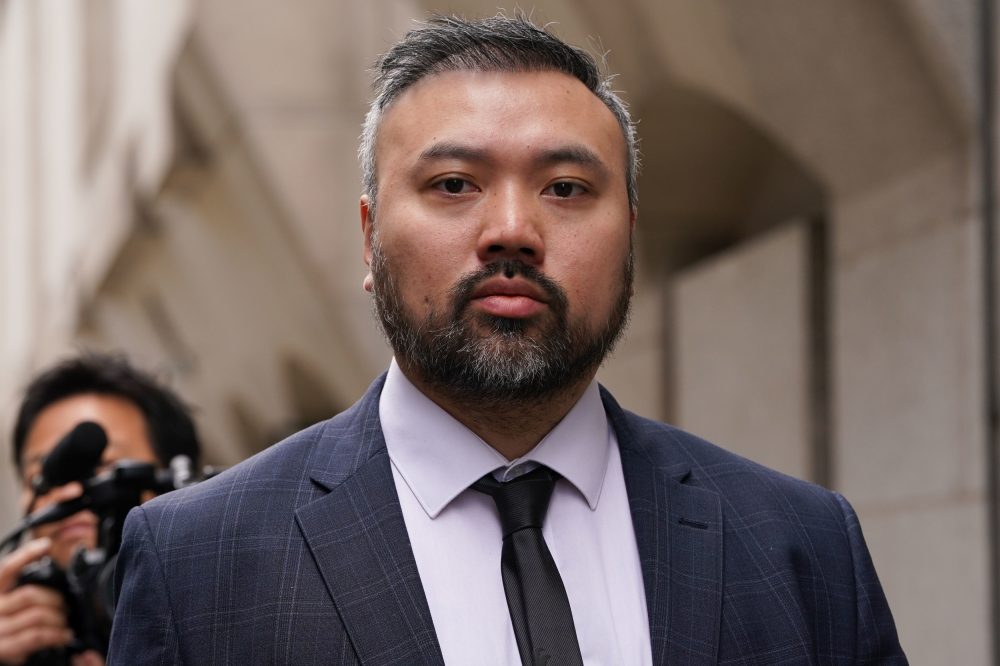

LONDON — Two men holding both British and Chinese citizenship were found guilty Thursday of conducting espionage activities for China through what authorities described as unauthorized law enforcement operations on British territory.
Peter Wai, age 40, and Bill Yuen, 65, falsely presented themselves as official police or intelligence personnel while conducting surveillance and collecting data on Hong Kong democracy advocates and dissidents, according to prosecutors.
London’s Central Criminal Court jury delivered guilty verdicts on charges that both men breached the National Security Act through their assistance to a foreign intelligence operation. Wai received an additional conviction for public office misconduct.
Bethan David, who leads counterterrorism efforts at the Crown Prosecution Service, stated: “These convictions send a clear message that transnational repression, foreign interference, unauthorized surveillance, and attempts to operate outside the law will not be tolerated on British soil. This conduct was deliberate, coordinated and carried out with full knowledge of who it would benefit.”
Following the verdicts, British officials called Chinese Ambassador Zheng Zeguang to the Foreign Office.
Security Minister Dan Jarvis declared in an official statement: “The activities carried out by these men, on behalf of China, are an infringement of our sovereignty and will never be tolerated. We will continue to hold China to account and challenge them directly for actions which put the safety of people in our country at risk.”
Hong Kong’s administration responded by stating it was not involved in the legal proceedings while strongly rejecting what it called baseless accusations against the territory or its London trade office.
Wai held positions with the U.K. Border Force and served as a special constable for the City of London while operating a private security business.
Yuen previously served as a superintendent with Hong Kong Police and worked in London for the Hong Kong Economic and Trade Office, which serves as Hong Kong’s official overseas representative.
Hong Kong officials had posted bounties reaching nearly 100,000 pounds ($136,000) for capturing or obtaining information about pro-democracy advocates.
According to prosecutors, Yuen exceeded his designated role as office manager by helping collect intelligence about the whereabouts and activities of Hong Kong activists and political figures who relocated to the U.K. following the implementation of comprehensive national security legislation in the Asian financial center.
Prosecutors said Wai, who received payments through the trade office account, was found guilty of misconduct for improperly accessing police computer systems during off-duty hours to obtain the intelligence.
Text message evidence revealed the pair conducted surveillance on former Hong Kong legislator Nathan Law and activists they described using derogatory terms.
Yuen instructed Wai to focus particularly on Parliament members and government workers, providing names of notable politicians in 2023, including Conservative MP Iain Duncan Smith, who co-chairs the Inter-Parliamentary Alliance on China.
The scheme came to light when counterterrorism officers, conducting their own surveillance operation, interrupted an attempt by nine individuals to break into a northern England residence belonging to a Hong Kong woman in May 2024.
The homeowner, Monica Kwong, faced accusations from her former employer, Beijing-based Australian businesswoman Tina Zou, of committing fraud worth 16 million pounds ($21.8 million). Kwong maintained the allegations were fabricated.
Those arrested at Kwong’s West Yorkshire home included Zou, Wai, and two additional former Hong Kong police officers. Yuen, who maintained contact with the group, was taken into custody in London.
Investigators subsequently assembled communication records demonstrating that Yuen had tasked Wai with conducting espionage for Hong Kong and Chinese authorities.
The charges also included Matthew Trickett, a U.K. immigration enforcement officer arrested at Kwong’s residence, who was later discovered dead in what authorities believe was suicide. Zou never faced charges.
The jury was unable to reach decisions on additional charges alleging the men engaged in foreign interference through the break-in at Kwong’s home.