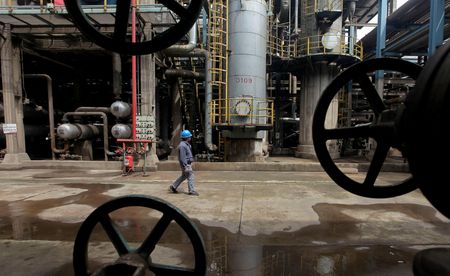

For the past five years, China consistently brought in an average of 11.5 million barrels of oil every single day. But since April, that figure has collapsed to just 8 million barrels per day — and the world’s energy markets are taking notice.
By June, Chinese oil shipments had fallen to roughly 40% of what they were before the Iran war began. That dramatic pullback has helped hold global oil prices in check and made more oil available to other nations.
But energy analysts are scratching their heads trying to figure out exactly how China managed such a steep reduction — and whether the drop is here to stay.
“It’s the million-dollar question,” said Michal Meidan, head of China Energy Research at the Oxford Institute for Energy Studies. “There’s a massive level of uncertainty because we don’t fully understand what has happened.”
Part of the difficulty in answering that question lies in China’s lack of transparency. The country’s strategic oil reserves are classified information, its state oil companies share little publicly, and official data is incomplete at best.
Some energy analysts now believe China’s oil imports could end up permanently lower by 1 million to 2 million barrels per day compared to pre-war levels — a significant shift for a country that has been one of the primary engines of global oil demand growth for decades.
TRANSPORTATION FUEL USE MAY HAVE CHANGED FOR GOOD
The war has exposed the fact that China’s transportation network can operate on considerably less fuel than previously believed. This matters greatly for crude oil imports, since roughly half of what China brings in gets refined into fuel for vehicles and transport.
What remains unclear is whether the conflict will significantly speed up the adoption of electric vehicles, particularly now that gasoline prices have retreated to pre-war levels after jumping by more than 25%.
Electric and hybrid vehicles reached a record high of 62% of all new car sales in China in June. However, overall car sales are down by hundreds of thousands this year due to a sluggish Chinese economy and the fact that 87% of vehicles on the road still run on gasoline.
One area where lasting change appears more certain is diesel. The Chinese government launched a plan in June to electrify its trucking industry, targeting 80% electrification on high-traffic short-haul routes by 2030.
Energy consultancy Rystad now projects Chinese gasoline and diesel consumption will fall by 6.6% and 6.9%, respectively — significantly steeper than its pre-war projections of 3.5% and 3%.
“The crisis has acted as a trigger,” said Ye Lin, an analyst at Rystad. “It helped consumers build more confidence in electric cars and trucks.”
ECONOMIC WEAKNESS ADDS ANOTHER LAYER OF UNCERTAINTY
Beyond transportation, the broader Chinese economy poses additional risks to oil demand, according to Meidan of the Oxford Institute for Energy Studies.
China’s ongoing property market crisis has hammered the construction sector and eroded diesel demand for several years, with property values still declining. A prolonged economic slowdown could also reduce demand for plastics and other petroleum-based products, putting pressure on refiners who are already facing competition from coal-derived alternatives.
“Something we’re not thinking enough about is the broader economic story,” Meidan said. “That is a really big question that will impact Chinese oil demand and industrial activity.”
THE ROLE OF STRATEGIC OIL RESERVES
Before the war, China had been aggressively building up its strategic petroleum reserves — a move that turned out to be well-timed when the Strait of Hormuz closed. That stockpiling activity inflated import numbers in the period leading up to the conflict.
That reserve-building campaign appears to have paused since the war began, but analysts say it’s difficult to predict when China might resume it or at what scale, given how little Beijing discloses about its reserve targets and current storage levels.
Reuters reported last year that China was constructing new oil storage facilities. In May, Premier Li Qiang called for even greater storage capacity during a visit to a reserve site.
“Although there is demand destruction, there will still be incremental crude oil imports that China will use to fill its strategic petroleum reserves,” said June Goh, a senior analyst at Sparta Commodities.
Goh noted that structural shifts like electrification could bring monthly crude imports down to between 8 million and 9 million barrels per day once conditions in the Gulf stabilize — but a new stockpiling push could push that figure back up to the 9.5 million to 11 million barrel range.
During China’s stockpiling effort last year, Brent crude was trading between $58 and $83 per barrel. The current price sits at around $85. Analysts suggest China could resume stockpiling if prices drop back below $70.
FUEL EXPORT POLICY ALSO SHAPES THE PICTURE
Reaching any new normal will also depend on the resumption of stable Gulf supplies and Beijing lifting its wartime restrictions on fuel exports, analysts say. Without the ability to export surplus gasoline, diesel, and jet fuel, Chinese refiners have little motivation to increase crude purchases and ramp up production.
Beijing did lift those export restrictions for July, but analysts warn they could be reinstated for August following a resumption of fighting in the Gulf.
Over the longer term, fuel exports will play a role in determining where China’s crude imports ultimately settle. If overseas markets absorb China’s excess refined fuel and petrochemicals, refineries may need to import more oil. China manages its fuel exports through a tightly controlled quota system.