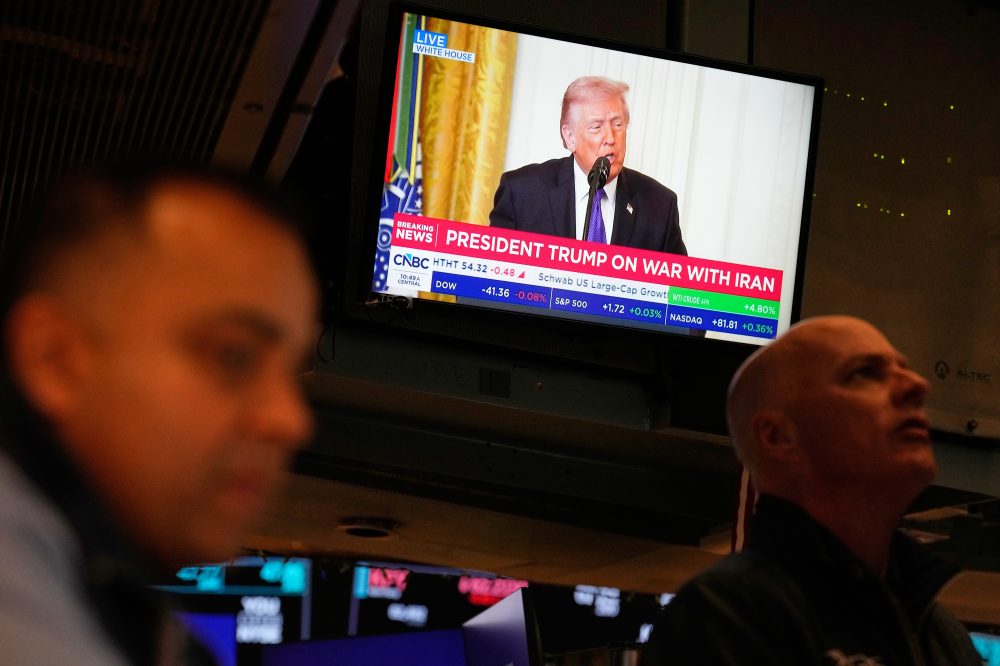

WASHINGTON — President Donald Trump’s traditional approach to steadying financial markets through public statements and social media messaging is proving less effective as his military conflict with Iran continues to unfold.
The president has focused heavily on preventing oil price spikes, stock market crashes, and interest rate increases as the war he initiated last month drags on. Despite his efforts to project confidence, the S&P 500 has dropped over the past five weeks while global oil prices have jumped approximately 60%.
“I thought oil prices were going to go up higher than they are now,” Trump stated during an investor summit on Friday. “And I thought that we would see a bigger drop in stock. It hasn’t been that bad.”
Rather than addressing voters directly about economic impacts, the administration has concentrated on limiting financial market volatility. These markets have experienced dramatic swings based on speculation about potential ceasefires or military escalation.
Trump demonstrated his contradictory messaging approach Monday morning before markets opened, posting on social media about significant progress in peace negotiations with Iran while simultaneously threatening to target civilian infrastructure like desalination facilities if an agreement wasn’t reached “shortly.”
The administration views financial markets as an indirect communication channel to voters, with Trump’s economic platform built on affordable gas prices, strong retirement account performance, and low mortgage rates.
However, this communication strategy appears to be losing impact as the president’s various statements have failed to address the fundamental issue of disrupted global energy supplies. Recent polling from The Associated Press-NORC Center for Public Affairs Research shows only 38% of Americans approve of Trump’s economic handling, while 35% support his Iran policy.
Gene Sperling, who served as a senior economic advisor under Democratic presidents Clinton, Obama, and Biden, argued that voters directly connect rising gas prices to Trump’s decision to attack Iran. He criticized what he called “simplistic jawboning” as inadequate for Americans paying over $4 per gallon for gasoline.
“Most advisers would say the president has to speak directly to the American people and fully acknowledge the economic pain that his policy has so directly caused in a short amount of time and make the case for why the national security concerns justify it,” Sperling explained. “Instead, you have a strategy of not recognizing or even dismissing people’s economic pain.”
White House press secretary Karoline Leavitt characterized the oil price increases Monday as a “short-term fluctuation.”
Jeffrey Sonnenfeld, a Yale University School of Management professor and co-author of “Trump’s Ten Commandments: Strategic Lessons from the Trump Leadership Toolbox,” believes Trump’s contradictory messaging is backfiring.
“The uncertainty is now soaring,” Sonnenfeld observed. “As the messaging to calm markets with false reassurances is having diminishing credibility in financial markets, so, too, has Trump diminished public confidence.”
Trump has maintained flexibility in his war strategy, though this has created confusion about his actual goals.
During Thursday’s Cabinet meeting, he claimed Iran was “begging” for a deal while threatening additional military strikes and insisting any economic damage would be temporary.
Following Friday’s market close, he postponed his deadline for Iran to reopen the Strait of Hormuz, a critical oil shipping route, announcing he would delay bombing Iranian energy facilities.
Treasury Secretary Scott Bessent told Fox News Channel’s “Fox & Friends” on Monday that Iran was allowing some tankers through the Strait of Hormuz and that markets remain “well supplied” due to strategic petroleum reserve releases and lifted sanctions on existing Russian and Iranian oil shipments.
“We are seeing more and more ships go through on a daily basis as individual countries cut deals with the Iranian regime for the time being,” Bessent explained. “But over time, the U.S. is going to retake control of the straits, and there will be freedom of navigation, whether it is through U.S. escorts or a multinational escort.”
Graham Steele, a former Biden administration Treasury official, noted that Trump’s messaging tactics “can work temporarily, but they have diminishing returns, over time,” when disconnected from concrete policies and outcomes.
“We saw a lot of the volatile market reactions initially, when he kept announcing these things and then walking them back,” Steele said. “The market reaction now is just a steady trend upward in prices,” adding that markets are “not responding to it in the same way anymore.”
The University of Michigan’s Index of Consumer Sentiment dropped to 53.3 in March on Friday, reaching its lowest point since December. Survey director Joanne Hsu attributed the decline to financial market instability “in the wake of the Iran conflict,” which has reduced economic confidence among middle and higher-income households.
Hsu noted that survey respondents don’t expect sustained higher energy costs and stock declines, but warned this could shift if the conflict “becomes protracted or if higher energy prices pass through to overall inflation.”
PNC Financial Services chief economist Gus Faucher emphasized that low consumer sentiment doesn’t automatically indicate an approaching recession. However, he said consumers need to witness lower gas prices, stable stock markets, and reduced mortgage rates to improve their economic outlook, requiring a definitive conflict resolution rather than repeated presidential announcements.
“The proof is in the pudding,” Faucher stated. “People need to see some substantive improvements before they feel better about conditions.”