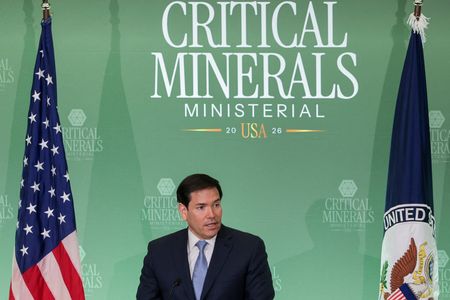

The Trump administration’s ambitious plan to reshape how critical minerals are priced and traded is encountering significant resistance — both from allied nations and from within the American mining industry itself — as G7 leaders gather in France for high-stakes talks.
The idea was first floated by U.S. Vice President JD Vance back in February. The goal is to create a Western trading bloc that would help reduce dependence on China, which has become the world’s dominant minerals producer by operating at a loss and keeping prices artificially low. Those minerals — including cobalt, lithium, and nickel — are essential building blocks for semiconductors, computer servers, military hardware, and countless other products.
By flooding markets with cheap minerals, China has made it nearly impossible for Western mining companies to compete, stunting new development and forcing some businesses to shut down entirely — a strategy Beijing has deployed in other industries as well.
The proposed trading bloc would look at price supports, market standards, government subsidies, or guaranteed purchase agreements to prop up production across multiple countries. Vance suggested the measures could be backed by “adjustable tariffs to uphold pricing integrity.”
Currently, many of the specialty minerals vital to technology and defense are traded with little transparency and are effectively priced according to Chinese market rates, which dominate globally due to China’s outsized production share.
Since Vance’s announcement, G7 member nations have privately pushed back against U.S. Trade Representative Jamieson Greer and have grown lukewarm toward a pricing approach derived from a Pentagon artificial intelligence model, according to three sources who spoke with Reuters.
European officials say the main sticking points include who would absorb the cost of paying a premium for minerals, how far along the supply chain those subsidies would reach, and how the overall governance structure would function.
On the domestic front, the U.S. mining industry is far from unified. More than 230 public submissions sent to Greer’s office — from miners, refiners, and their customers — reveal deep disagreements about what direction the U.S. should push its allies to take.
Analysts and consultants say the stakes are enormous. More than a dozen experts told Reuters that the outcome of these negotiations could reshape global minerals markets for years.
“It is a very hard thing to do, and I’m happy I’m not the one doing it,” said Ashley Zumwalt-Forbes, a minerals investor who previously managed the U.S. Department of Energy’s batteries and critical minerals portfolio under former President Joe Biden.
A draft U.S. proposal has been built around an AI-based pricing program developed by the Pentagon’s Defense Advanced Research Projects Agency, known as DARPA. Called the Open Price Exploration for National Security, or OPEN, the program attempts to calculate what a metal should cost based on labor, processing, and other real expenses — while stripping out the effects of alleged Chinese market manipulation. That draft has been delivered to the White House and the National Security Council, and U.S. representatives are expected to brief G7 allies on it during the current meeting, according to a U.S. official.
But European allies have so far resisted the idea of using a pricing system developed in Washington, with one source pointing to concerns that it would give the U.S. too much influence over the bloc’s pricing decisions.
Another source said Europeans are pushing for a broader set of tools and what they described as “agile governance” to allow flexibility depending on the specific mineral and its supply chain.
“For Europe, it would be better to have a price index based on real deals in the European market. The question is whether we can make these opaque pricing mechanisms more transparent, more market-driven, and less prone to manipulation,” said Nicola Beer, who oversees minerals financing at the EU-controlled European Investment Bank. “Different parts of supply chains and products across sectors are shaped by very different pricing mechanisms, which adds to the complexity.”
As a potential alternative, an EU-funded agency called EIT RawMaterials is collaborating with digital platform Metalshub to develop pricing indexes that operate independently of Chinese government-driven pricing. Those indexes could eventually include the United States, Australia, Canada, and Britain.
European and industry officials say they want more time to study the long-term effects of price supports rather than rushing into quick commitments — a stance that puts them at odds with the faster-moving American side.
Meanwhile, the Trump administration is resisting a French proposal to establish a permanent administrative secretariat within either the International Energy Agency or the OECD to track G7 critical minerals efforts as leadership rotates among member nations.
Canada and France — which currently holds the G7 presidency — are pushing for a trading bloc led by the full G7, while the United States prefers to bypass multilateral negotiations in favor of swift bilateral deals that could later be expanded, according to three sources familiar with the discussions.
“What we’re trying to do is take some of these approaches and turn them into an agreement,” Greer told reporters in early June at an OECD ministerial meeting in Paris. He added that the U.S. would use price supports “to protect production of critical minerals and derivative products. … We want to phase it in. … If other countries want to join us in that, they’re welcome to do that.”
Washington is aiming to present a proposal for binding bilateral agreements to Japan and the European Union before the end of June, two sources said. The first such agreement could cover five to ten minerals, including heavy rare earths, antimony, graphite, and tungsten — all of which are currently subject to Chinese export bans or restrictions.
Back home, the corporate world is equally divided. While submissions to Greer’s office broadly agree that the trading bloc should target niche minerals rather than widely traded metals like copper, and should also address downstream products such as cell phones and laptops, there is significant disagreement over how prices should be regulated.
Several major companies and mining trade groups have come out against price-setting. Divergent recommendations came from General Motors, recycler Umicore, platinum miner Sibanye Stillwater, the U.S. Chamber of Commerce, and rare earths company MP Materials, among others.
“There’s nervousness from all sides about what to do and how different actions could affect different parts of the supply chain,” said Blake Harden, a managing director focused on trade policy at the EY consultancy.
The National Mining Association advised Greer to avoid heavy price-fixing and instead focus on tax credits and other financial incentives. “While market interventions such as pricing mechanisms may play a role in certain circumstances, incentive-based approaches … are better suited to addressing challenges facing the domestic mining industry,” said Rich Nolan, the trade group’s CEO.
A metals analyst at the WoodMac consultancy, James Willoughby, summed up the current state of affairs bluntly: “There’s a very mixed message coming out of the U.S. right now on battery metals.”