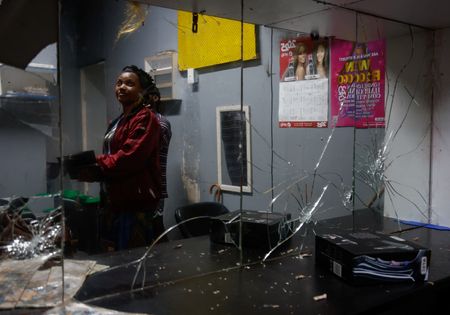

DURBAN, South Africa — Princess Adjei was just a toddler when her family moved from Ghana to South Africa. By the time she was 33, she had built an entire life there — completing all of her schooling, making local friends, and even learning Zulu, the dominant language of the eastern port city of Durban. She had rarely thought of herself as a foreigner.
In November, Adjei opened a hair salon in central Durban, pouring 50,000 rand — more than $3,000 — into renovating the space just a few months later in February. Then, on May 18, everything changed.
Protesters taking part in an anti-migrant march broke into her shop and stripped it bare. Suddenly, people she had known for years were telling her to go back “home” — to a country she had visited only once in her life.
“They took everything,” Adjei said, standing amid shattered mirrors and broken chairs in her ransacked salon. “Those were hair pieces I was selling here. There were acrylic nails, six hair dryers, a range of shampoos. All gone.”
Adjei is among scores of victims caught up in a surge of attacks targeting African foreign nationals. An anti-immigration movement has accused these migrants of living in South Africa without authorization — yet many hold legal documents and have spent decades building their lives there.
Sleeping on the Streets
With her salon destroyed and no income to pay rent, Adjei moved out of her central Durban apartment. She and her 14-year-old son now sleep under a blanket on the sidewalk alongside roughly 200 other displaced migrants. The group has set up camp outside the local office of the government’s Department of Home Affairs, hoping officials can verify their legal residency status.
Elsewhere, other African migrants have fled into the mountains and onto open land to escape violence that has claimed at least five lives and created a serious diplomatic rift between South Africa and neighboring countries on the continent.
Reuters spoke with a dozen migrants in Durban, four of whom had lived in South Africa since childhood.
The organization behind the protests, March and March, denies that its movement is driven by xenophobia.
“Xenophobia applies to those people who come to a country illegally and make people from that country feel uncomfortable,” said Jacinta Ngobese, the founder of March and March, in an interview in Durban.
Ngobese argued that her group has actually helped protect migrants by channeling South Africans’ frustration toward the government rather than toward foreigners. Even so, the group’s demonstrations have repeatedly coincided with outbreaks of violence, including the looting of shops owned by foreign nationals and the destruction of homes.
“We are not responsible for the violence,” Ngobese said. “If we were violent, we would have been arrested.”
Police Response Questioned
Some arrests were made after protesters killed five Mozambicans last month and in connection with other incidents. However, law enforcement responses have been largely rare.
Following the unrest in Durban, around 200 migrants camped outside the central police station seeking safety. Four of those migrants — including Adjei — told Reuters that police first took them to a homeless shelter, then to a market warehouse, but they were turned away from both locations by people already there.
The next day, police reportedly ordered them to disperse and later fired rubber-coated steel bullets and tear gas at the group, according to the four migrants and some local media outlets.
“They told us to look for another shelter,” said Tchomba Kasongo, a Congolese refugee who walked with a limp and showed a bullet wound scar on his leg. The displaced migrants now live under the shadow of a June 30 deadline that protesters have issued, demanding all “illegal” migrants leave the country.
Durban police spokesperson Booysie Zungu denied the allegations. “We never tear gassed anyone, we never fired on anyone,” he told Reuters. When informed about the attack on Adjei’s salon and other anti-migrant incidents, he responded, “We don’t have cases of that nature reported. They must open a case.”
A spokesperson for Durban’s mayor declined to offer any comment.
Old Friends Turn Away
After discovering her salon in ruins, Adjei returned to her apartment and ran into a South African neighbor she had considered a close friend — someone with whom she had often chatted in the hallway and shared tea. He was now scowling at her, demanding to know when she planned to leave.
It was the third time in her life that Adjei had experienced South Africa’s periodic eruptions of xenophobic hostility. The first came in 2008, when classmates who had never previously shown any interest in her background began bullying her during a wave of protests.
Not all South African friends have turned away. Wivene Bahati, a 25-year-old Congolese refugee who has lived in South Africa since 2011 and now sleeps on the curb near Adjei, said a former classmate reached out after the latest violence.
“She felt bad. She asked me is everything ok?” Bahati told Reuters.
Analysts say migrants are frequently viewed as competitors for jobs and public services, making them easy targets when economic hardship sets in or government services break down. Anti-migrant sentiment often intensifies around election periods as some politicians tap into the issue for popular support — South Africa has local elections scheduled by November.
Thamsanqa Ntuli, the Premier of KwaZulu-Natal province, where Durban is the principal city, pushes back against the idea that politics is driving the xenophobia, placing the blame instead on illegal immigration.
“We agree with the entire society when they say: ‘government, you should have started to manage migration properly … a long time ago,’” Ntuli told Reuters.