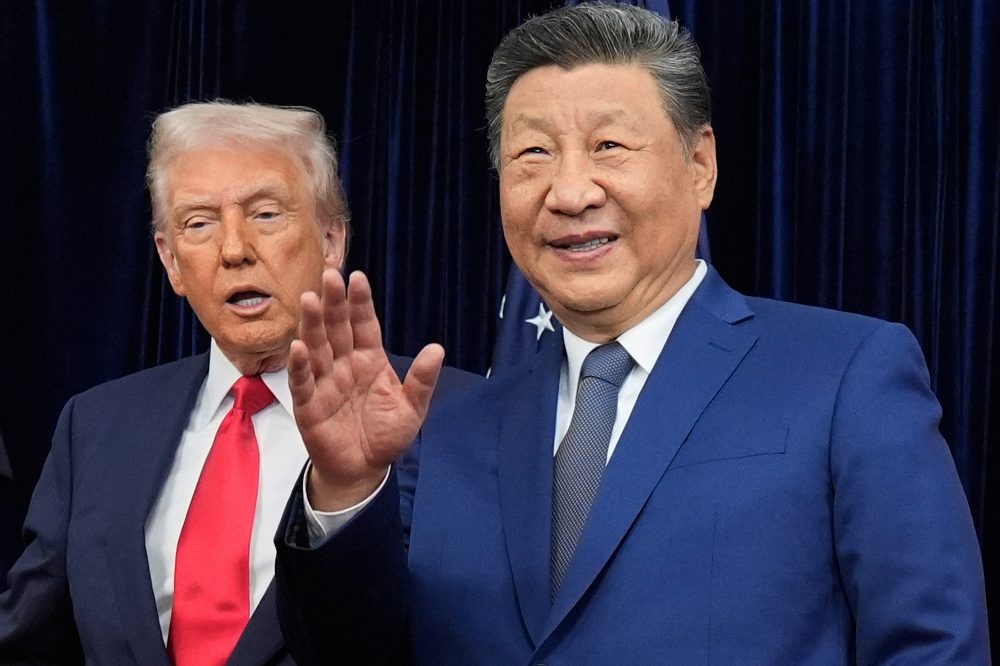

BEIJING — President Donald Trump and Chinese leader Xi Jinping are set to hold a crucial summit meeting as both nations describe their relationship as generally stable in recent months, with plans to maintain that stability moving forward.
However, numerous complex issues remain unresolved in what many consider the world’s most important bilateral relationship, with no clear resolution on the horizon.
Experts anticipate limited major progress on longstanding tensions between the two superpowers, which include technological competition and disputes over Taiwan, where the United States serves as the primary supporter. The ongoing conflict involving Iran is expected to join the discussion topics, as China has taken on an unofficial mediation role.
“Both nations agree that maintaining U.S.-China stability matters,” explained Henrietta Levin, a senior fellow for the Freeman Chair in China Studies at the Center for Strategic and International Studies in Washington. “Beyond maintaining stability, determining the relationship’s future direction becomes more challenging, which is why this meeting will likely produce minimal concrete results.”
Here are the key issues at stake:
The economic conflict between China and the United States began during Trump’s initial presidency but intensified significantly in April of last year on what Trump termed “Liberation Day,” when he imposed 34% tariffs on Chinese imports. China responded with retaliatory tariffs and additional restrictions, including limits on rare earth mineral exports. The escalating conflict saw tariffs climb as high as 145%.
Recognizing that such extreme tariffs were unsustainable, both countries agreed to a trade ceasefire, suspending many punitive economic actions. The leaders previously met in South Korea in October and extended their truce for an additional year. China agreed to buy soybeans from U.S. farmers, while America reduced tariffs by more than half.
“China’s approach involved promoting stability through pushback,” said Fudan University professor Zhao Minghao, who specializes in international relations. “Both nations could potentially announce a comprehensive trade deal this time. However, this wouldn’t end the conflict, and any agreement will include specific conditions.”
Last year’s ceasefire failed to address fundamental underlying issues and didn’t restore previous trade relationships. China has implemented new export permit requirements for rare earth materials that can be tightened whenever necessary.
Additionally, “there’s been insufficient intensive dialogue that has marked previous summits,” noted Wendy Cutler, Asia Society vice president and former U.S. trade negotiator.
China introduced new regulations in April establishing a framework for identifying and countering foreign actions targeting Chinese businesses. Under these rules, China’s Ministry of Commerce instructed affected companies, including a petroleum refinery purchasing Iranian crude oil, to disregard U.S. sanctions.
While some anticipate the sides might announce an extended trade truce, observers note continued targeted actions. “It’s a delicate ceasefire,” Cutler stated.
The White House announced Sunday plans to discuss establishing a new “Board of Trade” to maintain ongoing economic dialogue between the countries.
America implemented restrictions on advanced computer chip exports to China and related technology, including manufacturing equipment, during Trump’s first administration.
Nvidia, the California-based leading advanced chip designer, has urged Trump to permit exports to China. Company founder Jensen Huang argues that selling chips would create Chinese AI company dependence on American technology.
However, expanding chip export restrictions may drive China toward greater self-sufficiency. “China’s position has shifted somewhat, appearing more concentrated on developing its domestic chip sector rather than continuing dependence on advanced U.S. chips,” Zhao commented in written statements.
Two weeks prior to the meeting, Chinese Foreign Minister Wang Yi told U.S. Secretary of State Marco Rubio during a phone call that bilateral relations have stayed generally stable, but Taiwan represents the “greatest risk” to their ties. China indicated again Thursday that Taiwan would be a primary discussion topic.
Few anticipate resolution of the Taiwan situation, which has persisted since China and Taiwan separated during a civil war in 1949. While Beijing claims Taiwan, the island operates as a self-governing democracy.
Tensions have escalated since Taiwan elected Tsai Ing-wen as president in 2016. Her Democratic Progressive Party maintains Taiwan is functionally independent and sovereign. Beijing has ceased communication with Taiwan’s government and recently began sending military aircraft and naval vessels near the island in nearly daily exercises.
Taiwan’s current President Lai Ching-te also belongs to the DPP. Beijing has repeatedly criticized Lai, even portraying him as a “parasite” in military exercise propaganda.
U.S. law requires ensuring Taiwan can defend itself, but America officially maintains “strategic ambiguity,” leaving unclear whether the U.S. would intervene militarily if China attempted to reclaim Taiwan by force. Trump recently mentioned discussing Taiwan arms sales with Xi, raising additional questions about American support for Taiwan.
“One option involves China and the U.S. adopting ‘reciprocal restraint,’ such as reducing American arms sales to Taiwan in exchange for fewer mainland military exercises targeting Taiwan,” Zhao suggested.
As the world seeks an end to the Iran war that has disrupted the global economy, this conflict will likely arise in discussions.
China has openly criticized both the United States and Israel regarding the war. Additionally, given its strong political and economic connections with Iran, some view it as an unofficial mediator capable of influencing Tehran. Beijing has remained cautious so far, preferring minimal deep involvement.
“I don’t believe China has any desire to resolve Middle East problems the U.S. has created for itself,” said Levin from the Center for Strategic and International Studies.
Days before the summit, U.S. Treasury Secretary Scott Bessent urged China to pressure Iran to reopen the Strait of Hormuz, claiming Beijing’s Iranian oil purchases fund terrorism.
“Let’s see if China — let’s see them step up with some diplomacy and get the Iranians to open the strait,” Bessent said on Fox News. “Iran is the largest state sponsor of terrorism, and China has been buying 90% of their energy, so they are funding the largest state sponsor of terrorism.”