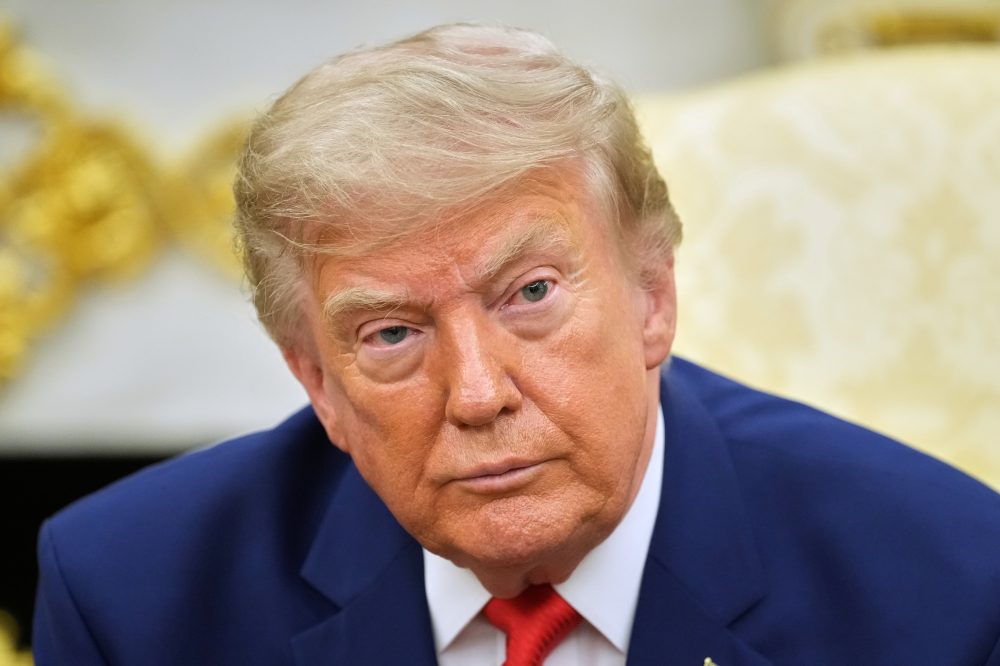

Former President Donald Trump is launching a revenge effort against fellow Republicans in Tuesday’s Indiana primary elections. The former president has thrown his support behind primary opponents challenging seven GOP state senators who refused to back his congressional redistricting initiative.
Through multiple social media messages, Trump has attacked the sitting lawmakers with harsh language, branding them as incompetent, calling them RINOs — Republicans in name only — or labeling them as losers.
During 2025, Trump pressured Republican officials across multiple states to redesign their congressional boundaries to help the GOP keep its slim majority in the U.S. House. While Texas, Missouri, North Carolina and Ohio complied with his request, Indiana’s effort collapsed when more than half of the state’s GOP senators joined with Democrats to reject Trump’s supported proposal. Of the eight state senators who opposed the plan and face reelection in 2026, Trump has endorsed challengers against all except one.
Democratic-friendly redistricting in California and Virginia has counterbalanced some anticipated Republican advantages elsewhere, though a new Florida map and last week’s Supreme Court ruling that weakened the Voting Rights Act of 1965 have strengthened GOP efforts to alter the political map before November.
All of the Indiana state senators Trump is targeting come from districts he won in 2024, typically by margins of 20 percentage points or greater. The closest contest was in District 1, located near Lake Michigan and southeast of Chicago, where Trump secured approximately 53% of votes with a 7-point victory over then-Vice President Kamala Harris. Trump’s strongest showing among the seven targeted districts came in District 19 along the Ohio border, where he captured roughly 68% of votes with a 39-point margin.
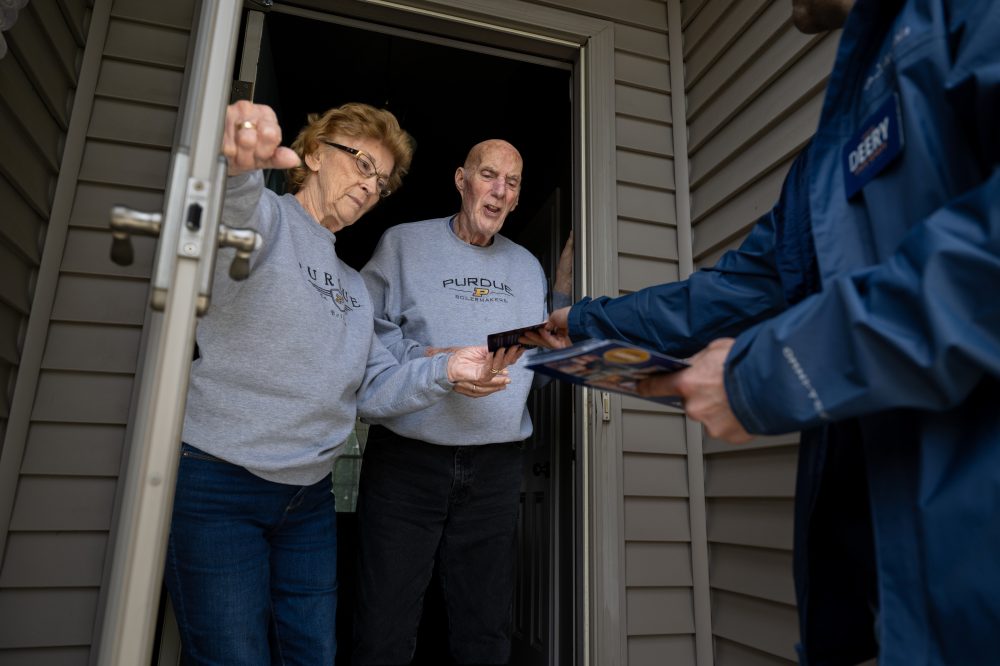
Just one of the current officeholders, state Sen. Spencer Deery from District 23, experienced a competitive primary in 2022. He prevailed with about 31% of votes in a four-way race that included Paula Copenhaver, who is now Trump’s chosen candidate to defeat him this cycle. Another Trump target, state Sen. Greg Goode from District 38, was appointed to fill a vacancy in 2023 and has never run in a full district-wide campaign.
Twenty-five of Indiana’s 50 state Senate positions and all 100 state House seats are on the ballot in 2026. The Republican Party maintains supermajorities in both legislative chambers.
Indiana voters will also select candidates for the U.S. House under current district lines, though none of the state’s nine congressional seats is anticipated to be crucial in determining which party controls the chamber after November.
One significant race is the Democratic primary in the 7th Congressional District, where U.S. Rep. Andre Carson is fighting off three opponents as he seeks nomination for a 10th full term. George Hornedo works as an attorney and political consultant. Destiny Wells serves as an attorney, holds the rank of Army Reserve lieutenant colonel, and was the 2024 candidate for state attorney general. Denise Paul Hatch, a former Center Township constable, is challenging a 2024 felony conviction for official misconduct.
The Associated Press follows strict guidelines and will only declare winners when no mathematical possibility exists for trailing candidates to overcome their deficits. For races not yet called, the AP continues reporting significant developments like candidate concessions or victory claims while clearly stating no winner has been determined and explaining the reasoning.
Indiana law does not provide for automatic recounts, though losing candidates may request and fund recounts regardless of vote margins. Depending on recount outcomes, costs may receive partial or complete reimbursement. The AP may call winners in races eligible for recounts if the victory margin is too substantial for recounts or legal challenges to alter results.
Polling locations across Indiana close at 6 p.m. local time. Most of the state operates in the Eastern time zone with 6 p.m. ET closures, while some areas use Central time and close at 7 p.m. ET. Among Trump-targeted seats, only state Senate District 1 has polls closing at 7 p.m. ET. The 1st, 2nd, 4th and 8th Congressional Districts also have final poll closures at 7 p.m. ET.
The AP will deliver vote tallies and winner declarations for competitive primaries covering U.S. House, state Senate and state House races. Republican incumbents face Trump-endorsed challengers in state Senate Districts 1, 11, 19, 21, 23, 38 and 41.
Indiana does not require party registration, allowing registered voters to choose their preferred party’s primary ballot. Voter identification is mandatory. State law includes an unusual requirement that primary voters must have supported a majority of that party’s candidates in the previous general election or intend to do so in the upcoming general election if they did not vote previously. While essentially unenforceable, voters facing party affiliation challenges must use provisional ballots unless they sign affidavits declaring party alignment.
Approximately 4.8 million registered voters lived in Indiana during the November 2024 general election. Registration numbers across the state’s nine congressional districts varied from roughly 442,000 in District 7 to about 505,000 in District 5.
Most targeted state Senate contests lacked competitive primaries in 2022, but those with contested general elections recorded between approximately 32,000 to 45,000 total votes.
The 7th Congressional District Democratic primary in 2024 drew about 34,000 votes, representing the highest turnout among all districts and roughly 8% of registered voters. The Republican primary in that district attracted about 25,000 votes.
Early voting accounted for approximately 29% of all 2024 primary ballots.
As of Friday, more than 175,000 combined Democratic and Republican primary ballots had already been submitted.
Indiana permits absentee ballot processing upon receipt, with counting allowed before Election Day poll closures. This system enables rapid absentee ballot tabulation. Election officials from over three-quarters of Indiana’s 92 counties typically include complete or nearly complete absentee and early voting results in their initial evening reports.
In 2024, the AP released first results for the Republican presidential primary at 6:06 p.m. ET, just six minutes after most polls closed statewide. The final vote update occurred at 11:34 p.m. ET with over 99% of total votes tallied.
Final election night updates for congressional districts with competitive primaries came much earlier. The 5th Congressional District concluded earliest at 9:10 p.m. ET, while the 1st District finished latest at 11:34 p.m. ET. The 7th District Democratic primary’s final update was at 10:04 p.m. ET.
Initial vote results for the state Senate District 23 primary appeared at 6:59 p.m. ET, nearly one hour after district polls closed. The last update came at 11:11 p.m. ET with more than 99% of votes counted.
As of Tuesday, 182 days remain until the 2026 midterm elections.