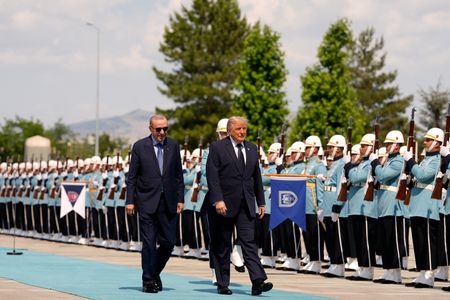

European leaders within the NATO alliance traveled to Ankara, Turkey on Wednesday with a clear goal: persuade President Trump to reaffirm his commitment to the decades-old military partnership after he stirred fresh controversy over Iran and Greenland.
Upon arriving in the Turkish capital on Tuesday, Trump suggested he might have skipped the summit entirely if not for his personal friendship with Turkish President Tayyip Erdogan. He also left the door open to pulling additional U.S. troops out of Europe.
Earlier Tuesday, NATO attempted to show that European members were taking Trump’s demands for greater self-reliance seriously, announcing a series of arms agreements totaling at least $50 billion.
Trump, who has been a persistent critic of NATO throughout both of his presidential terms, declared he was “very disappointed” with the alliance. He said the United States was not “treated well” during the U.S.-Israeli war on Iran, questioning why America continues to pour hundreds of billions of dollars into the alliance when European partners did not stand by the U.S. during that conflict.
“Why are we spending hundreds of billions of dollars, and they’re not there for us? We’ve always been there for them,” Trump said during a joint appearance with Erdogan on Tuesday.
Trump has specifically accused European nations of refusing to allow U.S. forces access to their airspace and military bases during the Iran war. European officials, however, have pushed back on that claim, saying they largely fulfilled their obligations to U.S. forces — even though they were not consulted before a conflict that disrupted their economies and proved deeply unpopular across the continent.
Among those caught in Trump’s crosshairs was Italian Prime Minister Giorgia Meloni, once considered a close ally of the president. Trump said his relationship with Meloni had soured “because she refused to help us” on Iran, though he still referred to her as a “nice person.” Italian officials have been working in recent days to put the disagreement behind them.
Trump also renewed his claim that Greenland — a semi-autonomous territory belonging to NATO member Denmark — should come under U.S. control. Danish Prime Minister Mette Frederiksen responded hours later from Ankara, stating she expects all allies to honor the sovereignty of the Danish kingdom and that Greenland is simply not for sale.
The 32 NATO heads of state gathered for a dinner Tuesday evening, with the formal summit session scheduled for Wednesday. Ambassadors from all member nations have already signed off on a summit declaration pledging an “ironclad commitment” to collective defense, though it will not be officially released until the leaders themselves endorse it.
The Trump administration has been pushing European allies to increase their own defense budgets and take primary responsibility for conventional military defense on the continent, as Washington shifts its strategic focus toward the Indo-Pacific region. The U.S. has already announced troop reductions in Europe, scaled back the forces it contributes to NATO defense planning — including an aircraft carrier, refueling planes, fighter jets, and drones — and launched a six-month review of its overall military footprint in Europe.
European leaders say they are prepared to shoulder more of the security burden but are urging a structured and predictable transition to prevent any vulnerabilities that Russia could exploit. Officials on the European side have expressed hope that Trump’s warm relationship with Erdogan and his positive ties with NATO Secretary General Mark Rutte could help ease tensions during the summit.