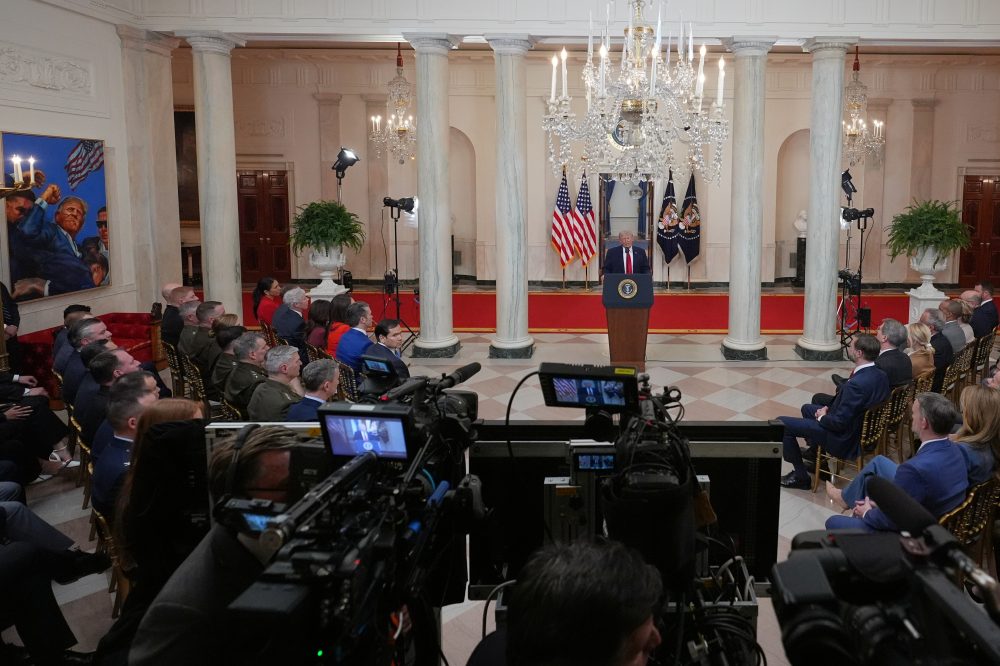

WASHINGTON — During his Wednesday evening national address amid rising gas prices and ongoing inflation concerns, President Donald Trump made several statements about the U.S. economy and Iran that appear to distort key facts, according to fact-checkers.
Among his assertions, Trump declared: “We were a dead and crippled country after the last administration and made it the hottest country anywhere in the world by far, with no inflation.”
However, economic data shows the administration he took over left behind a relatively strong economy. During 2024, the final year of Joe Biden’s term, the nation’s gross domestic product expanded by 2.8% when adjusted for inflation — outpacing nearly every other wealthy nation globally except Spain. The economy also maintained steady growth from 2021 to 2023. Under Trump’s current term, economic expansion has actually slowed to 2.1% last year, with a 43-day government shutdown contributing to reduced growth in the final quarter.
Additionally, inflation hasn’t disappeared as claimed. February’s consumer price index showed a 2.4% year-over-year increase, still exceeding the Federal Reserve’s 2% goal.
Regarding Iran, Trump stated: “Regime change was not our goal. We never said regime change, but regime change has occurred because of all of their original leaders’ death. They’re all dead. The new group is less radical and much more reasonable.”
This characterization appears questionable given current Iranian leadership. Following the February 28 Israeli airstrike that killed Supreme Leader Ayatollah Ali Khamenei at the conflict’s outset, Iran appointed his son Mojtaba to the position — someone considered even more hardline than his predecessor. The ongoing war has strengthened Iran’s paramilitary Revolutionary Guard, while civilian officials acknowledge having minimal control over the Guard’s operations.
Trump also claimed: “This murderous regime also recently killed 45,000 of their own people who were protesting in Iran.”
No verified sources support such a high casualty figure. The Human Rights Activists News Agency, a U.S.-based organization with a track record of accuracy regarding Iranian demonstrations, confirmed just over 7,000 deaths during nationwide protests that peaked in January. While acknowledging thousands more may have died, communication restrictions make verification extremely challenging. Iran’s government reported 3,117 deaths on January 21.
On energy independence, Trump declared: “We’re now totally independent of the Middle East, and yet we are there to help. We don’t have to be there. We don’t need their oil.”
While the United States leads global oil production and imports only 8.5% of its oil from the Persian Gulf region in 2025, Middle Eastern conflicts still impact American consumers. As University of Chicago energy analyst Sam Ori explained before Trump’s address, oil prices are “set in a global market,” meaning “a disruption anywhere affects the price everywhere.” U.S. crude oil prices have jumped over 50% since the Iran conflict began, pushing average gasoline prices above $4 per gallon this week.
Trump also touted “record-setting investments coming into the United States, over $18 trillion.”
No evidence supports this investment figure. Based on company announcements, foreign government statements, and White House documentation, this number appears significantly inflated and speculative. The White House website lists $10.5 trillion, which includes some commitments from the Biden era. A January study questioned whether more than $5 trillion in investment pledges from major trading partners would actually materialize.
Finally, Trump repeated his claim that “Obama gave them $1.7 billion in cash.”
This characterization misrepresents the transaction’s nature. While the Obama administration did transfer approximately that amount to Iran, it wasn’t a gift but rather settlement of a decades-old debt. Iran had paid the U.S. $400 million for military equipment in the 1970s that was never delivered due to the government’s overthrow and severed diplomatic ties. Following the 2015 nuclear agreement, both nations settled the matter with the U.S. paying the original $400 million plus roughly $1.3 billion in accumulated interest.