
Congressional Democratic leaders filed a federal lawsuit Wednesday challenging President Donald Trump’s new executive order that would impose restrictions on mail-in ballot access, contending that the Constitution grants voting authority to states and Congress rather than the president.
This legal challenge represents the second major court fight over Trump’s attempts to control election procedures. Democratic opponents successfully defeated Trump’s previous efforts last year, with federal judges ruling his earlier executive order on election changes was likely unconstitutional.
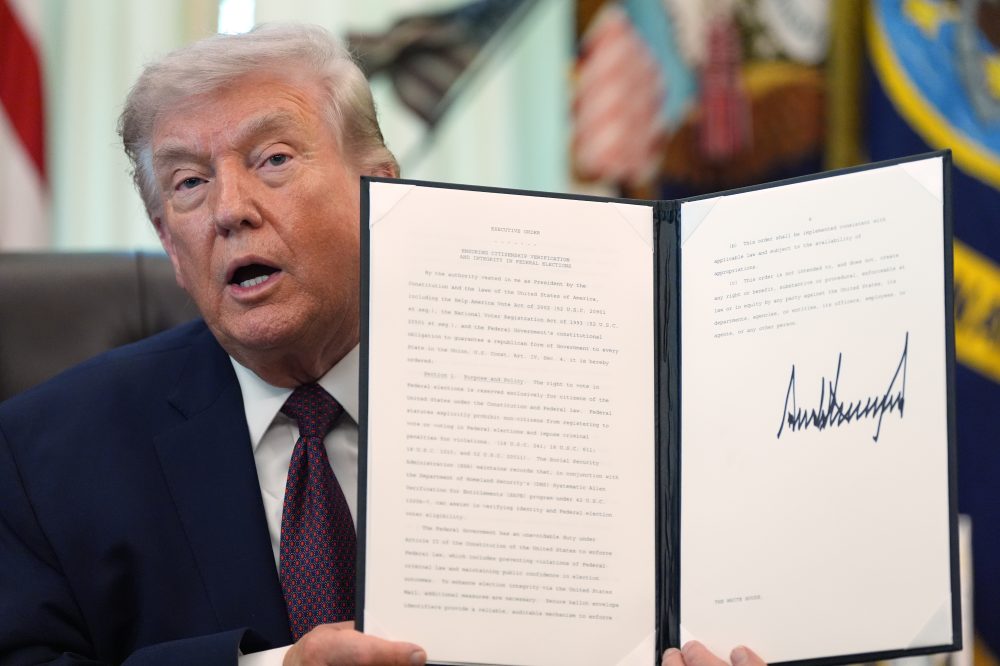
On Tuesday, Trump revealed plans for his administration to create voter eligibility lists by state, with the Postal Service instructed to deliver ballots only to individuals meeting specific criteria. Legal experts point out the tight timeline poses challenges, as election officials must review voter databases before autumn ballot distribution begins in some areas by September, while questioning the accuracy of any federal voter lists.
The legal action involves Senate Minority Leader Chuck Schumer, House Minority Leader Hakeem Jeffries, along with the Democratic National Committee and various party campaign organizations for congressional and gubernatorial races nationwide. Trump and senior administration officials are named as defendants.
“We will see him in court and we will beat him again,” Schumer said in a statement.
Democratic plaintiffs characterized Trump’s actions as an assault on fundamental democratic processes.
“President Trump has tried again and again to rewrite election rules for his own perceived partisan advantage,” their lawsuit said. It adds that “our Constitution’s Framers anticipated this kind of desire for absolute power,” dispersing the power to control elections to individual states and Congress.
Absentee voting has operated for over 100 years, gaining bipartisan support across red and blue states until 2020, when Trump began attacking the practice with unsubstantiated fraud allegations. This shift has decreased Republican participation while increasing Democratic usage, providing Trump additional motivation to restrict the practice ahead of midterm elections that will decide congressional control.
Ironically, Trump frequently uses mail-in voting himself, including during a Florida special election last month.
Following his return to the White House, Trump has attempted to interfere with state election administration, promoting repeatedly debunked claims about fraudulent activities costing him the 2020 election. Extensive investigations, including Republican-led reviews, found no evidence of widespread fraud in that election.
Despite these findings, Trump has demanded his administration “take over” voting operations in Democratic regions, initiated a 2020 election investigation based on conspiracy theories, and unsuccessfully lobbied Congress for legislation creating additional voting barriers, including mandatory in-person documentation of citizenship during registration. That proposal remains stalled in the Senate due to Democratic resistance.