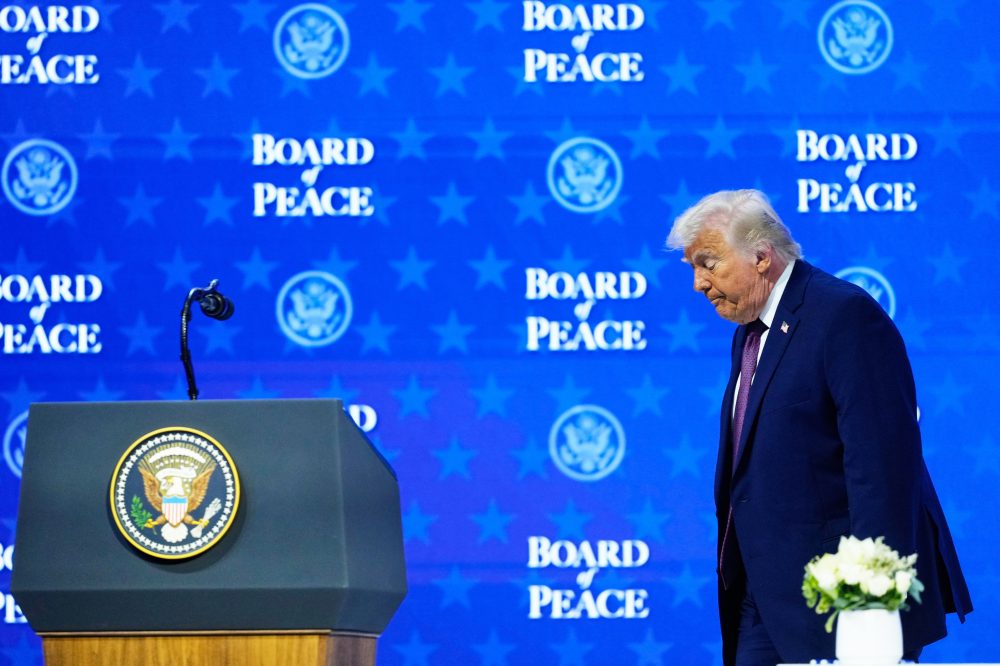

President Donald Trump launched his newly-formed Board of Peace Thursday, bringing together delegates from more than 40 nations plus observers from an additional dozen countries. The first-ever gathering centered on rebuilding efforts in Gaza and establishing an international peacekeeping presence in the war-torn region, where a fragile ceasefire remains in place.
According to Trump, board participants have committed $5 billion toward reconstruction efforts, though this represents only a small portion of the estimated $70 billion experts say will be required to fully restore the Palestinian territory. Participants are also expected to provide thousands of personnel for international peacekeeping and police operations, raising concerns among some that Trump aims to establish an alternative to the United Nations.
Earlier this week, Vatican Secretary of State Cardinal Pietro Parolin expressed reservations to reporters, stating that “at the international level it should above all be the U.N. that manages these crisis situations.”
The Trump administration defended the initiative Wednesday, with White House press secretary Karoline Leavitt responding: “This president has a very bold and ambitious plan and vision to rebuild and reconstruct Gaza, which is well underway because of the Board of Peace. This is a legitimate organization where there are tens of member countries from around the world.”
U.S. Ambassador to the UN Mike Waltz emphasized that the board “is not talking, it is doing.”
“We are hearing the chattering class criticizing the structure of the board, that it’s unconventional, that it’s unprecedented,” Waltz stated. “Again, the old ways were not working.”
Trump expressed hope this week that his board would motivate the UN to “get on the ball.”
“The United Nations has great potential,” he remarked. “They haven’t lived up to the potential.”
Meanwhile, UN Security Council members gathered Wednesday to advocate for making the Gaza ceasefire permanent and criticized Israeli expansion activities in the West Bank as threatening two-state solution prospects. The high-level UN session was originally planned for Thursday but was rescheduled earlier after Trump announced his board meeting for the same date, creating scheduling conflicts for diplomatic personnel.
This timing issue highlights potential coordination challenges between the UN’s most influential body and Trump’s broader goals to mediate international disputes, which has sparked worry in some nations about possible competition with the UN Security Council.
In related economic news, the Commerce Department announced Thursday that the U.S. trade deficit decreased slightly in 2025 as Trump implemented significant tariff increases on imports from most nations. The trade imbalance dropped to just over $901 billion from $904 billion in 2024, with exports climbing 6% and imports rising nearly 5%.
Countries participating in the Board of Peace include Argentina, Albania, Armenia, Azerbaijan, Bahrain, Belarus, Bulgaria, Cambodia, Egypt, El Salvador, Hungary, Indonesia, Jordan, Kazakhstan, Kuwait, Kosovo, Morocco, Mongolia, Pakistan, Paraguay, Qatar, Saudi Arabia, Turkey, United Arab Emirates, Uzbekistan and Vietnam.
The organization has evolved since its creation as part of Trump’s 20-point peace framework to resolve the Gaza conflict. Following October’s ceasefire, Trump envisions an expanded role that would address not only Israeli-Hamas peace efforts but also help mediate conflicts worldwide.
A critical component of both Israeli demands and the ceasefire agreement involves creating an armed international stabilization force to maintain security and ensure Hamas disarmament. So far, only Indonesia has made a concrete commitment to Trump’s proposed force, while Hamas has shown little indication of willingness to proceed with disarmament.