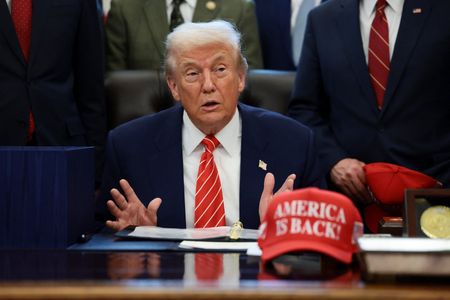

WASHINGTON – President Donald Trump has launched his most dangerous foreign policy venture yet with massive military strikes against Iran, a decision that could define his presidency while risking a wider Middle East war.
The president coordinated with Israel on Saturday to begin what the Pentagon calls “Operation Epic Fury,” offering minimal justification to Americans for what may become the largest U.S. military engagement since conflicts in Afghanistan and Iraq.
This marks a dramatic shift for Trump, who previously favored quick, targeted missions like last month’s rapid operation in Venezuela. Military experts now warn of a potentially lengthy conflict that could spiral into regional warfare across the oil-rich Middle East.
The president has established an ambitious goal of toppling Iran’s government in Tehran, believing aerial bombardments can spark civilian uprisings against the current leadership.
However, military history shows air power alone has never successfully achieved regime change without ground troops – an outcome most defense analysts believe unlikely to succeed now.
“Most Americans will wake up Saturday morning and wonder why we are at war with Iran, what is the goal, and why U.S. bases in the Middle East are under attack,” stated Daniel Shapiro, former Pentagon official and ex-U.S. ambassador to Israel, currently with the Atlantic Council think-tank in Washington.
Trump’s Iran obsession represents the clearest demonstration of how international affairs and military action have dominated his second-term priorities during the past 13 months, frequently overshadowing domestic concerns like living costs that polling indicates matter more to most Americans.
His advisors have privately pressed him for weeks to concentrate on voters’ financial concerns, recognizing the political risks before November’s midterm elections where Republicans could lose control of one or both congressional chambers.
Trump’s early-morning announcement on Truth Social explaining the Pentagon’s “Operation Epic Fury” offered only vague justifications for attacking a nation the U.S. has confronted for decades while avoiding full-scale war.
The president claimed he would eliminate Tehran’s ballistic missile capabilities – which defense experts say pose no direct U.S. threat – while providing Iranians opportunity to overthrow their government.
Trump declared American forces would destroy much of Iran’s military infrastructure and prevent nuclear weapons development. Iran maintains its nuclear program serves peaceful purposes only.
DIPLOMATIC EFFORTS ABANDONED
Trump’s sudden military action, utilizing massive U.S. forces assembled regionally in recent weeks, appears to eliminate immediate diplomatic possibilities with Iran. Thursday’s nuclear negotiations in Geneva failed to produce any progress.
Some administration officials previously suggested bombing campaigns might force Tehran back to negotiations for major concessions. Instead, Iran retaliated Saturday by firing missiles at U.S. ally Israel and Gulf Arab oil producers.
Trump’s video emphasis on urgent threats from Iran’s ballistic and nuclear programs resembles arguments President George W. Bush made for Iraq’s 2003 invasion, later proven based on incorrect intelligence and false information.
The president’s Tuesday State of the Union claim that Iran will soon possess missiles capable of reaching America lacks support from U.S. intelligence reports, according to sources familiar with assessments. Experts also dispute his administration’s recent assertions about Tehran’s ability to rapidly advance nuclear capabilities.
Saturday’s strikes removed any uncertainty that Trump seeks regime change in Tehran, following his January threats to attack Iran supporting street protesters facing violent suppression.
Analysts doubt Trump’s strategy can topple Iran’s established clerical government, which has survived crushing sanctions and repeated mass demonstrations, especially without deploying U.S. ground forces.
Initial strike waves primarily targeted Iranian leadership, according to informed sources. Supreme Leader Ayatollah Ali Khamenei had left Tehran before attacks and relocated to secure facilities, sources confirmed. However, several senior Revolutionary Guards commanders and political leaders were killed, an Iranian establishment source reported.
Even successful elimination of top officials could create unintended chaos across the 93-million-person nation or potentially establish military rule that might prove more hostile to Western interests and oppressive domestically, analysts warned.
“He wants to change the government,” explained Jon Alterman from the Center for Strategic and International Studies think-tank in Washington. “But it’s hard to change the government from the air. It’s hard to change the minds of Iranians through the air.”
Tyson Barker, former senior U.S. official now with the Atlantic Council, said Trump’s calls for Iranian popular uprising would likely fail.
“They’re really exposing these poor Iranian people by saying, ‘Stand up and overthrow your government. We got your back’,” Barker observed.
GROWING MILITARY APPETITE
Trump’s increasing willingness to use military force since beginning his second term led to briefings before Iran strikes that highlighted both risks of significant U.S. casualties and potential Middle East shifts favoring American interests, a U.S. official told Reuters.
The president appears encouraged by June’s bombing of Iran’s primary nuclear facilities, which he deemed highly successful, and January’s operation capturing Venezuelan President Nicolas Maduro, giving America substantial influence over that OPEC nation’s enormous oil reserves.
Trump may have committed himself to Iran action through repeated military threats while assembling naval forces he couldn’t maintain indefinitely in the region.
Military analysts consider Iran a more challenging, better-equipped opponent than Venezuela, despite air defenses and missile systems severely damaged in joint U.S.-Israeli June strikes.
“Iran is a more formidable military power, and even what the response is right now in the Gulf – they’re willing to cross lines that they weren’t willing to cross before,” said Nicole Grajewski with the Carnegie Endowment for International Peace.
However, Mark Dubowitz, CEO of the Foundation for the Defense of Democracies, a research institute considered pro-Israel and hawkish toward Iran, argued Tehran’s weakened condition justifies Trump’s risks to limit nuclear capabilities.
Whether Iran’s government survives or not, he suggested severely damaging Iran’s nuclear and missile programs could represent victory for Trump.