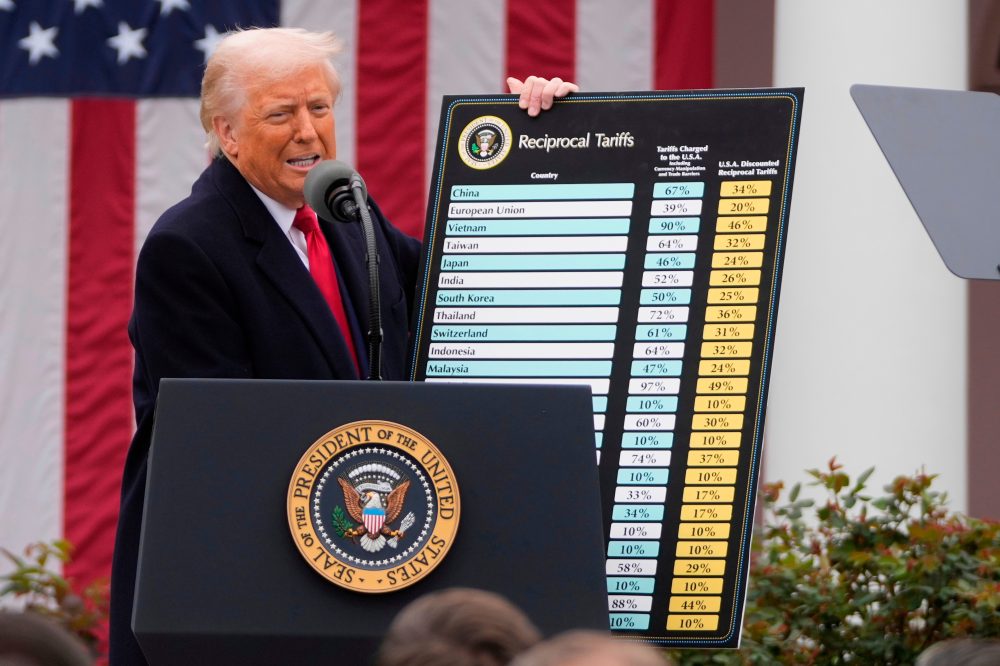

WASHINGTON — President Donald Trump signed three proclamations Monday placing 50% tariffs on the majority of goods coming into the United States from Canada, accusing the country of treating American autos, alcohol, and dairy products unfairly.
The decision threatens to trigger fresh economic turbulence, including the possibility of higher consumer prices and a deepening rift between the two neighboring countries. A senior administration official, speaking anonymously on a call with reporters ahead of the announcement, said Canada was among the very few nations — alongside China — that chose to retaliate against earlier Trump tariffs and must now face consequences.
Trump invoked Section 338 of the 1930 Trade Act to authorize the tariffs. It’s worth noting that several Democratic lawmakers proposed doing away with that provision last year, warning that it could be used to disrupt the broader economy.
While energy products, potash, fish, and critical minerals are carved out from the new tariffs, goods previously shielded under the United States-Mexico-Canada Agreement — known as the USMCA — will now be subject to the import taxes. That trade agreement, established in 2020, recently lapsed and has set off a fresh round of negotiations that could extend as far as 2036.
The administration official also revealed that Trump has directed his team to explore whether Canada’s wildfires — which have negatively impacted air quality in the United States — could justify additional tariffs on Canadian goods.
Just one day before the tariff announcement, Trump attended the World Cup final alongside Canadian Prime Minister Mark Carney, who has publicly pushed back against the U.S. president and has been working to diversify Canada’s trade partnerships. The administration official clarified that the two leaders’ time together at the sporting event was not intended as a working session on trade or tariff issues.
In the proclamations, Trump argues that Canada unfairly favors other countries over the United States when it comes to autos, alcohol, and cheese. However, much of Canada’s behavior that Trump cites as discriminatory was itself a direct response to tariffs the U.S. imposed on Canada under the justification that Canada needed to do more to curb fentanyl smuggling across the border.
On the auto front, Trump’s proclamation highlights that Canada began imposing a 25% tariff in April 2025 on American motor vehicles that did not qualify for preferential treatment under the USMCA.
Regarding alcohol, the proclamation points out that Canadian provinces and territories stopped purchasing and selling American alcoholic beverages last year — a retaliatory step taken in response to Trump’s tariffs and his repeated suggestions that Canada should become the 51st U.S. state.
On dairy, Trump has long taken issue with how Canada handles American cheese imports, arguing in his proclamation that Canada gives European dairy products more favorable treatment than those coming from the United States.