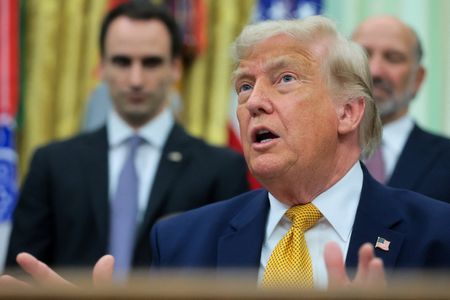

President Trump is heading to the U.S. Senate on Wednesday to personally push his fellow Republicans to pass a voting restrictions package that has repeatedly stalled — and exposed growing tensions within his own party.
Trump plans to attend a private lunch with Senate Republicans at the Capitol, where he intends to make his case for the SAVE America Act, which he has called his top legislative priority.
The measure would require voters to show a photo ID when casting ballots in federal elections and provide proof of U.S. citizenship when registering to vote. It would also require states to hand over their voter registration data to the federal government.
“We have to pass it, so we’re going to have a talk about that, and many other things,” Trump told reporters during a visit to Pennsylvania on Tuesday.
But the numbers remain a problem. Even though Republicans hold the Senate majority, they have already made five unsuccessful attempts to move the bill forward. The legislation has repeatedly fallen short of the chamber’s 60-vote requirement to advance, and attempts to work around that threshold have also failed to gain majority backing.
Republican senators have been blunt about where things stand.
“Those are just hard realities. And I think people at some point have to come to grips with that,” Senate Majority Leader John Thune said to reporters, in what may signal what GOP senators plan to tell Trump directly.
Presidential visits to Congress don’t happen often, and Wednesday’s meeting arrives at a particularly tense moment between Trump and Senate Republicans. With a November midterm election less than five months away — one that could cost Republicans their majority — senators have begun pushing back against the president on multiple fronts.
They forced him to drop a $1.8 billion “anti-weaponization” fund, voiced sharp criticism over his selection of a political ally with no intelligence background to lead the nation’s top intelligence agency, and backed legislation that would limit military action against Iran.
Senate Republicans have also refused Trump’s calls to use aggressive procedural tactics to advance the SAVE America Act — such as attaching it to must-pass spending bills or removing a Senate official who blocked it from a recent spending package. Trump has pushed unsuccessfully for Republicans to do away with longstanding Senate rules requiring 60 votes to move most legislation forward.
Supporters of the bill argue the effort shouldn’t be abandoned.
“For every bill up here, when it starts, there’s not enough votes,” said Republican Senator Rick Scott of Florida, a bill supporter who invited Trump to Wednesday’s meeting. “We’re going to have a nice conversation to see if we can figure out how to get this across the finish line.”
Democrats and other critics of the legislation argue that the bill is aimed at solving a problem — non-citizens voting — that barely exists, while risking the disenfranchisement of American citizens who don’t have easy access to documents like passports or birth certificates.
Some Republicans say the time spent on the bill could be better used elsewhere.
“Every minute we spend on it, we’re not spending on something that can get my colleagues reelected,” said Senator Thom Tillis, a Republican from North Carolina.