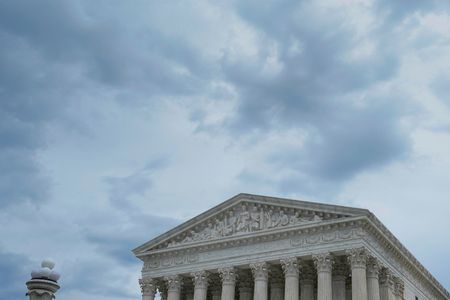

WASHINGTON — The U.S. Supreme Court is heading into the final stretch of its current term, with several landmark decisions still pending that will put Donald Trump’s aggressive push to expand presidential power to the test.
The court handed down five decisions on Tuesday, with additional rulings expected Thursday. The court’s annual terms typically run from early October through late June, occasionally extending into July. Justices have not yet announced an end date for this term or the start of their summer break.
As is customary, the court has saved many of its most significant decisions for the final days of the term. What stands out this year, however, is the sheer number of major unresolved cases — most of them centering on the boundaries of presidential authority and Trump’s particularly sweeping use of it.
Among the cases still awaiting rulings are Trump’s attempts to curtail birthright citizenship, remove Federal Reserve Governor Lisa Cook from her position, push out Democratic members of independent federal agencies, and end a humanitarian immigration program that shields hundreds of thousands of Syrian and Haitian immigrants from deportation.
University of Michigan constitutional law professor Sam Erman, a Supreme Court expert, noted the historic nature of the moment. “It’s totally normal for the most important cases of the term to come out in the last few days. What is unusual is that there are so many blockbuster cases,” he said.
Erman added that Trump’s unconventional use of executive power has generated a wave of significant legal questions. “We’ve seen a lot of novel uses of presidential power since Trump took office, and that’s produced some big questions about the nature of government and how presidential power works. So that’s produced a very active Supreme Court term, and a big bang at the end,” he said.
Since beginning his second term, Trump has aggressively tested the limits of presidential authority across domestic and foreign policy, sparking hundreds of legal challenges on multiple fronts.
The Supreme Court’s 6-3 conservative majority — which includes three justices Trump appointed during his first term — has largely been receptive to his positions, granting several emergency requests to allow his policies to move forward while lower court challenges work their way through the system.
Over time, the court’s conservative bloc has increasingly embraced the “unitary executive” theory, which holds that control over the entire executive branch of the federal government rests exclusively with the president.
That support, however, may not be unconditional. Legal observers who have followed the arguments predict Trump is more likely to prevail on his efforts to remove independent federal commission members than on his birthright citizenship order or the Cook firing.
“They have a view of a strong executive, but it’s not an unlimited executive,” Erman said of the conservative justices. “So when he is essentially advancing their project, he’s pretty likely to win.”
On birthright citizenship specifically, Erman suggested the court is unlikely to side with Trump. The president’s executive order — a central element of his hardline immigration agenda — would overturn a long-held interpretation of the 14th Amendment to the Constitution, which grants citizenship to anyone born on U.S. soil.
The court has already dealt Trump one notable setback, striking down in February the sweeping global tariffs he had imposed under a law intended for national emergencies. That decision drew a sharp public response from Trump, who criticized the court and personally attacked the justices who voted against him.
Beyond the Trump-related cases, the court also has several other significant decisions outstanding. These include cases touching on election rules, transgender rights, and state gun laws.
In one election-related case, Republicans in Mississippi are challenging a state law that permits mail-in ballots arriving up to five days after Election Day to be counted — a ruling that could have nationwide implications for voting procedures.
The court is also poised to rule on a Republican-backed effort, connected to a case involving Vice President JD Vance, to strike down federal limits on how much political parties can spend in coordination with their candidates, on free speech grounds.
Earlier this term, in April, the court’s conservative majority significantly weakened a key provision of the Voting Rights Act — a landmark 1965 civil rights law designed to prevent racial discrimination in elections. That decision triggered rapid redistricting efforts across Southern states to eliminate U.S. House districts where Black voters hold a majority or near-majority, as Republican-led legislatures moved quickly to capitalize on the ruling ahead of November’s midterm elections. Black voters have historically favored Democratic candidates.
The court is also considering cases from West Virginia and Idaho on whether state laws banning transgender athletes from competing on female sports teams should stand, as restrictions on transgender rights continue to intensify across the country.
On firearms, the justices are set to rule on a challenge — supported by Trump’s administration — to a Hawaii law that bars people from carrying handguns on privately owned properties open to the public, such as most businesses, without the property owner’s consent.
Just last week, the court unanimously rejected a stance taken by Trump’s administration that would have threatened the Second Amendment gun rights of millions of Americans who both use marijuana and own firearms.