
WASHINGTON — As President Donald Trump enters the fourth week of military action against Iran, he delivered cautiously optimistic news Monday about potential diplomatic progress, sparking market rallies while Iranian leadership strongly disputed his assertions.
Trump announced via social media before markets opened that he would postpone his weekend threat to strike Iran’s electrical infrastructure for five days, pushing back his Monday evening deadline for Tehran to reopen the Strait of Hormuz. The crucial shipping lane handles roughly 20% of global oil transport and has remained closed throughout the conflict, driving fuel costs higher worldwide.
The president explained his decision to delay attacks on Iran’s essential infrastructure stemmed from what he described as productive weekend discussions between his representatives — son-in-law Jared Kushner and Steve Witkoff — and unidentified Iranian officials he called “respected.”
Trump’s statement ignored Iran’s warning that critical Gulf region infrastructure, including energy production and water desalination plants necessary for drinking water supplies, would face “irreversible destruction” if he followed through on his bombing threats. These escalating threats had triggered significant sell-offs in Asian financial markets as Trump’s deadline approached.
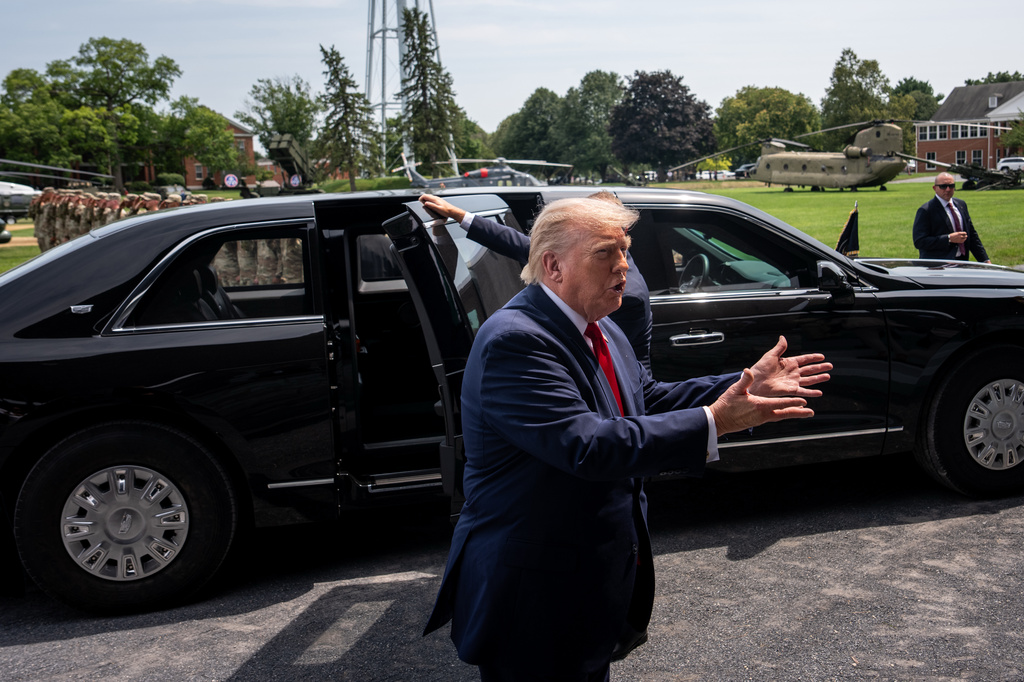
“All I’m saying is we are in the throes of a real possibility of making a deal,” Trump told reporters Monday morning before departing Florida for Memphis, Tennessee aboard Air Force One. “And I think, if I were a betting man I’d bet for it. But again, I’m not guaranteeing anything.”
Within two hours of Trump’s comments, before his aircraft reached Tennessee, Iranian officials flatly rejected claims of any diplomatic contact with Washington and characterized Trump’s remarks as market manipulation tactics.
“No negotiations have been held with the US,” Mohammad Bagher Qalibaf, Iran’s parliamentary speaker, wrote on X. “And fakenews is used to manipulate the financial and oil markets and escape the quagmire in which the US and Israel are trapped.”
Iran’s Foreign Ministry echoed similar sentiments, describing Trump’s announcement as merely an attempt “to reduce energy prices and to buy time for implementing his military plans.”
Regional experts note that ending the conflict now would mean Trump abandoning military action without fully accomplishing his declared mission objectives.
Throughout recent weeks, Trump has provided varying justifications for initiating the conflict while facing Democratic criticism for destabilizing the global economy, and polling data shows Americans remain split along partisan lines regarding the military engagement.
The president has established specific goals requiring achievement: weakening Iran’s missile capabilities, dismantling its defense manufacturing infrastructure, eliminating Iranian naval forces, preventing nuclear weapons development, and securing Strait of Hormuz shipping lanes.
Combined U.S. and Israeli airstrikes have advanced some objectives, though analysts question Trump’s ability to credibly claim complete success — especially regarding permanently eliminating Iran’s nuclear weapons potential.
Intelligence agencies and nuclear monitoring organizations estimate approximately 970 pounds of weapons-grade uranium remains buried under debris at three Iranian nuclear facilities severely damaged during June’s limited U.S. military operation in the 12-day Israel-Iran conflict.
Trump indicated Monday that retrieving Iran’s enriched uranium would be part of any potential agreement with the Islamic Republic, though he provided no implementation details beyond stating the U.S. military would “take it ourselves.”
“Trump’s war choice has not accomplished his military goals,” Aaron David Miller, former State Department Middle East negotiator and current Carnegie Endowment for International Peace senior fellow, posted on X. Miller observed that Iran retains the ability to attack regional allies and maintain Strait of Hormuz control. “No nukes; no enrichment, good luck with that. A singularly incompetent use of America’s power.”
Trump carefully avoided firm commitments Monday while highlighting positive energy market responses to his morning social media announcement about ongoing diplomatic discussions.
“The price of oil will drop like a rock, as soon as a deal is done. I guess it already is today,” Trump stated. “Now we have a very serious chance of making a deal. That doesn’t guarantee anything. I’m not guaranteeing anything. I’m not going to come out here in a week or two weeks, and have you all say, ‘Oh, you said…’ — I didn’t say anything.”
Last week, Trump authorized additional U.S. military deployments to the region as his administration considers options for securing Strait of Hormuz control to ensure safe oil tanker passage from Gulf nations to Asian markets.
The military moved three additional amphibious assault vessels and approximately 2,500 Marines to the Middle East last week, according to Associated Press and other news organizations. This deployment followed redirecting another amphibious group carrying 2,500 Marines from Pacific operations to Middle East assignments. These forces will supplement over 50,000 U.S. troops already stationed regionally.
While Trump has ruled out ground invasion plans for Iran, he maintains that all military options remain available. The incoming Marine reinforcements are expected to require several weeks to reach Middle East positions.
“We are witnessing how a conflict that began over politics and security is moving to be defined by energy and economics,” said Behnam Ben Taleblu, senior director at the Foundation for Defense of Democracies, a Washington-based policy organization. “It’s hard to ignore the logic inherent in the president’s own commentary, which both calms markets but also buys time for Marines to arrive.”