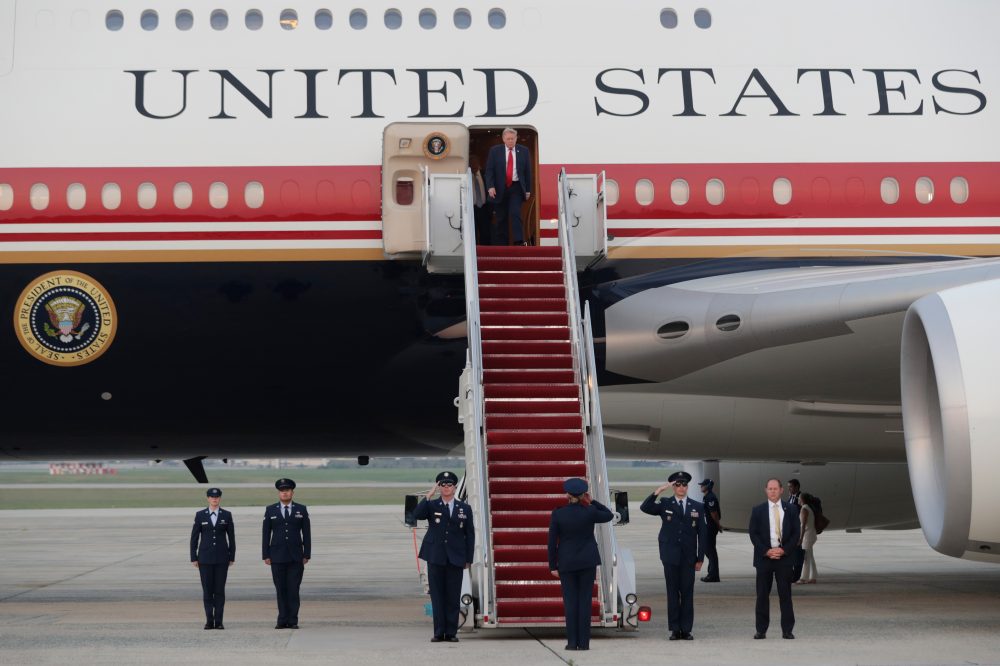

President Trump took to social media Monday claiming that Iran had requested a meeting with U.S. officials, set to take place Tuesday in Doha, Qatar. Iranian officials, however, pushed back, saying no such meeting was on the calendar.
The conflicting statements come at a critical moment, as Trump works to hold together an increasingly fragile interim deal with Iran while tensions have been building in the Strait of Hormuz. Rising hostilities in the waterway could push oil prices higher, potentially undermining Trump’s argument to American voters that inflation is under control.
On Monday, Trump celebrated the fact that U.S. oil futures were trading at around $69 a barrel, attributing the drop to the interim agreement with Iran. He also claimed that $69 a barrel represents a price lower than before the conflict began — a claim that is false. Oil futures were actually trading in the $65 to $66 range before the war started in late February.
Iran’s president, Masoud Pezeshkian, said Monday that Qatar would release $6 billion in frozen Iranian assets. The announcement appeared designed to help sell the Iranian public on the interim deal, even as Iran’s hold on the Strait of Hormuz has been challenged by efforts to open Oman’s territorial waters to commercial traffic. Iran’s actions had previously blocked cargo ships and tankers from moving through the strait, through which roughly one-fifth of the world’s traded oil and natural gas passed during peacetime, sparking a global energy crisis. Iran also launched drone and missile attacks targeting Bahrain and Kuwait on Sunday.
On a separate front, Trump has stirred controversy by suggesting that Syria — rather than Israel — should take on the Iran-backed militant group Hezbollah in Lebanon. Trump has proposed that the Islamist-led forces who overthrew Syria’s former autocratic leader and now govern the country would be more effective at rooting out Hezbollah than the Israeli military. Syrian President Ahmad al-Sharaa has flatly rejected the idea, saying he has no interest in such a conflict and that Trump’s remarks were misunderstood. Trump has continued to push the proposal despite the pushback. The suggestion has raised serious concerns in Lebanon and in Israel, which views al-Sharaa’s government with deep suspicion and has taken control of a portion of southern Syria since he came to power.
The Supreme Court is also in the spotlight this week as it prepares to wrap up a term heavily shaped by Trump’s broad assertions of presidential authority. Among the remaining cases are disputes over Trump’s efforts to restrict birthright citizenship, his push to fire the heads of independent federal agencies, and his attempt to remove a sitting Federal Reserve governor. The court is also weighing laws in roughly half the states that bar transgender girls and women from competing in public school and college sports. Two election-related cases and a dispute over cellphone location tracking by law enforcement are also pending decisions.
Elsewhere, a new poll from AP-NORC finds that Americans have grown less proud of their country’s history and democratic processes over the past decade. Pride in the U.S. military and its global political influence has declined since 2017. Much of the drop is driven by Democrats, who have become increasingly disillusioned since Trump’s first term in office. The poll also found that Republicans are far more likely than Democrats or independents to say being American is a central part of their personal identity, while younger adults are less likely than older Americans to feel that way.
In other news, the former House Speaker is partnering with the University of California, Berkeley, to launch a new nonpartisan academic institute aimed at strengthening democracy. The Democrat, who is leaving Congress after nearly 40 years representing San Francisco, said she wants to “strengthen our democratic institutions and forge a future that serves the public good.” The Nancy Pelosi Institute for Representative Democracy is set to launch in January and has already secured more than $35 million in philanthropic commitments. She plans to co-teach a course on Congress through the institute.
Also making news, tech journalist Kara Swisher — known for her candid interviews with major figures like Mark Zuckerberg and Elon Musk — is expanding her reach into political media. Her podcasts, including “On with Kara Swisher” and “Pivot,” are drawing growing audiences as political platforms. Swisher told The Associated Press from her Washington home that presidential candidates have been reaching out to her, and she plans to interview all of them.
Finally, Trump on Sunday toured several of his construction projects near the nation’s capital, later suggesting that his redevelopment of the East Potomac Golf Links could one day host major tournaments. “When completed, this Course will have the ability to host Major Golf Tournaments, including The U.S. Open, The Ryder Cup, The PGA Championship, and other top PGA Tour events,” Trump wrote on social media. He toured the course alongside Interior Secretary Doug Burgum, various aides, and golf course architect Tom Fazio and his son, Gavin Fazio. The redevelopment project is currently the subject of a federal lawsuit. Tournament locations are typically chosen years in advance — U.S. Open venues are already booked through 2051, with some openings in 2043, 2046, and 2048, while the PGA Championship is scheduled through 2035.