
BOGOTA, Colombia — Colombia’s deeply divided electorate handed conservative political newcomer Abelardo de la Espriella a razor-thin advantage in a presidential runoff Sunday, though the results face an imminent legal challenge from the opposing camp.
De la Espriella — a business owner and attorney who secured an endorsement from U.S. President Donald Trump despite never previously seeking elected office — captured 49.7% of the vote with 99.9% of ballots counted. His opponent, progressive lawmaker Iván Cepeda, an ally of outgoing President Gustavo Petro, received 48.7% support. Electoral authorities have not yet formally declared a winner.
Should de la Espriella prevail, his administration is expected to reverse many of Petro’s policies, including a controversial effort to conduct simultaneous peace talks with multiple illegal armed groups — an initiative that has largely fallen short. Cepeda had promised to continue that approach along with broader social reforms if he had won Sunday’s vote.
The campaign unfolded against a backdrop of widespread public anxiety over the possibility of renewed internal conflict in the country.
Addressing thousands of supporters from behind bulletproof glass in the northern city of Barranquilla on Sunday night, de la Espriella — known by the nickname “The Tiger” — opened with a unifying message before shifting to a more combative tone.
“I will govern for all Colombians,” he said, before adding: “Pack your bags and prepare to exercise the opposition. Make no mistake, Mr. Cepeda. You already know how fiercely the tiger roars.”
Speaking to his own supporters in Bogota after the results were tallied, Cepeda declared the vote count “unofficial and non-binding” and announced his campaign would contest results from more than 30,000 polling stations. It is worth noting that no presidential election recount in Colombian history has ever reversed an outcome. Petro also pledged to join the challenge.
“We will not allow … the rollback of the social gains we have achieved,” Cepeda said. “We will not allow democracy to be violated.”
The winner of Sunday’s election will begin a four-year presidential term on August 7.
The two candidates offered starkly contrasting visions for addressing the ongoing violence — including car bombings, kidnappings, forced disappearances, and mass displacements — that has plagued Colombia for decades.
De la Espriella, 47, advocated for a tough-on-crime stance, particularly regarding drug trafficking. He pledged to end Petro’s dialogue efforts with armed groups and proposed building large-scale prisons modeled after the aggressive security policies of Salvadoran President Nayib Bukele — measures that have reduced homicide rates in that country but have also drawn human rights criticism. De la Espriella holds both Colombian and U.S. citizenship and is a member of the Republican Party.
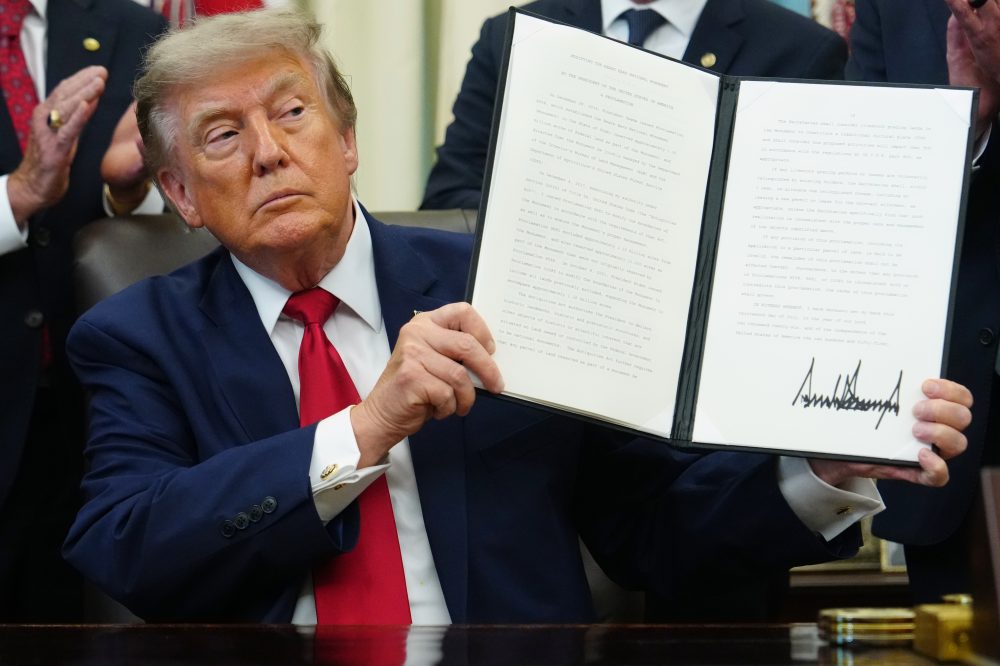
Trump weighed in on the results via his social media platform, writing: “He Won, BIG!”
Yolanda Hernández, a 49-year-old who earns her living recycling trash, said she voted for Petro in 2022 but chose de la Espriella this time around. While she acknowledged that congressional gridlock prevented Petro from delivering on his promises to the poor, she said the country cannot afford another four years of his leadership.
“We want change in Colombia because it’s always the same violence, always the same thing,” Hernández said. “(Petro) said he was going to lower the cost of services, that he was going to lower the price of food, and everything is more expensive.”
Will Freeman, a fellow for Latin American Studies at the Council on Foreign Relations, said the close result indicates Colombia “has not shifted overwhelmingly or decisively” either against Petro’s agenda or in favor of de la Espriella’s outsider “iron fist showmanship.” Freeman also noted the outcome highlighted deep regional divisions within the country.
“It’s regional not just ideological polarization; or rather, the two overlapping,” Freeman said. “Ironically, de la Espriella’s iron-fist message performed best in the core of the country, not the periphery, which bears the brunt of Colombia’s violence.”
Colombia’s illegal armed groups currently number more than 27,000 members. Last year, authorities recorded 14,780 homicides — the highest total since at least 2015 — driven largely by clashes between those groups. Among those killed was conservative presidential candidate Miguel Uribe.