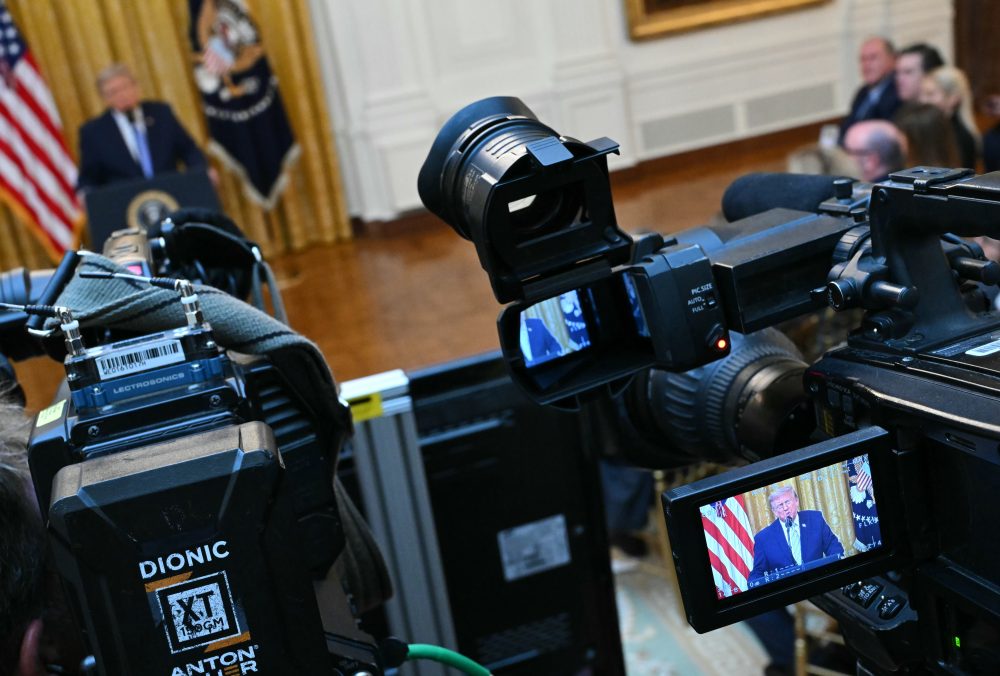

President Donald Trump announced Wednesday that he will indefinitely prolong the current ceasefire with Iran to provide more time for peace negotiations, though Iranian and Israeli acceptance of this extension remains uncertain.
In a social media post, Trump revealed that the United States had accepted a request from Pakistani mediators “to hold our Attack on the Country of Iran until such time as their leaders and representatives can come up with a unified proposal … and discussions are concluded, one way or the other.”
Pakistani officials have been facilitating peace negotiations in Islamabad aimed at ending the two-month conflict that has resulted in thousands of deaths and destabilized the world economy.
However, while announcing what seemed to be a one-sided ceasefire extension, Trump also indicated he would maintain the U.S. Navy’s maritime blockade of Iranian trade routes, which Iran considers an act of aggression.
Iranian officials had not responded to Trump’s statement by early Wednesday, though initial reactions from Tehran appeared skeptical of the announcement.
The Tasnim News Agency, which has ties to the Islamic Revolutionary Guards Corps, reported that Iran had not requested any ceasefire extension and reiterated threats to forcibly break the American blockade. An advisor to Iran’s chief negotiator, parliament speaker Mohammad Baqer Qalibaf, dismissed Trump’s announcement as potentially meaningless and possibly deceptive.
Trump’s wartime statements have fluctuated dramatically. Just two weeks prior, he made an expletive-laden threat against Iran, warning that a “whole civilization will die tonight,” while at other moments he has seemed eager to halt the violence and economic instability.
With this latest announcement, Trump once again stepped back from his threats to target Iran’s power infrastructure and transportation networks. UN Secretary General António Guterres and other international leaders have criticized such threats, pointing out that international humanitarian law prohibits attacks on civilian targets and infrastructure.
The conflict began February 28 when the United States and Israel launched airstrikes against Iran. The fighting rapidly expanded to include Gulf nations hosting American military installations and Lebanon after the Iran-backed militant organization Hezbollah entered the war.
Israeli Prime Minister Benjamin Netanyahu has spent decades working to remove Iran’s current government, but Trump has provided inconsistent and sometimes conflicting explanations for America’s participation in the war and his vision for its conclusion, creating uncertainty in international markets.
The regional conflict has claimed more than 3,000 civilian lives and displaced hundreds of thousands, primarily in Iran and Lebanon. The war has effectively shut down the Strait of Hormuz, a crucial passage for global energy transport between Iran and Oman, causing oil prices to spike and raising concerns about a potential worldwide economic downturn.
Iran has repeatedly used its control over ship traffic in the strait as leverage against American and Israeli military actions.
In his statement, Trump said he was prepared to extend the ceasefire because “the Government of Iran is seriously fractured, not unexpectedly so,” referring to U.S.-Israeli targeted killings of Iranian leaders during the war’s early weeks, including former Supreme Leader Ayatollah Ali Khamenei, who has been replaced by his son.
Hours before his announcement, Trump had told CNBC that he was reluctant to continue the temporary truce and that American forces were “raring to go.”
These remarks came as the tentatively planned peace discussions in Islamabad appeared close to collapse. U.S. Vice President JD Vance, whose attendance Iran had requested, was scheduled to return to Pakistan on Tuesday.
Prior to Trump’s latest statement, a senior Iranian official told Reuters that Iran’s negotiators were prepared to participate in additional talks if the United States abandoned its strategy of pressure and intimidation, and rejected negotiations designed to force surrender.
Iran has denounced the U.S. Navy’s interception and seizure of two Iranian commercial vessels as part of its blockade, including the second ship taken on Tuesday. Iran’s foreign ministry accused America of “piracy at sea and state terrorism.” The United States, supported by several other nations, has criticized Iran for restricting navigation freedom in the Strait of Hormuz.
Initial peace talks held 10 days ago failed to produce any agreements, with much attention focused on Iran’s reserves of highly enriched uranium.
Trump seeks to remove the uranium from Iran to prevent the country from further enriching it to weapons-grade levels. Iran maintains that its nuclear program serves only peaceful civilian purposes and asserts its sovereign right to continue such activities as a signatory to the nuclear non-proliferation treaty.