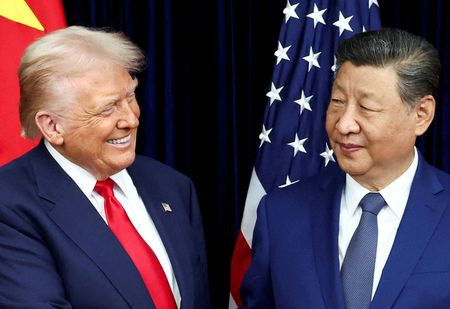

President Donald Trump will travel to Beijing next week for a pivotal meeting with Chinese President Xi Jinping, marking the first visit by an American leader to China in nearly ten years. The May 14-15 summit comes as both nations work to manage growing tensions over trade disputes, Taiwan, and the ongoing Iran conflict.
Business leaders and policy experts aren’t anticipating major diplomatic breakthroughs during the visit, though smaller agreements like extending the October trade agreement could emerge from the discussions.
TRADE NEGOTIATIONS TAKE CENTER STAGE
With November’s midterm elections approaching, Trump is expected to push for significant trade concessions from Beijing. Both nations are developing a Board of Trade framework designed to identify products that could increase bilateral trade while protecting national security interests and supply chains.
Under consideration are Chinese purchases of American poultry, beef, and various non-soybean agricultural products, along with a commitment to buy 25 million metric tons of soybeans annually for the next three years. Washington also seeks Chinese investment in Boeing aircraft, coal, oil, and natural gas.
A major Boeing deal has been under negotiation for years, with industry insiders suggesting it could involve 500 737 MAX aircraft plus multiple wide-body planes. According to Dennis Wilder, a former CIA China analyst now at Georgetown University, the agreement has been delayed due to Trump’s threats to restrict critical engine parts exports to China.
TECHNOLOGY AND RARE EARTH DISPUTES
China wants the United States to relax restrictions on advanced semiconductor exports and has expressed concerns about legislation that would limit critical chip manufacturing equipment access. Conversely, the U.S. is demanding China allow rare earth and critical mineral shipments to American companies, as Chinese export controls have significantly disrupted U.S. automotive and aerospace production.
Both countries have recently implemented new economic pressure tactics ahead of the talks. In March, Washington launched investigations into alleged Chinese industrial overcapacity and forced labor practices. The Treasury Department sanctioned a Chinese refinery in April for purchasing Iranian oil and warned of secondary sanctions on Chinese banks facilitating such transactions.
China has responded with legal countermeasures. Premier Li Qiang approved new regulations in April giving authorities broad powers to investigate foreign companies, governments, and individuals attempting to relocate supply chains away from China. These rules could also serve as retaliation against Western sanctions on Chinese businesses abroad.
IRAN CONFLICT DISCUSSIONS
Treasury Secretary Scott Bessent confirmed the presidents will address the Iran war, calling on China to “join us in this international operation” to ensure the Strait of Hormuz remains open for global shipping.
Beijing considers the conflict Washington’s responsibility to resolve, though the war threatens China’s energy supplies and could damage relationships with Gulf nations. While China worked quietly to facilitate Iran-U.S. peace talks in Pakistan last month, experts believe Beijing won’t appear to be following Trump’s directives.
Iranian Foreign Minister Abbas Araqchi visited Beijing this week, briefing Chinese counterpart Wang Yi on the U.S. discussions.
TAIWAN REMAINS FLASHPOINT
During a recent conversation with Secretary of State Marco Rubio, Wang emphasized Taiwan’s critical importance to China, calling the democratically governed island “the biggest point of risk” in bilateral relations. Wang stated the U.S. should “keep its promises and make the right choices in order to open up new space for China-U.S. cooperation.”
China maintains territorial claims over Taiwan and hasn’t ruled out military force to achieve control. Taiwan firmly rejects these claims, asserting only its people can determine the island’s future.
Sources familiar with summit preparations indicate Beijing has privately urged the Trump administration to modify U.S. language regarding Taiwan independence, similar to requests Xi made to former President Joe Biden during their 2024 meeting.
At that summit, Xi requested Biden change the U.S. position to state “we oppose Taiwan independence” instead of the current phrasing that America “does not support” Taiwan independence.
Even minor changes in American language could influence Beijing’s perception of U.S. commitment to supporting Taiwan and raise new concerns about Washington’s security guarantees throughout Asia.