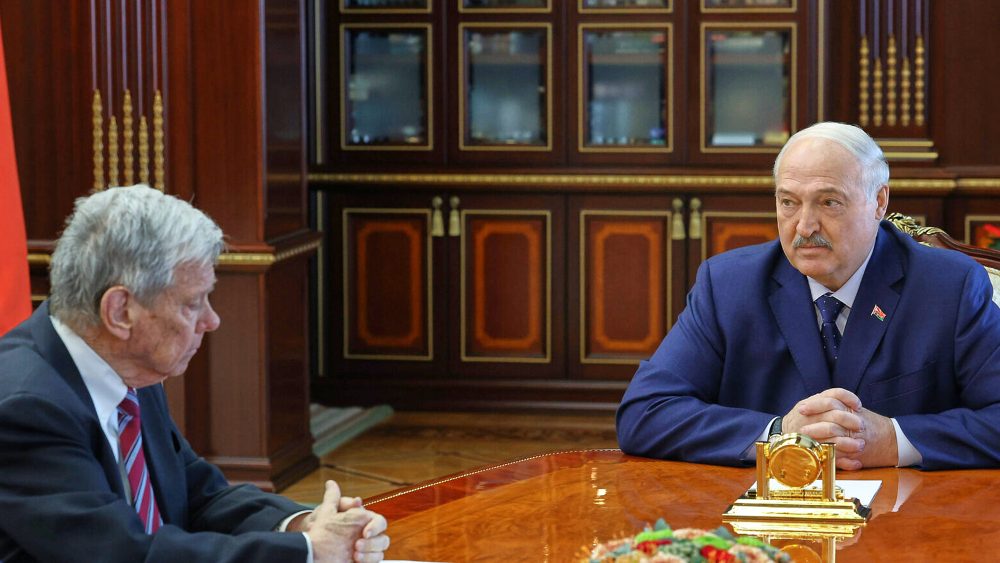

WASHINGTON — The White House announced Thursday it has relaxed penalties against several Belarus-connected financial institutions and fertilizer producers, marking another step toward warmer relations between Washington and the Eastern European nation’s authoritarian president, Alexander Lukashenko.
American farmers are facing severe fertilizer shortages as the conflict with Iran has virtually halted nitrogen fertilizer exports from the Persian Gulf region, cutting off access to essential agricultural inputs. Rising fertilizer prices have made it impossible for some agricultural producers to secure needed supplies at any cost.
During a Cabinet session Thursday, President Donald Trump announced his administration will introduce multiple measures “to support American farmers” while continuing military operations in the Middle East.
Last month, Lukashenko held discussions with Trump’s Belarus special representative, John Coale, in the Belarusian capital of Minsk. As part of an agreement with Washington to reduce certain American penalties, the Belarusian leader authorized the freedom of 250 political detainees.
Following those talks, Coale informed the media that America would eliminate sanctions targeting two state-owned Belarusian banks and the country’s Finance Ministry, while also removing major Belarusian potash manufacturers from the penalties list.
Prior to the White House announcement, the Treasury Department’s Office of Foreign Assets Control released a general authorization permitting specific business dealings with entities that were previously prohibited from conducting commerce with American companies under Belarus-related sanctions.
The sanctions relief applies to the Belarussian Bank of Development and Reconstruction and Belinvest-Engineering. The penalties were also removed from fertilizer producers Belaruskali, Belarusian Potash Company and Agrorozkvit.
According to an official statement, the office concluded alongside the State Department “that circumstances no longer warrant the prohibitions.”
However, the decision does not release any frozen company assets, and additional sanctions continue to remain active.