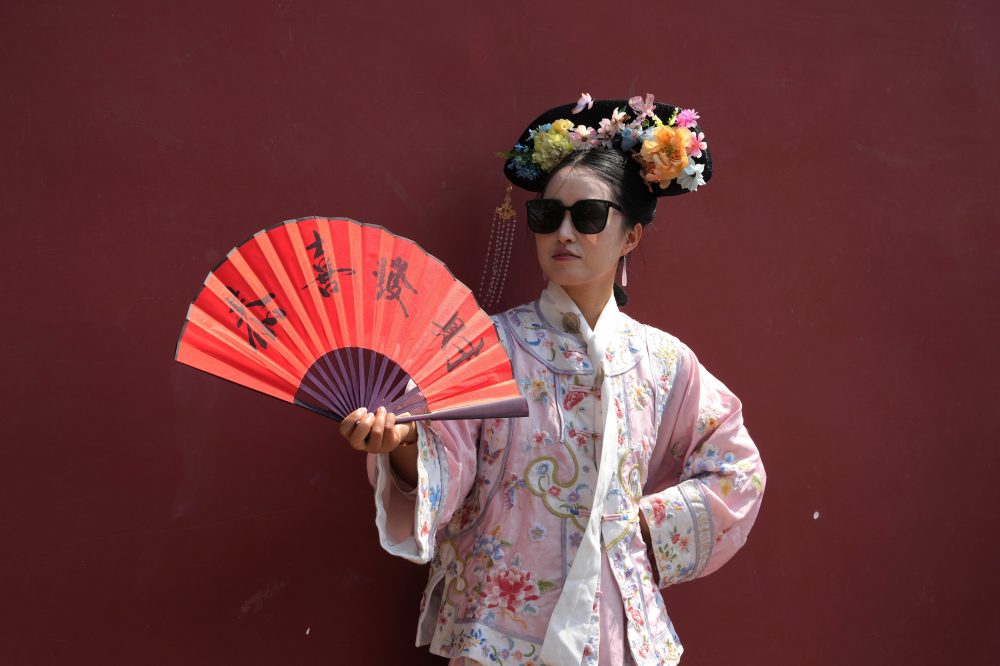

Chen Jiao works in an unusual profession: she helps tourists transform themselves into ancient Chinese royalty as part of a growing cultural revival among young people.
She’s among hundreds of styling professionals operating near Beijing’s Forbidden City, the former palace complex that housed rulers from China’s final two imperial dynasties, the Ming and Qing periods.
Daily, customers visit to don elaborate robes featuring phoenix embroidery and accessorize with jade jewelry, pearl ornaments, and golden nail protectors reminiscent of imperial court fashion. Artists carefully apply period makeup while arranging hair with decorative pins and tassels.
Typical sessions cost 300 yuan ($45), while premium packages can reach over 1,000 yuan (exceeding $150).
After their makeovers, clients head to the ancient fortress walls and surrounding waterways for photo shoots, sharing images across social platforms. The experience blends historical elements with contemporary touches, as some participants wear athletic shoes and designer eyewear while sipping modern beverages.
“Peak periods bring tremendous crowds, particularly during national holidays and weekend days,” Chen said.
During a recent busy period, she started her workday at 6 a.m. and completed styling for approximately 24 young women. The industry experiences steady demand year-round, with only brief slowdowns when the historic site closes, she explained.
This immersive historical fashion experience has gained momentum among youth in recent years, with Beijing’s offerings drawing primarily from the nation’s two most recent dynasties.
The Ming period lasted over 270 years before ending in 1644, during which the Forbidden City was constructed and the Great Wall was strengthened. The subsequent Qing dynasty, led by Manchu rulers, fell in 1912, concluding over 2,000 years of imperial governance.
Chen Xiao represents the tourists now flocking to Beijing’s heritage locations for these styling experiences. The university student journeyed overnight from Shandong province in eastern China during the recent Qingming festival period.
“I believe when visiting a particular place, your attire should complement the environment,” Chen said while wearing rose-colored garments typical of a “Gege,” representing a Qing dynasty princess.
The facility housing Chen Jiao’s business demonstrates this industry’s explosive expansion. Approximately four years ago, only several costume studios operated in the building. Current estimates suggest more than 100 now function there, according to regional news sources.
“Young Chinese citizens are recognizing the beauty of ancestral dress while discovering their nation’s deep cultural legacy,” said Cai Zehong, who established Hanfu Beijing, among the first organizations created by enthusiasts to celebrate Han ethnic traditions and customs.
China’s enduring fascination with period television dramas has fueled this movement.
“I’ve viewed numerous historical television series,” Chen Xiao said. “Those programs have certainly shaped my interests. Recently, I’ve become particularly fascinated with Qing dynasty history.
Liu Ruitong, a college student visiting from Hebei province, selected dark-colored Ming-era clothing.
“This style appears very refined and stately, particularly in its color scheme. I selected black because it complements the Forbidden City beautifully and harmonizes with traditional Chinese landscapes overall,” Liu said.