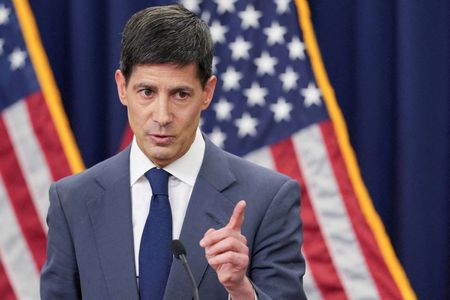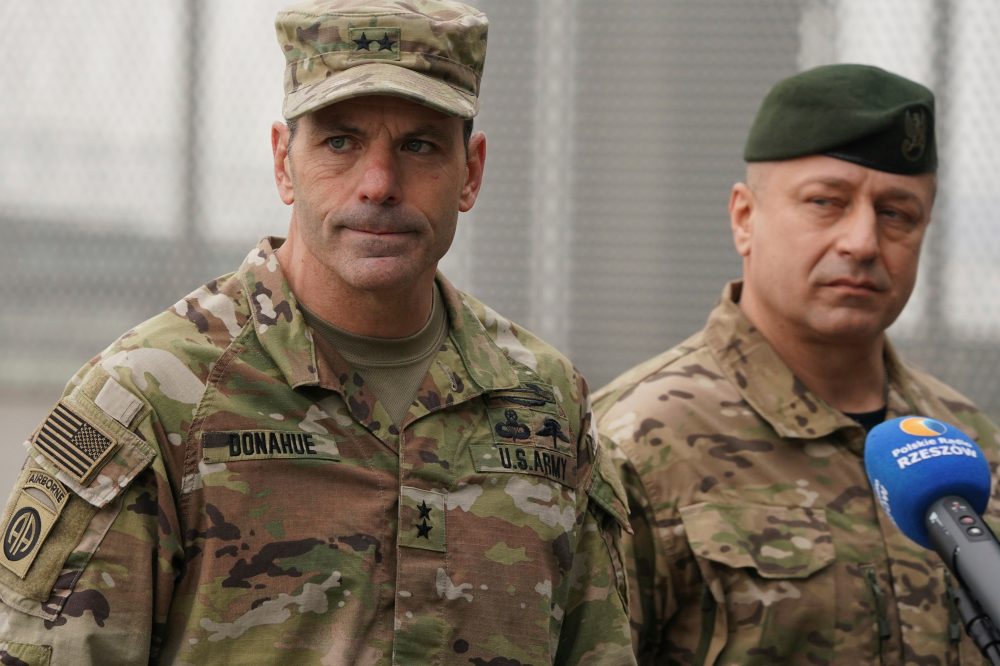

WASHINGTON — The Army general who made history as the final American soldier to walk off Afghan soil is now walking away from his current command under unexpected circumstances, the Army confirmed late Tuesday.
Gen. Christopher Donahue, who serves as the commanding general of U.S. Army Europe and Africa and also leads NATO’s Allied Land Command, will step down from his position on July 2, according to an Army statement provided to The Associated Press. He becomes the latest in a string of nearly two dozen senior military leaders who have either retired or left their roles ahead of schedule since Defense Secretary Pete Hegseth took charge, driven by his push to reduce the number of generals in favor of more frontline troops — a philosophy he has summed up as “less generals, more GIs.”
Until a permanent replacement is named, Donahue’s deputy, Maj. Gen. Christopher Norrie, will take over his responsibilities, the Army statement said.
Donahue is a graduate of West Point and spent his career in special operations, commanding Delta Force units in both Iraq and Afghanistan before taking charge of the 82nd Airborne Division from July 2020 through March 2022.
It was during that assignment that he oversaw security operations at Hamid Karzai International Airport amid the turbulent American withdrawal from Afghanistan in 2021. On August 30, 2021, Donahue stepped onto the final C-17 cargo aircraft departing the country, making him the last U.S. service member to leave after nearly two decades of war that began following the September 11, 2001 attacks. A now-iconic photograph captured through night vision equipment documented that historic moment.
Both Hegseth and President Donald Trump had repeatedly criticized the Afghanistan withdrawal — a pullout that originated from a deal the Trump administration itself negotiated with the Taliban during its first term — and made it a recurring political talking point. The Pentagon has since launched yet another review of the withdrawal, ordered by Hegseth last May, despite the fact that multiple prior investigations had already been conducted by the Pentagon, U.S. Central Command, the State Department, and Congress, involving hundreds of interviews and extensive review of photos, videos, and other data. What new information this latest review aims to uncover remains unclear.
Despite the political controversy surrounding the withdrawal, Donahue’s handling of the evacuation earned him praise from both sides of the political aisle. Within Army circles, he was widely regarded as someone with the potential to lead the entire service or even become chairman of the Joint Chiefs of Staff.
An Army official, speaking anonymously to discuss internal deliberations, told The Associated Press that Donahue’s exit is connected to ongoing talks about downgrading U.S. Army Europe and Africa from a four-star command to a three-star command.
That potential restructuring fits within a broader context of tensions between Hegseth and European allies. Just last week, Hegseth informed NATO partners that he would be conducting a six-month Pentagon review of American military forces stationed in Europe, saying it was “designed to ensure that NATO is moving fast and irreversibly toward Europe leading, stepping up to take primary responsibility for the defense of Europe.”
“It’s a review that some countries will fail and others will pass with flying colors,” Hegseth added.
The Pentagon had not issued a response to news of Donahue’s departure as of Tuesday evening. The story was first reported by The Atlantic.