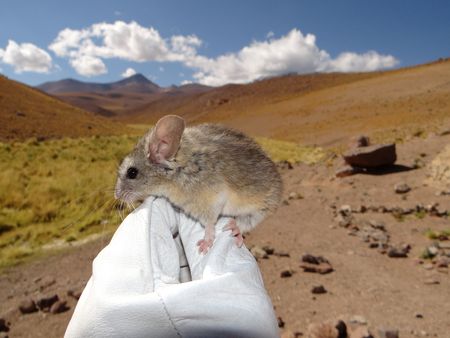

High on the peaks of Andean volcanoes, a small rodent with distinctive rounded, leaf-shaped ears is doing something no other mammal on Earth can match — thriving across a wider range of elevations than any other known mammal species.
The Andean leaf-eared mouse, which ranges from the desert coastline of northern Chile all the way up to the towering crests of the Andes mountain range along South America’s western edge, has developed a remarkable set of physical and genetic traits that allow it to survive in conditions that would be fatal to humans.
Jay Storz, an evolutionary biologist at the University of Nebraska who led the research — published in the journal Science — described just how extreme those conditions are. “On the summits of approximately 22,000 feet (6,700 meters) peaks where we have trapped these mice, there is less than half the oxygen that is available at sea level, and temperatures are almost always below freezing,” he said.
Storz put that into perspective for human comparison: “With proper acclimatization, a well-trained mountain climber can tolerate the lack of oxygen at such heights during a one-day summit attempt, but such elevations far exceed the limits of long-term human survival.”
To figure out how these mice manage to pull it off, researchers examined whole-genome data collected from 167 individual mice captured at various points along the species’ elevation range. What they found was that the animals have developed a highly efficient system for managing both energy and oxygen at the same time.
“When a mammal is challenged by extreme cold, it relies on metabolic heat production to maintain a constant body temperature. This … requires oxygen as fuel. Since there is less oxygen at high elevation, mammals that live in such environments make metabolic adjustments to use oxygen more economically,” Storz explained.
Mice captured at the highest elevations showed clear physical differences compared to those caught lower down. The high-altitude mice were better at maintaining their ability to generate body heat — something scientists call thermogenic capacity. Their skeletal muscles also showed a stronger ability to produce energy within mitochondria, the tiny structures inside cells responsible for generating power. Additionally, their brown fat — a type of tissue specifically designed to produce heat — was more efficient at burning fats, another trait that likely helps them stay warm in frigid, oxygen-thin air.
Perhaps the most surprising discovery involved what these mice eat. Researchers found genetic evidence suggesting the species has also adapted to handle toxic compounds found in the plants available at different elevations.
“The discovery that the mice have evolved the ability to metabolize dietary toxins was unexpected,” Storz said. “In the high-elevation environment … they can’t even get a decent meal — the only available food-plants are loaded with toxic secondary compounds. Things are tough all over.”
Guillermo D’Elía, a systematist and zoologist at the Universidad Austral de Chile and a co-author of the study, elaborated on that finding: “We identified signals of selection on genes involved in antioxidant defence and the metabolism of dietary toxins. … We know genes under selection are involved in those biological functions but cannot state adaptation to which particular toxin or plant.”
The research has implications that reach beyond the mountains. Storz noted that “high-elevation mammals have evolved the ability to survive and function under conditions of chronic oxygen deprivation that mimic disease states in humans.” He added that a deeper understanding of these biological mechanisms could help researchers develop better treatments for people living with cardiorespiratory diseases that reduce oxygen delivery even at normal altitudes.
Still, much remains unknown. D’Elía said the team now has a solid foundation of knowledge about the physiological and genetic factors at work, but acknowledged, “there’s much to learn.” Basic questions — such as what exactly the mice eat at extreme heights, how long they live, and whether they reproduce on the summits — remain unanswered.
Zachary Cheviron, a biologist at the University of Montana and another co-author of the study, pointed out that even the most desolate-looking mountain environments are far from lifeless, containing unique organisms still waiting to be studied and understood.
D’Elía said the broader lesson from this research is a reminder of how much about life on Earth remains a mystery — and why protecting the natural world matters.