
KHARTOUM, Sudan — A routine call from a husband became the last contact a Sudanese family would ever have. He had finished his duties and planned to visit the market on his way home. But this wasn’t an ordinary workday — he was coming back from battle.
Fahmy al-Fateh never returned home that day. His wife, Azaher Abdallah, began reaching out to friends, family members, and eventually his military unit colleagues. Witnesses last spotted her husband departing from a military facility in Khartoum on a motorcycle. That occurred more than 12 months ago.
Today, their young 3-year-old boy yells at every motorcycle that passes by, believing his father might be riding it, Abdallah explained.
“He was the most precious thing in my life,” she expressed through tears, covering her face with her palms. “I would feel more at peace if I knew something. It’s better than not knowing what happened to him, whether he’s alive or dead.”
Al-Fateh represents just one case among more than 8,000 individuals who have disappeared throughout Sudan’s three-year conflict, based on data from the International Committee of the Red Cross. The warfare has shattered families across the nation. Citizens have become separated during evacuation attempts, vanished amid combat operations, or been secretly imprisoned, leaving loved ones desperate for answers about their whereabouts.
Numerous missing persons from Khartoum state are believed to rest in unmarked burial sites where tens of thousands of remains have been discovered since Sudan’s army regained control of the capital from paramilitary forces last year.
During active fighting, burying bodies in traditional cemeteries proved extremely hazardous. Residents created graves wherever possible under the circumstances.
While traveling through the city last month, Associated Press journalists observed sports facilities and burial grounds filled beyond capacity with the deceased. Dirt piles next to an abandoned fuel station displayed improvised markers bearing names and dates, though many lacked any identification.
A military media representative accompanied the AP throughout the visit, including during interview sessions. The AP maintains complete editorial authority over its reporting.
The ICRC reported resolving more than 1,000 missing person cases but declined to specify how many individuals were found alive versus deceased.
Abdallah was asleep when her husband departed their home before dawn last January. Al-Fateh, a 38-year-old farmer and trader, had enlisted with Sudan’s army at the war’s onset. That morning, he was participating in efforts to reclaim Khartoum from the paramilitary Rapid Support Forces.
Since his disappearance, the 30-year-old Abdallah has searched throughout the city, checked hospital morgues, and requested military assistance. His unit promised to attempt locating him. If no news emerged, they advised, she should assume he was missing.
At their residence on Khartoum’s outskirts, she reviews photographs of him wearing his uniform, maintaining hope for his eventual return.
“That is what my heart tells me,” she stated.
Mental health experts explain that uncertainty regarding missing family members can trigger years of severe emotional distress.
“Families of missing persons experience additional layers of vulnerabilities due to hostilities, displacement and ambiguous loss,” explained Nathalie Nyamukeba, a psychologist with the ICRC.
Several Sudanese families report that continuing the search remains their only coping mechanism.
Sulafa Mustafa’s son disappeared two years ago. The reserved 18-year-old Suleiman Abdalsid visited a friend’s residence near Khartoum and failed to return home.
His mother persistently traveled through neighborhoods, even while artillery sounds echoed nearby, conducting house-to-house inquiries. She has checked medical facilities and detention centers, showing his photograph to countless strangers.
She has even used a rented microphone to call out his name.
“I haven’t lost faith in finding you,” she declared, then covered her face with her hands.
Locating people dead or alive remains extremely difficult in Sudan, particularly as the conflict continues. Laboratories that could have conducted DNA analysis have been destroyed, and few forensic experts remain in the country.
In Khartoum state, officials have relocated nearly 30,000 bodies — from approximately 50,000 total — that had been quickly buried near residences, in athletic fields, or alongside roads when the RSF controlled the territory. Their efforts are ongoing.
Roughly 10% of relocated bodies remain unidentified.
Hisham Zienalabdien, director general of the forensic medicine department for Khartoum state, explained they are preserving DNA from unidentified remains with hopes of eventually matching it with family members.
For families who have located loved ones but cannot provide proper burials, a different type of anguish exists.
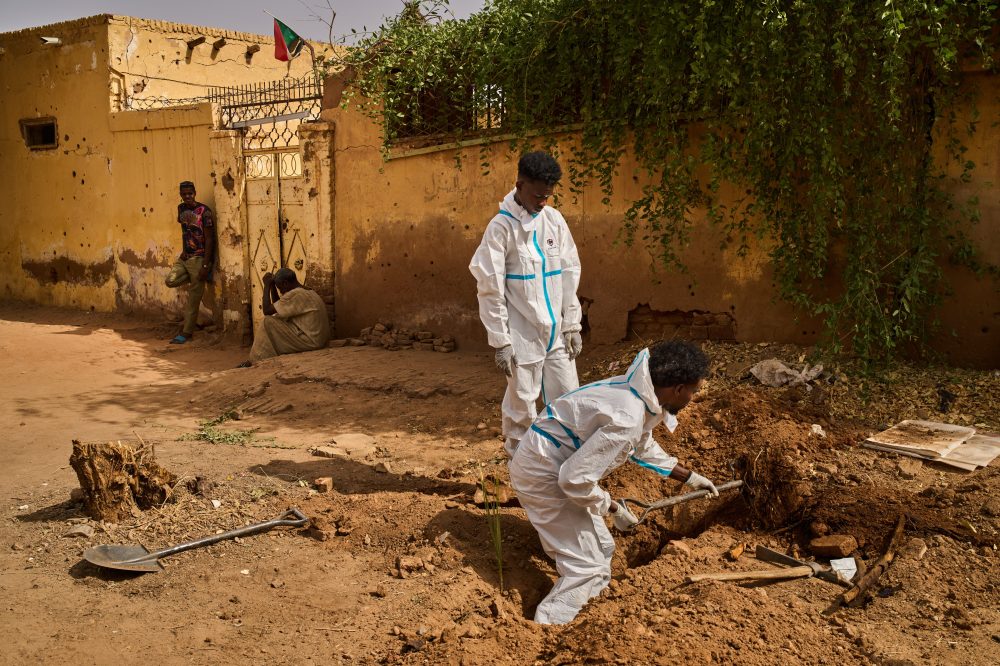
Abubakar Alswai waited over a year to transfer his 73-year-old brother, Mohamed, from where he had been interred in front of his residence to a public cemetery.
The RSF had killed Mohamed but waited three weeks before allowing a neighbor to bury his bullet-struck and decomposing body. According to Islamic customs, widely practiced in Sudan, funeral services should occur as rapidly as possible, preferably within 24 hours.
Alswai wiped tears from his face while watching grave diggers exhume his brother’s remains. At least Mohamed would now receive the respectful burial he deserved, he said, and his family could find some closure.
“What happened had left a mark on my heart,” he said.