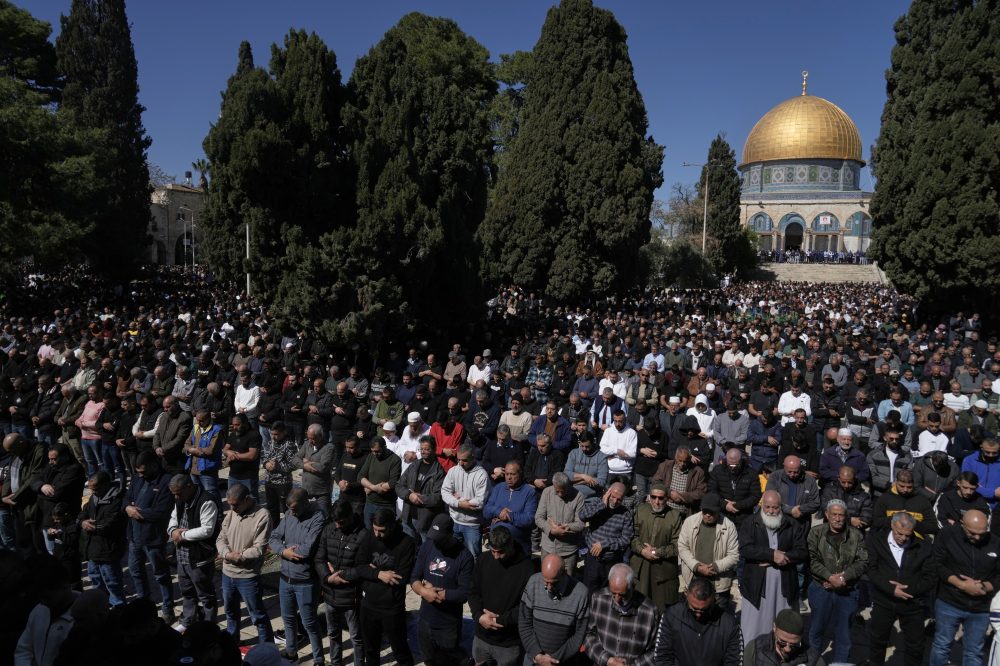

Massive crowds of Muslim worshippers converged on Jerusalem’s Al-Aqsa Mosque compound Friday for the opening Friday prayers of Ramadan, marking the first such gathering since the fragile ceasefire between Israel and Hamas took effect in October.
The historic religious site welcomed tens of thousands of faithful, including Palestinians who traveled from the West Bank under tight security measures. For many, this represented their first chance to worship at the Jerusalem Old City location since Ramadan a year ago.
Israeli authorities implemented strict limitations, permitting only 10,000 Palestinians from the West Bank to enter Israel on Friday. Access was restricted to men aged 55 and older, women over 50, and children under 12 – similar age-based restrictions previously imposed for security reasons.
The compound holds profound significance for both faiths: Jews revere it as the Temple Mount, Judaism’s most sacred location and site of the ancient biblical temples, while Muslims know it as the Noble Sanctuary, housing the Al-Aqsa Mosque, Islam’s third-holiest site.
This religiously significant area has repeatedly become a source of tension in the ongoing Israeli-Palestinian conflict.
More than 3,000 Israeli police officers were stationed throughout Jerusalem, according to authorities who emphasized their deployment was designed for emergency assistance rather than intimidation.
The Jerusalem Islamic Waqf, Jordan’s religious authority overseeing the compound, reported 80,000 attendees. During typical years, Ramadan Friday prayers at Al-Aqsa can attract as many as 200,000 worshippers.
West Bank Palestinian Ezaldeen Mustafah expressed disappointment with the attendance limitations. “We need more people than this,” Mustafah said.
Many Palestinian worshippers described how the month’s usual celebratory atmosphere feels diminished as they cope with sorrow and devastation from the two-year Gaza conflict.
Gaza resident Ramiz Firwana, participating in Friday prayers held in a schoolyard, reflected on the destruction. “Previously, there were mosques, but today all the mosques have been bombed,” Firwana said.
Thursday evening saw families breaking their fast with Iftar meals surrounded by debris and ruins.
Mohammad Kollab from Khan Younis expressed resilience despite the circumstances. “Despite the displacement, the pain, and the destruction, we want to rejoice and live,” he said. “We are a people who want to live, we are not a people destined only for destruction and killing.”
Gaza’s Health Ministry reports Israel’s military campaign has resulted in over 72,000 Palestinian deaths, along with extensive destruction that has displaced most residents. Israel initiated this offensive following the October 7, 2023 Hamas-led attack that killed approximately 1,200 people, primarily civilians, and resulted in 251 hostages.
The U.S.-mediated ceasefire agreement from October 10 sought to end more than two years of warfare between Israel and Hamas. Although major combat operations have decreased, the ceasefire period has witnessed nearly daily Israeli military actions.