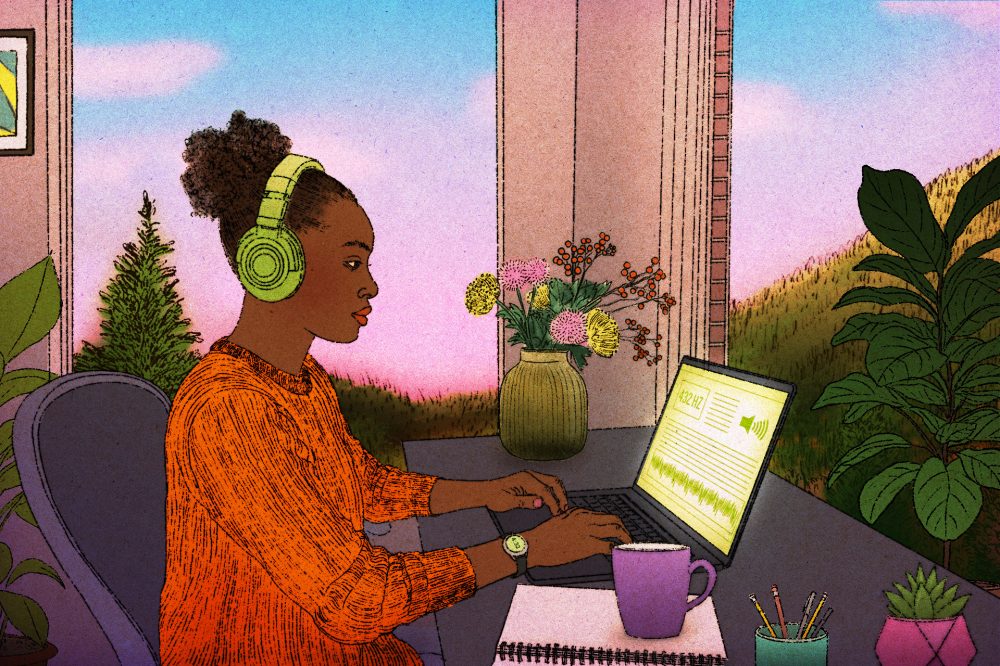

Yoselin Sanchez has lived with constant pain from cervical scoliosis since birth. Though few things provide relief from her discomfort, she’s discovered methods to take her mind off the pain.
Her routine includes yoga and free flow dance. During work hours, she often plays house music set to 432 hertz, a frequency that’s lower than standard concert tuning.
“Music is medicine. Sound is medicine,” explained Sanchez, who works in telehealth services for a California healthcare management organization. “It helps me focus and be engaged with the patient I’m assisting, and it also helps me relax.”
Songs recorded at 432 hertz (cycles per second) are gaining popularity across social media and streaming platforms, where listeners can discover growing collections of tracks and playlists featuring this alternative tuning. The selection ranges from meditation soundscapes to reggae tracks by Ziggy Marley.
Supporters claim 432 hertz connects with the natural world. Some attribute healing qualities to this frequency or believe it can lower blood pressure. However, solid scientific research hasn’t validated these assertions.
“There are frequencies going on right now that are higher than what we can hear and lower than what can hear. And they’re not special because they’re one of the billions and billions of frequencies that we’re receiving right now,” explained Susan Rogers, a professor emeritus at Berklee College of Music who served as Prince’s sound engineer in the 1980s. “To set one aside and say that it is the frequency of the universe is, as far as the science community is concerned, nonsense.”
For Sanchez, whether the pain relief and emotional benefits she connects to 432 hertz music have scientific backing doesn’t matter.
“When it comes to music, it could activate different feelings in people, the vibrations of it. It’s not like a one-size-fits-all,” she explained.
Across musical history, when people performed together, they matched their instruments to the same pitch for harmonious sound. Vocalists and instrumentalists typically selected a musical note — usually the A above middle C on a piano — as their reference point.
The “432 Hz” music style gets its name from its tuning method, where the A above middle C gets adjusted to vibrate at 432 hertz rather than the conventional 440 hertz. This lower frequency is audible, creating slightly deeper notes. Some listeners believe this adjustment creates a warmer, more balanced sound that connects with human physiology and nature.
Most orchestras and performers today tune to 440 hertz. However, this wasn’t historically standard.
Before the 19th century, musicians tuned according to regional practices that differed between countries, noted Fanny Gribenski, a music historian at New York University. “For most of music history, people are just singing within their own vocal range,” she added.
Over time, orchestras and ensembles began tuning to higher frequencies, causing some composers to worry that singers wouldn’t be able to perform historical pieces, Gribenski explained.
“The idea that it should be mainly a lower frequency than the ones that were in use at the time is really the cultural concern for protecting music from the past, protecting the voices of singers,” she said.
Meanwhile, as global travel expanded, the need for universal tuning standards increased. In 1939, delegates from several European nations and the U.S. established 440 hertz as the worldwide standard.
Musicians kept experimenting with pitch in subsequent decades. During the 1980s and ’90s, sound engineers would sometimes accelerate or decelerate recorded tracks to create brighter or slower sounds, departing from 440 hertz, Rogers noted.
However, Rogers questions whether retuning entire bands or orchestras to 432 hertz would enhance their sound, since contemporary instruments were built to sound optimal at 440 hertz.
“Some of those instruments might sound a little sweeter, but it’s likely that most won’t,” she said.
Higher pitch typically creates more brilliance or additional power in certain instruments, Gribenski noted. For listeners who prefer lower 432 hertz music, “I wonder if there is a sense of deceleration, slowing down slightly, and also taking one step down from the bright sounds of modernity,” she said.
People who work with 432 hertz soundtracks give various explanations for their preference.
Amelia Beamer, who manages marketing at Andrews Apothecary, the North Carolina pharmacy her parents operate, believes taking work breaks to hear 432 hertz music helps manage her attention deficit hyperactivity disorder. She’s observed improved focus when she listens before beginning projects.
Beamer follows a pattern of working 25 minutes, taking five-minute listening breaks, then returning to her tasks. She also explores other frequencies, including 528 hertz music.
“It definitely helps me feel more grounded and more centered,” Beamer said about 432 hertz music. “It helps me slow down and to take some intentional space and time for myself.”
Diana Wolf Torres, who produces videos and writes a newsletter about robots, regularly experiences migraines and has noise sensitivity. When a neighbor’s gardener operates a leaf blower, she struggles to block it out. Playing 432 hertz music or sounds like white noise through noise-canceling headphones provides relief.
“I just want to be there and get it done and feel like I’m doing my best writing possible, and anything that keeps me in the zone is a fantastic tool,” Torres said.
Torres doesn’t believe there’s scientific basis or unique properties in 432 hertz music but thinks “maybe some people find this lower tuning more soothing.” She pointed out that most people can’t verify if music marked as 432 hertz on social platforms is correctly labeled.
“What does it matter? If you’re getting an effect, are you really going to check the resonance? Do you care?” Torres asked.
Sanchez, the telehealth professional, also enjoys music set to other alternative frequencies, including 528 hertz and 963 hertz.
“It’s something worth exploring and finding out for yourself whether it has any benefits or not,” Sanchez said. “For me, I find that grounding is beneficial to my overall wellbeing, so I see how it helps my livelihood.”