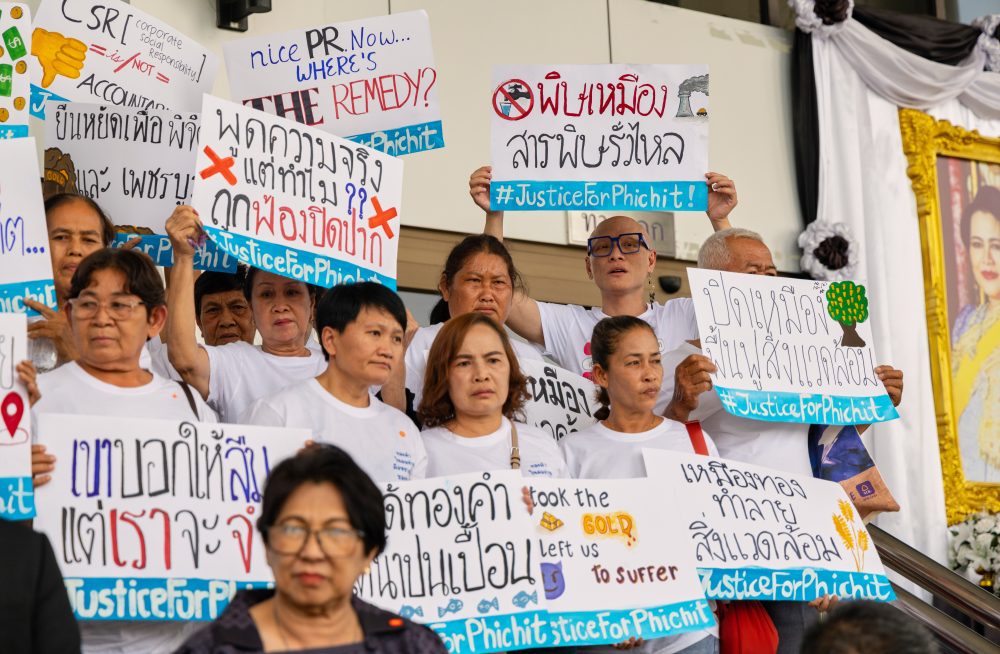

A Bangkok court delivered a significant victory for environmental justice Tuesday, determining that an Australian-owned mining company must pay damages to hundreds of Thai villagers who suffered health consequences from toxic pollution.
The legal battle began in 2016 when more than 300 residents of Phichit province filed Thailand’s first environmental class action lawsuit against Akara Resources, which operates the Chatree Gold Mine — the nation’s largest gold extraction facility owned by Australia-based Kingsgate Consolidated.
According to the Bangkok Civil Court’s decision, the mining company could not demonstrate that dangerous contamination found in the community was unconnected to their operations. Medical examinations revealed dangerous concentrations of heavy metals in residents’ blood, including arsenic, cyanide and manganese.
“The fight is also for our future generation,” plaintiff Thanyalak Boontham stated following the court proceedings. “I’d like them to be able to grow up in a good environment.” Her own medical tests showed toxin levels above safe thresholds.
The court ordered individual compensation payments between 50,000 baht ($1,535) and 200,000 baht ($6,143) per affected person, along with additional funds for medical expenses and emotional suffering.
Emilie Palamy Pradichit from the Bangkok-based Manushya Foundation, which supported the villagers throughout their legal challenge, emphasized the broader implications. The outcome could determine whether communities see the judicial system as “a pathway or a dead end,” she explained.
Legal experts believe this verdict establishes important groundwork for environmental accountability across Southeast Asia. Jameela Joy Reyes from the Grantham Research Institute on Climate Change and the Environment described the decision as a “clarion call for many of the cases that are currently taking place” in nations like the Philippines and Indonesia.
Even when court precedents aren’t legally binding across borders, judges frequently reference similar cases from other countries, particularly in emerging legal areas such as climate litigation, Reyes noted.
The mining controversy involved multiple legal proceedings, several health studies, and a counter-lawsuit. Former Prime Minister Prayuth Chan-ocha eventually used emergency military government authority to halt the mine’s operations, prompting Kingsgate to sue the Thai government in 2017 for improper license cancellation. The parties resolved that dispute through a settlement agreement last year.
Cherdsak Utha-aroon, Akara Resources’ sustainability general manager who attended the hearing, told reporters the company acknowledges the court’s determination and will consult with legal counsel about potential next steps. He declined additional commentary.
Environmental law specialist Georgina Lloyd with the United Nations Environment Program noted that these “polluter pays” lawsuits, where communities pursue legal action against corporations for environmental harm, are becoming increasingly prevalent in climate-related litigation.
“Asia’s share of climate and environmental litigation is increasing,” Lloyd observed. “We continue to see this trend growing both in the volume of cases but also the geographical scope of jurisdictions.”
The Grantham Research Institute documented approximately 225 climate litigation cases filed in 2024, part of nearly 3,000 cases they monitor across 60 nations worldwide.
Climate-vulnerable regions like Southeast Asia, which have experienced devastating extreme weather causing billions in damages, are expected to see more such legal challenges, according to Reyes.
Two groundbreaking “polluter pays” cases in Southeast Asia are pioneering legal strategies to hold corporations responsible for “climate harms” resulting from their greenhouse gas emissions, Reyes explained.
Survivors of 2021’s Super Typhoon Odette filed suit against energy giant Shell in British courts last year, arguing that Shell’s emissions significantly contributed to climate change and therefore the storm’s devastating intensity.
Additionally, a Swiss court in 2025 permitted Indonesian fisherfolk from Pari Island to proceed with their case against cement manufacturer Holcim, claiming the company’s emissions contribute to flooding and rising sea levels that endanger their homes and livelihoods.
These cases, along with Thailand’s Chatree decision, represent a “very poignant call for discussions on climate justice,” Reyes stated.
Beyond monetary compensation, the legal expert emphasized that “the fact that the court made a proclamation of liability is a win in and of itself. That could be translated to other jurisdictions and be used as a cautionary tale for other companies moving forward.”