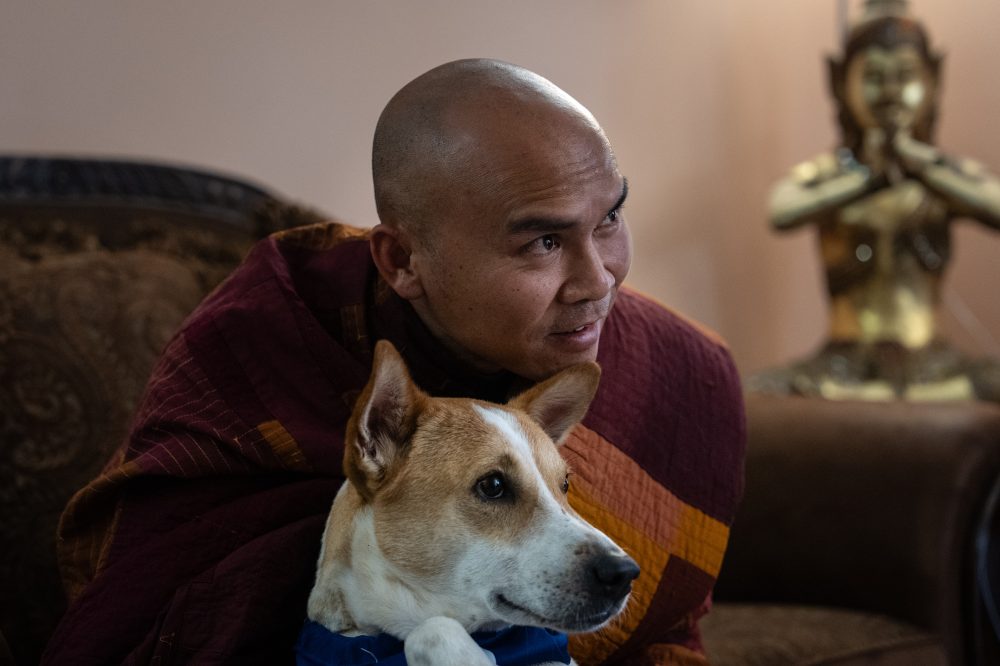

LOS ANGELES (AP) — Chien Le first crossed paths with the Venerable Bhikkhu Pannakara back in 2005, several years before Pannakara took his vows as a novice monk at the Fort Worth, Texas Buddhist temple where he now serves as deputy abbot.
What left an impression on Le back then — and continues to astonish him today — is Pannakara’s unwavering resolve.
“When he decides to do something, he goes all the way,” said Le, who serves as secretary of the Huong Dao Vipassana Bhavana Center in Fort Worth. “He’s never been afraid of obstacles. He always finds a way through them.”
That fierce determination was on full display during the meditative Walk for Peace that Pannakara led earlier this year. Accompanied by an international group of monks and his rescue dog, Aloka — who has become a symbol of the movement — the group covered 2,300 miles (3,700 kilometers), departing Fort Worth on October 26 and arriving in Washington, D.C., on February 14.
Along the route, Pannakara delivered talks on mindfulness and compassion in churchyards, town squares, and before the Lincoln Memorial, drawing large and diverse audiences. Millions more followed the journey from around the world via the internet.
Within weeks, the walk transformed this relatively unknown monk into a prominent voice for peace and unity at a time of deep national division. His profile has continued to rise, with some observers drawing parallels to the Dalai Lama, the Rev. Martin Luther King Jr., and the late Thich Nhat Hanh — a celebrated Zen master and peace activist who, like Pannakara, had Vietnamese roots.
Pannakara, who recently visited Southern California with Aloka for a series of speaking events, said the growing attention is not something he seeks.
“There is no fame for monks,” he said. “I made a vow to walk to raise awareness of peace, loving kindness and compassion. That’s what it’s about.”
As a practitioner of Theravada Buddhism, Pannakara adheres to the “Vinaya” — a rigorous set of monastic guidelines. This means abstaining from social media, owning no personal property, never handling money, and practicing celibacy and humility.
He does not eat after noon, and according to Le, sleeps in a seated position — not a requirement for Theravada monks, but a discipline embraced by some as a way to cultivate deeper mindfulness.
Pannakara was born in 1981 in Dak Lak, Vietnam, the youngest among 10 siblings. He describes his family’s relationship with Buddhism as being Buddhist in “name only.” He came to the United States in 1997 and later earned a degree in information technology from the University of Texas at Arlington. His real introduction to Buddhist practice, he said, came through temple summer camps and youth leadership programs in the U.S.
He eventually stepped away from his engineering career to pursue monastic life, receiving full ordination in 2010 under his teacher, the Venerable Ratanaguna, whom he frequently credits as his greatest source of inspiration. He said no single moment drove him to make the change — rather, it was the accumulated weight of watching loved ones struggle and witnessing people trampling one another in pursuit of success.
“To me everything just seemed fake,” he said.
Le remembers that Pannakara’s parents were devastated by his decision.
“Even on the day he was ordained, his mother came, and she cried a lot,” Le said, adding that his family ultimately came to accept his path.
Le noted that Pannakara proved to be a fast learner at the temple, taking on numerous projects including landscaping, building a new kitchen, constructing housing for monastics, and creating a memorial hall for deceased members.
At his teacher’s urging, Pannakara traveled to Myanmar between 2018 and 2020 to deepen his study of Vipassana meditation — an ancient technique traced back to the Buddha himself as a foundation for achieving enlightenment. When the COVID-19 pandemic struck, he returned to Fort Worth and helped organize food drives, according to temple member Amanda Phan.
“(Pannakara) is a rare human being,” Phan said. “He is an embodiment of kindness, compassion, wisdom — a bodhisattva — a being whose purpose is to relieve others from their suffering.”
In late 2022, Pannakara joined roughly 100 monks on a 2,100-mile (3,380-kilometer), 112-day pilgrimage retracing the path of the Buddha — beginning at his birthplace in Lumbini, Nepal, continuing to Bodh Gaya where the Buddha achieved enlightenment, then to Sarnath where he delivered his first sermon, and finally to Kushinagar, where he passed away. The monks walked barefoot, ate one meal each day, and slept beneath the open sky.
“I had learned the Buddha’s teachings from the Tipitaka (Buddhist canon),” Pannakara said. “But with this walk, I experienced it.”
The journey also taught him something about himself — about his capacity to endure hardship and pain.
“I learned that we can do much more than we think we’re capable of,” he said.
That pilgrimage also brought Aloka into his life. The name Aloka means “light” in Pali.
“Even when he faced challenges and almost died he walked with us,” Pannakara said of his dog.
On an earlier visit to Bodh Gaya — beneath the Bodhi tree where the Buddha is said to have attained enlightenment — Pannakara said he experienced a vision to construct stone stupas to safeguard the sacred teachings for future generations. Seven years later, he shared that vision with Ratanaguna. With his teacher’s blessing, the $200-million Dhammacetiya project was set in motion — a plan to build 840 stupas inscribed with the Buddha’s teachings in 10 languages, designed to endure for 4,000 years.
During the temple’s 2022 International Vesak Ceremony, Pannakara knelt before an assembly of monastics and guests and vowed that if he cannot complete the project in his current lifetime, he would “be reborn to continue this project until its completion.” He said both the Dhammacetiya project and the peace walks — which he intends to continue — serve his deeper commitment to promoting peace and preserving Buddhist teachings.
Ajahn Nisabho, a Theravada Buddhist monk based in Seattle, said he was deeply moved by Pannakara’s sincerity and dedication.
“The story of his quilted robe that he stitched together from pieces of cloth he picked up during the walk in India — he was honoring that past and that ethos,” Nisabho said. “As a fellow monk, it was inspiring for me to see floods of people walking behind him during the peace walk.”
Bhikkhu Bodhi, a senior Theravada monk who spoke at the closing of the Walk for Peace in Washington, praised Pannakara’s decision to stay out of political discussions during the walk. However, Bodhi, 81, expressed hope that Pannakara will eventually use his platform to address pressing social concerns such as poverty, hunger, housing, and climate change.
“I just hope that as (Pannakara) becomes more established and gets accustomed to publicity, he’ll consider taking a stand on these issues that have deep moral and spiritual significance,” he said.
Nisabho, for his part, believes Pannakara made the correct call by keeping politics out of the walk. He observed that few spaces today can draw the kind of broad, diverse participation the peace walk achieved — comparing that rare ability to Dolly Parton, “who brings truckers and drag queens together.”
“The vision of a monastic is the one chance someone has, to be inspired toward awakening and find an escape from suffering,” Nisabho said. “If you bring politics into that, you cause damage by alienating half the country.”