
AUSTIN, Texas — A proposal that could require more than 5.5 million Texas public school students to read Bible stories is heading toward a final vote, reigniting a national conversation about how much religion belongs in America’s classrooms.
The Republican-controlled Texas State Board of Education is scheduled to cast its deciding vote on the plan Friday. The move comes after Texas already made history last year as the largest state to mandate the display of the Ten Commandments in every public school classroom — a requirement that was recently upheld by a federal appeals court.
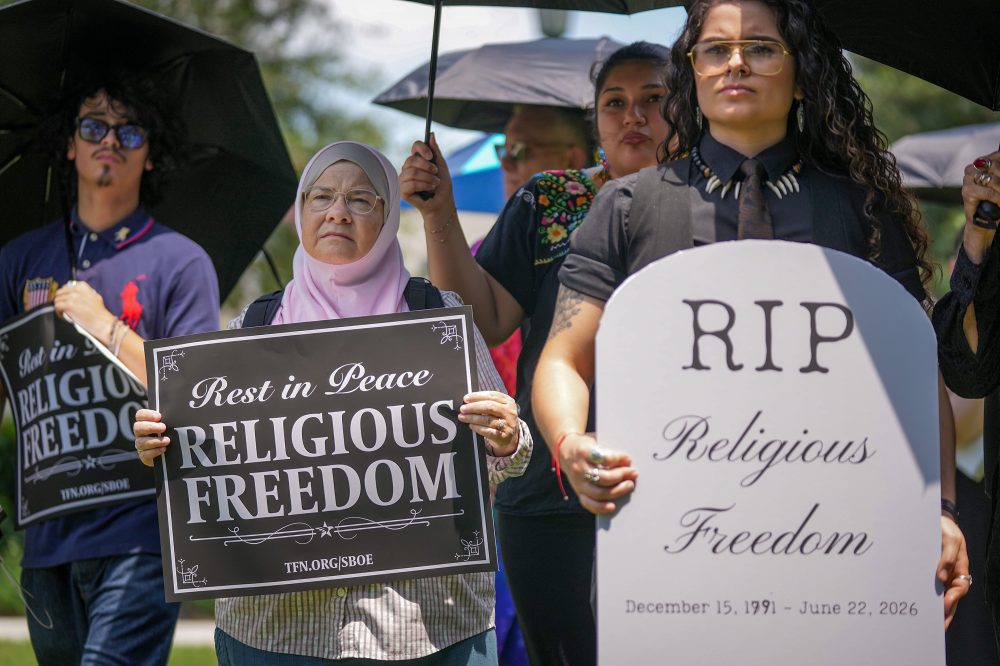
Opponents of the new proposal argue it crosses the constitutional line separating church and state, overstates Christianity’s role in U.S. history, and gives preferential treatment to one faith over others. Those in favor contend that Judeo-Christian values were central to the founding of the country and deserve a place in public school curricula.
President Donald Trump has made expanding religious expression in public schools a national priority, and Texas — home to roughly one out of every ten public school students in the country — frequently leads the way on education policy.
The state has been steadily integrating religion into its schools in recent years. In 2023, Texas became the first state to permit the hiring of chaplains to provide student counseling. The following year, the board narrowly passed an optional Bible-based curriculum for elementary grades.
If Friday’s vote goes in favor of the proposal, the required reading list would go into effect in 2030.
Susan Perez, founder of Citizens for Education Reform, spoke in support of the plan during public testimony before the board. “We need to focus on what our nation was founded on and not apologize for that,” she said. “It is the truth and we should not be afraid.”
The proposed reading list spans all grade levels. Younger elementary students would encounter picture-book retellings of stories like “Noah’s Ark,” “David and Goliath,” and “Daniel and the Lion’s Den.” By fourth grade, students would begin reading New Testament passages referencing Jesus.
At the middle school level, students would be assigned multiple passages about Jesus, including excerpts from his most well-known sermon and one in which he urges people to set aside worldly worry and pursue the kingdom of God. A separate assignment would link a reading from the Book of Lamentations — focused on the fall of Jerusalem — with texts about the Holocaust.
High schoolers would be expected to read the parable of the prodigal son, portions of the Book of Job, and the story of Adam and Eve.
Education experts say Texas may be the first state to establish a mandatory reading list that includes required religious texts. Antero Garcia, president of the National Council of Teachers of English and a professor at Stanford University, said he is unaware of any other state with a comparable requirement. Garcia noted that decisions about what students read are typically left to educators at the school or district level.
Kasey Meehan, director of PEN America’s Freedom to Read program, described such a mandated list as “unique” to Texas. “I think there’s lots of state lists that exist that are like advised readings, suggested readings,” she said.
The proposed texts draw heavily from the King James Bible, one of the most widely used translations, along with more recent evangelical versions. Critics say those newer translations tilt too far toward Christian interpretations of the scripture.
Others raise broader concerns about requiring religious readings in schools that serve thousands of students from Muslim, Buddhist, Hindu, and other faith backgrounds, as well as those who identify as atheist or agnostic.
“I do think that it’s disturbing that there are no texts from other religious traditions that are included,” said Frank Strong, an English and journalism teacher and co-founder of the student advocacy group Texas Freedom to Read.