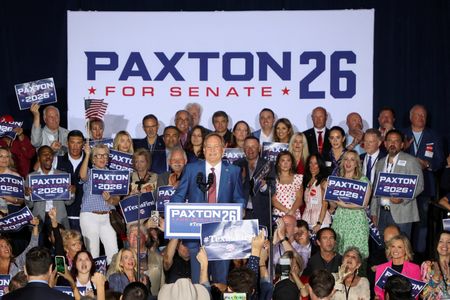

WASHINGTON — Texas Attorney General Ken Paxton’s commanding victory over longtime Senator John Cornyn in Tuesday’s Republican Senate runoff delivered President Donald Trump a significant political triumph, but it may have also handed Democrats exactly the matchup they were hoping for in the Lone Star State.
Though Trump’s last-minute endorsement of Paxton proved successful, political analysts warn the outcome could jeopardize the GOP’s slim Senate majority.
Here are five key implications from the race:
CORNYN BECOMES AN UNPREDICTABLE FORCE
Trump’s backing of Paxton created friction with Senate Republican Leader John Thune and Senator Tim Scott, who leads the GOP’s Senate campaign efforts.
With no future election campaigns to consider, Cornyn could now operate as an independent voice during his remaining time in office, similar to retiring Senator Thom Tillis of North Carolina, who successfully opposed Kevin Warsh’s Federal Reserve chair nomination, or Senator Bill Cassidy of Louisiana, who lost his state’s primary runoff and recently joined Democrats in supporting an Iran war powers resolution.
Cornyn now finds himself in that same category of senators, though whether the former GOP leadership member will challenge Trump during his final months remains uncertain, especially after running a campaign closely aligned with the president.
FINANCIAL CHALLENGES LOOM FOR PAXTON
During his victory remarks Tuesday evening, Paxton urged supporters to contribute through his campaign website, cautioning that his Democratic opponent, state Representative James Talarico, will “raise more money than any Democrat in America.”
Recent financial disclosures revealed Paxton held $2.3 million in campaign funds as of early May, while Talarico possessed $9.9 million in early April.
A confidential memo from last year by the Senate Republicans’ campaign organization cautioned that a Paxton candidacy could “cause Republicans to divert hundreds of millions that would otherwise be spent winning key battlegrounds.”
With Paxton now the nominee, the source of that funding remains uncertain. The Senate Leadership Fund, the GOP’s main super PAC, declined to comment, as did MAGA Inc, Trump’s $356 million super PAC.
“This is the wrong election to have someone who’s as weak of a nominee as Paxton up against someone who’s as strong a fundraiser as Talarico,” observed one Texas political consultant, predicting that “MAGA Inc. will have to step in.”
TEXAS BECOMES MORE COMPETITIVE
Both Cook Political Report and Sabato’s Crystal Ball at the University of Virginia’s Center for Politics moved their Texas Senate race ratings from “likely Republican” to “lean Republican,” confirming concerns that Paxton represents a more vulnerable candidate than Cornyn.
Despite Trump carrying Texas by nearly 14 points in 2024, Republicans must now invest millions in what’s expected to be a contentious battle to protect what was previously a secure seat.
A Wednesday campaign memo from Talarico’s team positioned him as “the best positioned candidate in a generation to win Texas.” He characterized Paxton as “the most corrupt and damaged nominee in the modern Texas GOP,” referencing his felony charges, Texas House impeachment proceedings, corruption allegations, and reports of extramarital relationships.
Paxton and his supporters plan to target Talarico on cultural issues, including his support for transgender youth, describing God as nonbinary, his previous “non-meat campaign” purchasing only vegan products, and statements suggesting more than two biological sexes exist.
A Wednesday advertisement also highlighted Talarico’s comparison of the border to a “front porch” with “a giant welcome mat.”
OTHER COMPETITIVE RACES AT STAKE
Republicans currently maintain a 53-47 Senate advantage, meaning Democrats need to gain four seats for control.
Democrats must defend two states Trump carried in 2024 — Georgia and Michigan — while pursuing Republican-held territories including North Carolina, Maine, Ohio, and Alaska.
Lauren French, a spokesperson for the Democratic group Senate Majority PAC, suggested Republicans face a “tough conversation” about reallocating resources from other competitive states.
In North Carolina, former Governor Roy Cooper faces former Republican National Committee Chairman Michael Whatley to replace the retiring Tillis. Ohio features former Senator Sherrod Brown challenging incumbent Republican Senator Jon Husted. Both contests are rated as toss-ups and will be crucial for determining Senate control in November.
“Will it be less in North Carolina, where their candidate is already down?” French questioned. “Less in Ohio, where they put an astronomical amount of money signaling their concern over Husted?”
LOW TURNOUT AIDED PAXTON’S SUCCESS
While Trump may view Paxton’s win as proof of his endorsement power, the general election will feature a vastly different voter pool than the limited Republican runoff participants.
Paxton benefited from minimal runoff turnout, securing fewer than 900,000 votes — significantly below the March primary participation levels. Over 2 million Democrats voted in their primary, with more than a million supporting Talarico.
Without Trump appearing on the ballot, some voters may skip the election or leave the Senate race blank while Talarico appeals to independent and moderate Republican voters.