
One year ago, Tesla CEO Elon Musk was making bold promises — his company’s robotaxi network would grow at a “hyper-exponential rate” and reach half of all Americans by the close of 2025. But during an earnings call Wednesday, the tone from Musk and his leadership team was noticeably more restrained as analysts pressed them on why the rollout has been moving slower than expected.
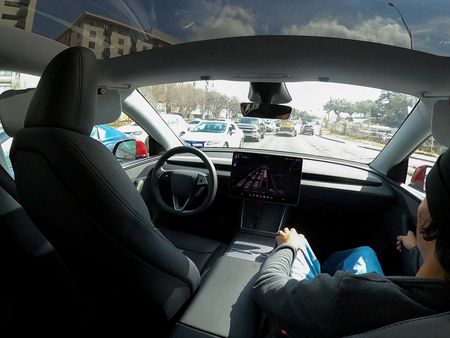
Since kicking off a limited robotaxi pilot in Austin in June 2025, Tesla has only expanded the service to a small number of additional cities in Texas and Florida, and even then, rides are frequently restricted to areas on the outskirts of those cities.
The company reported that paying customers have logged 2.5 million miles through its robotaxi service, including 380,000 miles taken without a safety monitor inside the vehicle.
However, those numbers pale in comparison to a key competitor. Forrester analyst Paul Miller pointed out that Waymo — the self-driving division of Alphabet — had already surpassed 220 million autonomous miles through the end of March, highlighting just how far ahead Waymo is in real-world commercial deployment.
Analysts at Barclays noted earlier this month that Tesla’s supposed edge in the robotaxi space is its “ability to scale more rapidly,” yet the company “has been seen by many investors as somewhat ‘slow.’”
Much of Tesla’s sky-high stock valuation is built on the expectation that robotaxis and its Optimus humanoid robots will eventually become the company’s main sources of revenue. The stock currently trades at more than 166 times forward earnings estimates — a figure far beyond what traditional automakers or major tech companies command. As of the most recent close, Tesla shares had fallen nearly 17% this year, and they slipped an additional 4% in premarket trading following the earnings call.
When asked why the expansion has been slow, Tesla executives offered a city-by-city explanation. Lars Moravy, Tesla’s vice president of vehicle engineering, said, “Regulatory situations are different city by city. The reason we’re expanding city by city is to make sure that we’re meeting all of those one at a time.”
CFO Vaibhav Taneja acknowledged that the company is working through challenges beyond just software. “There are different kinks … not just on the software front, but on the operations front, that we’re trying to tackle,” he said. Taneja added that Tesla wants to “sort these things out in a smaller fleet in a controlled manner” before pushing toward large-scale deployment.
A Wells Fargo analyst questioned why the number of vehicles in service remains “in the dozens as opposed to hundreds,” asking what the “roadblock to start adding more vehicles on the ground” is. Tesla’s Vice President of AI Ashok Elluswamy responded that even a small fleet can generate significant mileage, and that the growth in miles driven is “literally exponential. Just it’s in the early part of the exponential. That’s why it’s hard for others to comprehend.”
Musk echoed the safety-first message, saying, “We want to grow as fast as possible with robotaxi, without harm to anyone.”
Back in January, Tesla had told investors it planned to launch robotaxi service in seven metro areas by the end of June — Dallas, Houston, Phoenix, Miami, Orlando, Tampa, and Las Vegas. As of Tuesday, only three of those cities — Dallas, Houston, and Miami — had launched, and service in Houston and Miami was confined to less-busy outlying neighborhoods. Tesla then announced Tuesday that it had expanded into Tampa and Orlando, though those cities also had service limited to lower-traffic areas away from city centers.
Reuters reporters who tested the robotaxi service in the weeks following the Dallas and Houston launches found lengthy wait times and, at times, no availability at all.