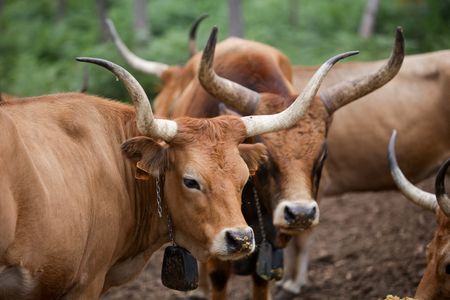

In the wildfire-scarred hills of Galicia, in northwestern Spain, a small, sure-footed breed of cattle is making a dramatic return — and locals hope it can help stop the next devastating blaze before it starts.
Communities across the region are reintroducing native livestock, including goats, sheep, and a diminutive long-horned cow known as the Cachena, as a natural way to keep flammable vegetation from taking over the landscape. The Cachena, the smallest cattle breed on the Iberian Peninsula, is nicknamed the “goat-cow” by locals because of its ability to eat almost anything and navigate steep, rugged mountain terrain that larger breeds cannot handle.
The push for native livestock gained momentum after a 2017 fire ripped through the parish of Vincios, prompting community land associations there to turn to a time-honored wildfire prevention method: letting animals graze the land clean of dangerous shrubs like brambles, gorse, and broom. Those plants contain oils that burn intensely and can carry flames from the ground all the way up into the tree canopy.
“The native livestock keeps scrubland at an appropriate height so it does not become dangerous,” said Jose Taboada, coordinator of the Vincios land collective.
The effort has paid off. According to regional association BOAGA, the native livestock population has climbed from just over 1,800 animals in the late 1990s to more than 30,000 by early 2026. The Cachena cow population alone jumped from around 400 to roughly 8,000 during that period. The regional government helped fuel that growth by offering incentives for farmers to hold onto young female cows rather than sell them, while a local zoological center provided bulls at reduced cost to support breeding.
The animals are not confined by fences. Instead, they wear GPS collars that allow land managers to track their movements as they roam freely across the terrain. Taboada explained that the cows keep vegetation at manageable levels without wiping it out entirely.
“They are perfectly adapted to terrain like ours,” Taboada said.
Vincios is part of a broader system in Galicia in which roughly 3,000 communities collectively manage about 700,000 hectares — a quarter of the region’s total land area. This practice dates back to medieval times and was formally recognized by law in 1989.
The stakes are high. Last year, nearly 119,000 hectares — approximately 294,000 acres, or roughly twice the size of Madrid — burned in Galicia alone, making 2025 Spain’s worst year for wildfires. Scientists connect the increasingly destructive fire seasons seen across southern Europe to climate change. Spain, which ranks as the third-most forested country in Europe, has recorded average temperatures 5.6 degrees Celsius above historical norms for July, according to the Reuters Climate Monitor.
The livestock-as-firebreak approach is spreading beyond Galicia. Landowners and community groups in other Spanish regions, including Andalusia, Catalonia, and Castile-La Mancha, have also adopted the strategy.
Forestry engineer and professor Jose Vicente Oliver noted that while scientific studies support the use of livestock for fire prevention, it works best alongside other methods such as mechanical thinning, pruning of excess vegetation, and controlled burns carried out by trained crews.
For Taboada and his community, the motivation goes beyond simply raising animals for profit. “Livestock farmers need to earn a living by producing meat, or milk. But our common-land communities care about land stewardship,” he said. “This area has always burned… the livestock allow us to keep the woodland open, managed, and under control.”
The large-scale planting of highly flammable pine and eucalyptus trees for industrial purposes originally pushed native breeds like the Cachena out of the region, while rural depopulation left vast stretches of land unmanaged and overgrown. Now, communities are working to reverse that trend — one grazing animal at a time.